
Disabled and trans people ‘may compete for toilets’
Disabled and trans people might have to "compete" for access to toilets in the wake of new guidance on single-sex spaces, a government analysis has said, as it warned of "a significant possibility of this creating tension".
Use of disabled toilets as a so-called third space by trans people who do not wish to use the toilet of their biological sex "may not foster good relations between groups", the equality impact assessment states.
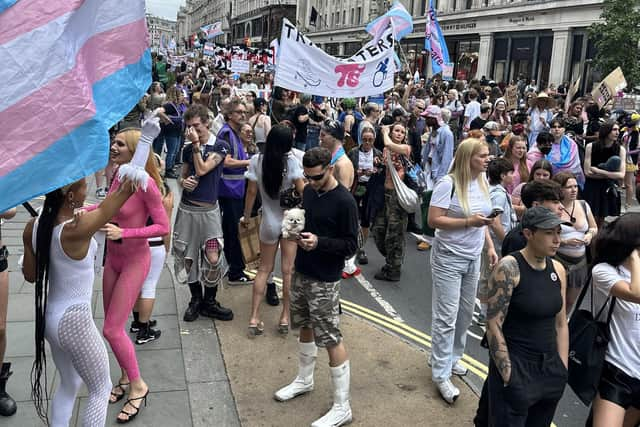

The document was published alongside updated guidance from Britain's rights watchdog the Equality and Human Rights Commission (EHRC), which has updated its code for service providers just over a year after a landmark ruling by the UK's highest court.
The Supreme Court ruling ruled in April 2025 that the words "woman" and "sex" in the Equality Act 2010 refer to a biological woman and biological sex.
The newly-published EHRC guidance has confirmed that single-sex services must be on the basis of biological sex, meaning a trans man (a biological female) can be excluded from a men-only service, while a trans woman (a biological male) can be excluded from a women-only service.
This means single-sex toilets and changing rooms must be used on the basis of someone's biological sex rather than gender identity.
The guidance applies to a wide range of facilities including hospitals, sports, leisure centres and cafes and states that an accessible toilet could be used as a mixed-sex toilet.
But it adds that in such cases a service provider should "monitor whether there is any negative impact on both trans and disabled people and take appropriate action".
An accompanying impact assessment by the Office for Equality and Opportunity (OEO), stated guidance "concerning the potential need for trans people to use disabled toilets as 'third space' facilities, may not foster good relations between groups".
It added: "This is because disabled people and trans people may have to compete to access a limited number of facilities. Disabled people have had (and continue) to fight for access to suitable toilets.
"Whether this creates tension between the two groups will depend on how providers choose to arrange and label their facilities, which is likely to be impacted by resources and site limitations.
"EHRC have tried to manage this in their example, but we must recognise that there is a significant possibility of this creating tension."
The guidance also advises that mixed-sex changing facilities which have private cubicles with floor-to-ceiling lockable doors are likely to be "proportionate and lawful" under the Equality Act.
In sport, the guidance states trans people should compete alongside others of their birth sex rather than gender identity.
Sport England , which is an arms-length body of government, said it is "reading and reviewing" the code "and assessing the implications for both sport provision and facilities".
The organisation said it will issue an update "in due course", but it is expected that could be months from now, as it will need to consult with other UK sporting bodies.
The NHS has also said it will review the updated code - which said single-sex hospital wards can lawfully exclude trans patients - "with the aim of publishing draft guidance for the health service shortly".
Under current NHS guidance, trans patients can be accommodated on single-sex wards based on the gender they identify as.
In an interview with the Press Association , EHRC chairwoman Mary-Ann Stephenson said provision for a trans patient "might be about individual rooms, it might be about thinking about how you organise the ward".
She added: "The decisions that service providers make in order to make sure that services are both single-sex and that there's provision for trans people will vary depending on the kind of organisation of facilities and what service they're providing."
She urged a "common sense approach", and rejected any notion of the policing of toilets.
She told the Press Association : "I think we have to have a common sense approach to this.
"We've had separate toilet services for women and men for decades, and we don't have people on the door checking who goes in."
On toilets, which the commission says are "necessary for everybody", the code notes that it would be "very unlikely to be proportionate to put a trans person in a position where there is no service that they are allowed to use".
UKHospitality welcomed the new guidance as being "more pragmatic and reflective of the practical challenges facing hospitality businesses" and added that the "shift to make clear that gender-neutral toilets and facilities are acceptable is a particularly positive step".
The trade body noted that there will likely be "some physical challenges and limitations for some businesses" given restaurants and bars differ in size, space and how old the building is, meaning "it's crucial that a proportionate approach is taken with businesses who will need time to adapt".
For Women Scotland, who brought the case which resulted in the Supreme Court ruling last year, hailed the publication of the long-awaited guidance as a "significant milestone in ensuring women's rights are upheld and protected".
The group said the code's publication should "mark an end to the unjustified excuses and delays in implementing" the court ruling, adding that there is "now no reason for public bodies and organisations to evade their responsibilities to women".
But the Trans+ Solidarity Alliance argued the new code has an "exclusionary core" and could risk "pushing trans people yet further out of public life", while the president of the National Union of Students (NUS) said the code "will functionally exclude trans people from engaging in public life" and called for Parliament to reject it.
The code, which would apply across England , Scotland and Wales has now been laid before Parliament for scrutiny from both MPs in the Commons and peers in the Lords and will not be enacted for 40 days.
While a vote would not be required to enact the code and make it statutory, either House could pass a motion to reject it within that period.
The commission's code of practice for services, public functions and associations, which runs to more than 300 pages, covers nine protected characteristics including age, sex, disability, race and gender reassignment, and has been updated in full for the first time since 2011.