
Donald Trump US tariffs may reduce Irish Government’s focus on acquiring Northern Ireland, economist says
New US trade tariffs are likely to make dividing Northern Ireland from the United Kingdom "much less of a priority" for the Irish Government, a leading economist says.
The Republic of Ireland is expected to be one of the countries most impacted when US President Trump intoduces his new trade tariffs this week.
Goods exported by the EU are expected to face tariffs of about 20% when entering the US.
And among all EU states, the Republic of Ireland is the most reliant on the US as an export market – almost a third of its exports last year were to the US (£61bn).
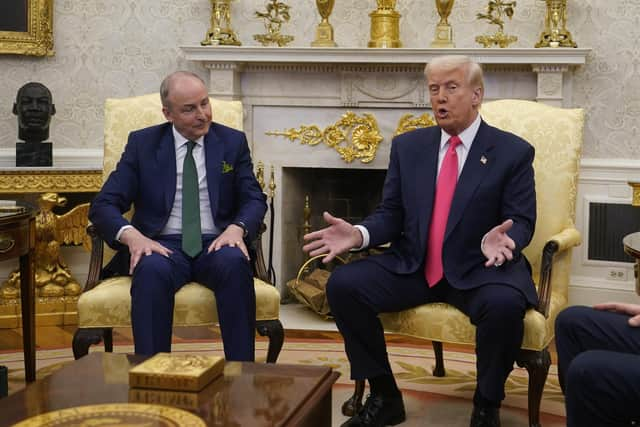

On Monday Taoiseach Micheál Martin said that increased US tariffs were “a very grave and serious threat”.
Joint analysis by the Republic of Ireland's Department of Finance and the Economic and Social Research Institute think tank suggested the tariffs could cost Ireland more than (£15bn) in lost trade, the BBC has reported.
The report also warned that a prolonged trade war between the EU and US –- in which the Republic would be caught – would pose a risk to Dublin's public finances.
Reflecting on the potential political ramifications of the changes, Ulster University senior economist Dr Esmond Birnie suggests that the unprecedented reforms will push any discussion about dividing Northern Ireland from the UK much lower down Dublin's priorities.
“We are not looking at the collapse of the southern Irish economy, but we are looking at the possible demise of an economic development model which they’ve had from the 1960s and one which in its time worked very well for them,” he told the News Letter.
“The implication is that the Irish government is going to be rather pre-occupied and any national 'mission' to 'unify' with Northern Ireland may be seen as much less of a priority.”
The potential loss of up to 3.5% of GDP in the south could result in no economic growth – or very little – in the south next year, he said.
And the ramifications are likely to extend far beyond Mr Trump's four years in office.
“Almost certainly there will be important long-term effects. An entire way of doing business (internationally and globalised) which has built up within the Western world since about 1950 is being brought to an end. The results, economic and political, will be immense.”
There are currently 2.8m people employed in the south, he noted, and about 7.5% of them (210,000) are employed in American-owned companies.
There is now “a very real risk”" of such companies returning to the US under Mr Trump's influence.
“We saw how Trump, in his meeting with Irish Prime Minister Martin, zeroed in on the scale of US pharma activity in Ireland,” he added.
The reforms are much less likely to impact US companies in Northern Ireland because they are mainly service based, such as IT, finance and back office support.
In the south, by contrast, US companies are much more manufacturing focused and more vulnerable.
“The Republic of Ireland has had one of the top rates of foreign direct investment in the world, particularly American investment in sectors such as pharma and computing. So the new tariffs may well end an economic era based on attracting foreign companies based on a very low rate of business (corporation) tax.”
The proportionally very large international business sector in the south - especially American owned and in pharmaceuticals - makes the southern Irish economy "particularly vulnerable to Trump policies" he said.
In Tuesday's News Letter, Dr Birnie said the expected US tariffs will be "a huge blow" to both the world economy but also "a self-inflicted blow to the USA as well".
He told the News Letter previously that history shows Trump's protectionist approach to the US economy is likely to harm it in the long run. One key reason, he says, is that removing international competition from domestic manufacturing in any country usually results in home grown companies becoming less efficient, he explained.