
DUP says Dublin government must not be allowed to appoint anyone to Northern Ireland Troubles legacy body ICRIR
The DUP has said that Dublin should not have a role in appointing anyone to the government’s Troubles legacy body, the Independent Commission for Reconciliation and Information Recovery (ICRIR).
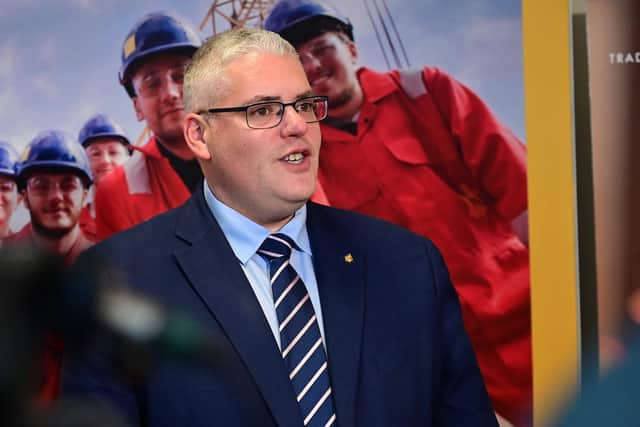
Party leader Gavin Robinson pointed to Dublin’s history of “hiding the truth of the past”.
A DUP party spokesman said that their objection also applies to appointees to a new ICRIR oversight board, as well as commissioners themselves.
It comes after the Northern Ireland Secretary Hilary Benn addressed MPs this week, updating them on the negotiations that are going on with the Irish government about legacy.

The outcome of those negotiations has yet to be revealed, but unionists have voiced concern that an agreement regarding Dublin involvement in ICRIR could be on the table.
After Mr Benn’s appearance at Westminster’s Northern Ireland Affairs Committee on Wednesday, the UUP’s Doug Beattie issued a statement condemning any Dublin input into the ICRIR as “outrageous” – in particular, the idea of “allowing the Irish government to sit on or have an input to the ICRIR oversight body”.
The TUV likewise signalled its objections to Dublin involvement.
Now Mr Robinson MP has said: “Anyone with an ounce of sense will realise you can not have ‘independent commissioners’ who simultaneously represent a specific interest.
"That was accepted by Sir Declan Morgan [the chief commissioner of the ICRIR] when I questioned him in the committee.
"No commissioner could or should represent any outside interest, particularly a state that appears more committed to hiding the truth of the past than to uncovering it.
"That would not just be a failure of justice, it would be a betrayal of victims.”
At Wednesday’s committee meeting, chairwoman Tonia Antoniazzi said that Sir Declan had "stated that the commission would need Irish and international commissioners – how is this being considered as part of the negotiations, and is it something that you are considering seriously?"
Mr Benn replied: "In looking for the idea of an oversight board for a reformed commission, something it doesn't have at the moment... what I'm envisaging there is people would apply, they could come from anywhere – international. And then appointments would be made.
"So that is a possibility, depending on who would apply for those particular positions to oversee the work of the legacy commission."
In the wake of Mr Benn’s appearance, the UUP had issued a statement saying “the Irish government have shown absolutely no interest in dealing with their part in the legacy of our past; why on earth would the Secretary of State involve them in the ICRIR?”
In it, Mr Beattie said: “The Irish government have done absolutely nothing to address legacy but instead has stood as a passive bystander complaining, indeed taking legal action, against a UK government that has been attempting to address legacy. This would challenge both the independence and the integrity of the ICRIR...
“The UUP is clear; they will not support an ICRIR if former RUC and PSNI officers are barred from serving on it, and it will not support the Secretary of State in allowing the Irish government to sit on or have an input to the ICRIR oversight body.”
And Jim Allister said: “His [Mr Benn’s] approach and interest is singularly focused on placating Dublin – which continues its legal challenge against the government.
“He is even now, clearly, going to give place(s) on the legacy oversight body to Dublin representatives.”
The Northern Ireland Office has said in a statement: “The Legacy Act [which created ICRIR] was opposed across Northern Ireland and a number of its core provisions were rejected in the domestic courts.
"This government has committed to replace it with a fair and proportionate system that enables families and victims of the Troubles across the UK to seek answers.
"As expressed by both governments at the British-Irish Intergovernmental Conference in April, any joint agreement on legacy issues must include clear, reciprocal commitments by both the UK government and the government of Ireland."