
DUP veteran hopes Troubles Bill now 'finished' as ex-Tory Northern Ireland minister urges new PM to 'make Legacy Act operable'
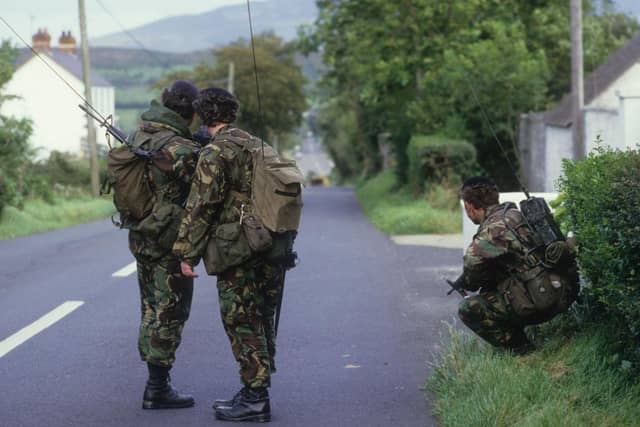

DUP former soldier Jim Shannon has voiced hope that Keir Starmer’s exit spells the end for the Troubles Bill.
In addition, ex-Northern Ireland Office minister Conor Burns has urged whoever takes over as Prime Minister to ditch the legislation and try to work with the Tories’ Legacy Act instead.
Sir Keir quit as Prime Minister on Monday, leaving the future of the bill – and Hilary Benn, the Northern Ireland Secretary who is pushing it – up in the air.
It is understood that the government’s position is that it continues to back the bill.
Last week Paul Young, the former soldier who is spokesman for the Northern Ireland Veterans Movement, told the News Letter that the bill has become a headache for Labour, and hoped that a new leader “takes Benn out of the equation and puts another person in that isn’t wedded to the Troubles Bill”.
Now that Sir Keir’s departure is confirmed, Jim Shannon has voiced similar sentiments.
Mr Shannon, DUP MP for Strangford, served three years as a UDR private and 11-and-a-half in the Royal Artillery, where he held the rank of lance bombardier.
He had heard that the Troubles Bill was next set to come before MPs in the first week of July, but with the PM quitting “I’m not quite sure that’ll happen”.
“All the opposition parties are opposing it as well,” he said.
"But not just that – I think there are some within the Labour Party who also have concerns: a number of people who have served in uniform and those who represent constituencies where there’s a large army and defence element.
“Our hope would be that the Legacy Bill that the Labour Party have will not be brought forward.
“We’d hope the new person that’d come in would look upon [the bill] in the way that we do, and if so the Troubles Bill would be finished.”
Meanwhile Belfast-born former Tory MP Mr Burns, who was minister of state at the Northern Ireland Office from 2021 to 2022 when the Legacy Act was moved, has likewise called for the Troubles Bill to be withdrawn.
The Legacy Act passed responsibility for investigating Troubles deaths from the PSNI to a new body which could grant perpetrators immunity (the Independent Commission for Reconciliation and Information Recovery, or ICRIR), and also halted inquests and civil suits.
The act has since run into trouble in the courts and Labour pledged to scrap it and replace it with the Troubles Bill, reforming ICRIR and reopening inquests and civil suits.
Mr Burns has told the News Letter he had helped shepherd the Legacy Act through parliament even though he had “very, very severe reservations about it”.
It was “the best route forward, with all its imperfections” he said, adding: “I wouldn’t call it a model piece of legislation, but if you were going to do something in this space then that was probably the best you were going to get to.”
He said it is “ludicrous” that “terrorists are in government” while those who tried to uphold the law are brought before courts, and said when it comes to the Troubles Bill “I would pull the legislation” and would instead concentrate on making “the Legacy Act operable – implement it, and deliver the closure many people in Northern Ireland want”.
However, he cautioned against assuming that this is the path a new PM will take.
"The honest answer is no-one has any idea,” he said.
"The UK is about to get a Prime Minister where we know remarkably little about what he stands for...
"So I don’t suspect there is any reason to suppose that he would differ from the line that has been taken by the Labour government over the past nearly two years.”
Doug Beattie MLA, who recently quit the UUP, said: “The veterans’ lobby, already positioning itself for a new Prime Minister, will push for renewed scrutiny of the Northern Ireland Troubles legislation, while the current Secretary of State is likely to defend the legacy framework agreed between the UK and Irish Governments.
"This approach remains deeply unpopular and continues to create tension between the Ministry of Defence and the Northern Ireland Office.”
Defending the bill in the Commons in April, Hilary Benn had said: “This final chance to get legacy right has fallen to us, in this Parliament, and we will deliver it.
"Since its introduction in October 2025, the troubles Bill has been welcomed by a significant number of victims, families and representative groups.
"Many recognise that, while not providing everything they may have sought, the bill will enable families’ cases to be taken forward sensitively, efficiently and lawfully.”