
Economist questions community sector employment schemes - as £26m spend gets just 2218 in work for 6 months
Questions have been raised about how effectively public money has been spent on community and voluntary sector schemes designed to get people back to work in Northern Ireland.
Figures obtained exclusively by the News Letter have revealed that the taxpayer spent £26m in one year, with just 2218 people in work which lasted for at least six months.
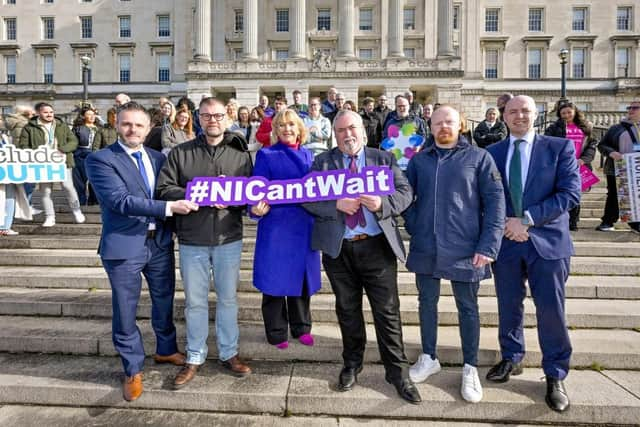

When the government decided earlier this year that it would shift Local Growth Fund cash towards capital projects and away from “employment, skills and inclusion services”, there was cross-party opposition at Stormont.
While the changes were presented as cuts to the community and voluntary sector (CVS), the funding which the groups had been given was to tackle economic inactivity. Politicians and CVS organisations said 400 jobs would be lost.
The sector in Northern Ireland employs over 54,000 people representing around 7% of the workforce, more than double the UK average of 3%.
The Local Growth Fund (LGF) was a replacement for the UK Shared Prosperity Fund (UKSPF). The News Letter has obtained data on the latter from the Ministry of Housing, Communities and Local Government in London, using Freedom of Information (FOI) laws.
Ulster University Senior Economist Dr Esmond Birnie, who has looked at the figures, has questioned whether the schemes were the “most effective ones possible” – and questioned the “relatively high” costs.
Dr Birnie told the News Letter that economic inactivity (people who are neither classed as employed or unemployed) is a relatively bigger problem in Northern Ireland than it is in Great Britain and so, in principle, policy measures to tackle it are very welcome.
He added: “whilst one approach is to work though the existing structure of voluntary and community groups (a structure which grew up partly because of the previous availability of EU Peace and other monies pre-Brexit) that structure has become overly dense and complex”.
He said there is “probably a lot of duplication and waste” – but MLAs won’t deal with that as “all politics is local”.
He said UKSPF was intended in part as a "transitional replacement for the former EU monies”.
In relation to the figures uncovered in the FOI request, Dr Birnie said: “In, for example, 2025/26 (the most recent year) UKSPF funding to deal with economic inactivity was nearly £26m (£25.75m) – but when we look at outcomes ‘only’ 2218 got employment which was sustained for at least 6 months.
“So, that is a cost per (reasonably long lasting) job of £11.6k which seems relatively high.
“Admittedly, if you include anyone who got a job however short lived that new employment number goes up to 4143 but some of those could have been extremely short lived.
“Of course, it is hard to get someone who has been out of work for a long time back into a job or, indeed, someone who has never been in employment.
“Nevertheless, we should at least ask the question were the measures adopted the most effective ones possible?”
£129 million is currently available for Northern Ireland from the three-year LGF scheme – but the Executive is not happy that it will have to spend the bulk of that money on capital projects.
Local parties are united in their view that more of the money should be spent on existing schemes delivered by CVS organisations.
The government has said that a consultation on its plans is not about rebalancing the split for the LGF – which would mean £27.4m to capital projects and £11.8m to resource projects – such as “employment, skills and inclusion services”.
Ministers have backed a shift in funding to capital investment projects and away from such services right across the UK in a bid to boost regional economies.
The News Letter asked the government about the money spent on economic inactivity schemes; and their effectiveness in tackling economic inactivity.
The data showed that under UKSPF:
- in 2023/24, £27,322,370 was spent on economic inactivity projects, 79.61% of the funding available to NI. That resulted in 2,371 people in some form of employment, with 643 staying for six months or more.
- in 2024/25, £30,711,589 was spent, 45.11% of the total. That resulted in 4,847 in some form of employment, with 2,924 staying in work for six months or more.
- in 2025/26, £25,753,485 was spent on the schemes, 57.29% of the NI total. This got 4,143 back into some form of work, with 2,218 getting work for six months or more.