
Equality Commission dodging trans guidance call means NI women have fewer rights, says campaign group
The Equality Commission dodging a decision on whether a Supreme Court ruling that sex is determined by biology applies in Northern Ireland continues “the dark history of failing women here by allowing our rights to lag behind”, a campaign group has said.
On Friday, the commission (ECNI) didn’t give clear guidance on the implications of the ruling, pointing to uncertainty it said was created by the Windsor Framework.
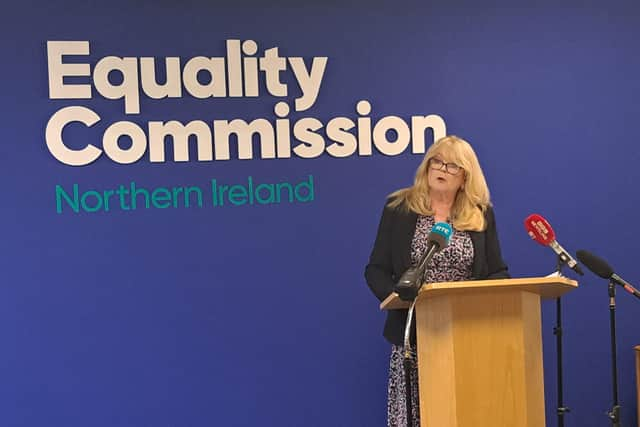

ECNI Chief Commissioner Geraldine McGahey has said that sex and related terms might not mean the same thing in Northern Ireland as in the rest of the UK, and the province’s equality laws “use terms like ‘sex’, ‘men’ and ‘women’ without providing comprehensive definitions” of what those words mean.
Now, campaign group Women’s Rights Network NI has claimed the ECNI’s position means women in the province “have fewer rights than women in the rest of the UK”, but remained confident the Supreme Court ruling will eventually be followed here.
The ruling was that under the Equality Act, sex is determined by biology – which was hailed as a victory by women’s rights groups, but criticised by pro-transgender campaigners.
ECNI now wants the High Court in Belfast to rule on how the Windsor Framework affects the legal situation in Northern Ireland, Ms McGahey saying that if it were not for the post-Brexit deal, the Supreme Court ruling would apply here.
Kirsty Montgomery, Women’s Rights Network NI Equality and Legislation spokeswoman, said the ECNI’s current position “does not go far enough to protect women’s rights in Northern Ireland”.
“We are now in a position where women in NI have fewer rights than women in the rest of the UK,” she said. “We are continuing the dark history of failing women in NI by allowing our rights to lag behind.
“We have grave concerns that women and girls are now left unprotected, exposed to sexual harassment and discriminated against by employers, service providers and in daily life.
“Organisations here have fallen victim to a dangerous ideology which has forced them to believe that gender self-identification should come before the law. This misinterpretation is now being allowed to continue as the ECNI has not taken a firm stance.
"We are also concerned that the ECNI will not be able to represent women in cases of discrimination which is also one of its responsibilities.”
Conceding there are clear “complexities around the Windsor Framework”, she maintained those issues “do not change the fact of biological sex”.
“Our equality, discrimination and workplace health and safety laws have been written with the same intent as the Equality Act, which the Supreme Court has clarified,” she said.
"Self-determination is not law here and is not consistent in the EU. We would argue that any different interpretation here would be a diminution of women’s rights.
“It is perfectly legal to discriminate. What is not legal is for the rights of trans people to infringe on the rights of women.
“We believe the High Court will confirm that the law protects women on the basis of biological sex, as the Supreme Court has already clarified, and we encourage supporters to have their say by responding to the ECNI consultation to ensure women’s voices are heard.”