
Equality watchdog chiefs face resignation calls as they lose the confidence of unionist parties in NI Assembly
The leadership of Northern Ireland’s equality watchdogs have faced calls to resign in the Assembly, with unionist parties united in condemnation of the public bodies over a recent Supreme Court judgment and claims of political activism.
The Equality Commission (ECNI) and the NI Human Rights Commission (NIHRC) have taken an “expansionist” view of how EU human rights provisions should apply in Northern Ireland under the Windsor Framework.
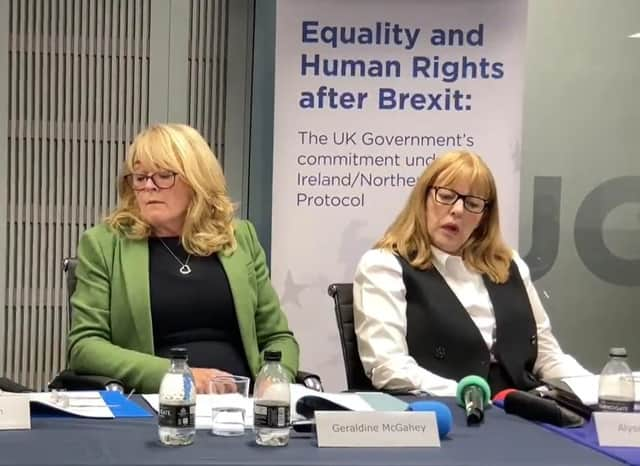

Last week, their position was rejected at the UK Supreme Court, who made clear that the impact of the post-Brexit deal on domestic law is limited.
The organisations have also jointly called on local and national government to go beyond what was agreed in the deal – and align UK with EU law even where it isn’t required to do so.
Both bodies have said they are considering the judgement, and have not responded to a previous call from TUV leader Jim Allister for resignations. They have also insisted they work within their statutory remit.
The issue was raised by the TUV in the Assembly on Monday, with Timothy Gaston saying “their agenda has been unmasked” and the UK Supreme Court (UKSC) ruling had shown that the “expansionist viewpoint” of both bodies on using Article 2 of the Windsor Framework to “apply European rights in Northern Ireland over the head of UK law was wrong”.
Ulster Unionist MLA Steve Aiken said his party had always questioned why the “unelected quangos” had been “given agency” to “set themselves up as the self appointed guardians of the Belfast / Good Friday Agreement they are not and they never were”.
Mr Aiken questioned why they are “under the same leadership as they are” and said they are unaccountable and “cannot be allowed to continue in this process”.
“It is more than enough time that both these quangos were brought well and truly under heel and, if necessary, got rid of – because they're not doing what they were designed to do”, he told MLAs.
DUP MLA Phillip Brett said the DUP now expects the the Chief Commissioner of ECNI Geraldine McGahey to appear before the Assembly’s Executive Office committee to answer questions.
“The Supreme Court has spoken. There can be no ambiguity. There can be no questions. There is no need for the Equality Commission, the Human Rights Commission, or any other faceless organisation to read the judgment.
“The judgment is clear. They are wrong. They have wasted public money, and it's now time for each and every one of them to consider their position”, the North Belfast MLA has said.
Opposition SDLP MLA Patsy McGlone said it is now a matter for the Attorney General to scrutinise the UKSC judgment.
“The SDLP has always believed that rights protections must be practical, enforceable and accessible to ordinary citizens, particularly victims and families.
“And there will understandably be some concern that the scope of post-Brexit safeguards has been interpreted more narrowly than many had anticipated. This case underlines, once again, the need for a comprehensive bill of rights for Northern Ireland as envisaged in the Good Friday Agreement.
“We must avoid any drift towards weakening rights protection through constitutional ambiguity or political expediency”, the Mid Ulster MLA said.
Sinn Fein and Alliance focused purely on the legacy aspect of the case, and what domestic UK legislation on the matter should be, rather than the wider implications on sovereignty.
A legal challenge to the European Court of Human Rights was floated by SF MLA Deirdre Hargey, who said the ruling "was a disappointing result for families”.
“It's clear that the British establishment is closing ranks to protect national security interests by way of protecting British state forces”, she said.
Alliance MLA Connie Egan said it is “vital” that the government’s new troubles bill “creates a fully human rights compliant process for legacy investigations that is capable of winning the trust and confidence of all victims and survivors”.
ECNI said last week: “The Commission’s intervention in ‘Dillon and others’ was grounded in its statutory remit and in particular our role to monitor the implementation of Article 2(1) of the Windsor Framework. The courts in Northern Ireland previously ruled on this matter which was then appealed to the Supreme Court. The Commission works within the parameters of the law and court judgments”.
NIHRC said it will now consider the UKSC judgment “in full and its implications”.