
European Convention on Human Rights 'worsening double standards over Troubles cases' the House of Lords is told


The House of Lords has heard that the European Convention on Human Rights is making matters worse when it comes to “double standards” in dealing with the legacy of the Troubles.
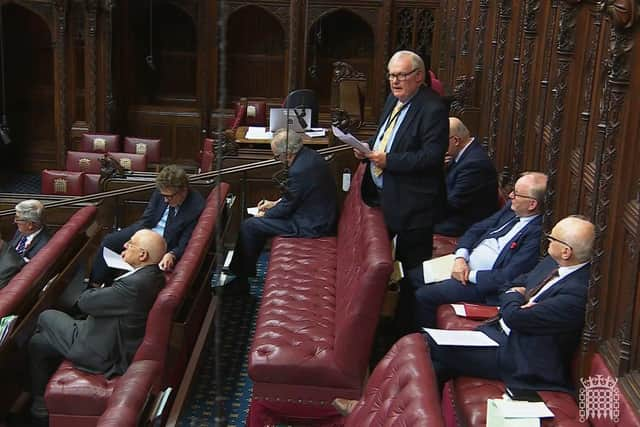
The house sat late on Wednesday night to debate a motion brought by Baroness Nuala O’Loan about the government’s approach to the issue.
Specifically, she lamented that the Labour government is not going far enough in its moves to scrap the Legacy Act 2023, which brought into being the Independent Commission for Reconciliation and Information Recovery (ICRIR), ended internment claims against the government, and halted inquest hearings, among other things.
It was brought in because of Tory concerns that the law was being utilised to unfairly shine a spotlight on failings by state forces, to the exclusion of the crimes of paramilitaries.
The days of the former Tory government’s Legacy Act have appeared to be numbered ever since the High Court in Belfast ruled a year ago that large tracts of it were incompatible with the European Convention on Human Rights, to which the UK is signatory.
The Labour government is currently moving to annul parts of the act, but not all of it.
Baroness O'Loan’s motion in the house voiced “regret” that Labour’s actions do not “address all areas of the 2023 Act identified by the courts as being incompatible with the United Kingdom’s obligations under the European Convention on Human Rights”.
During the course of her contribution, the cross-bench peer said: “The government must have the courage to face the past and acknowledge the terrible failings and wrongdoings of agents of the state, as well as the murderous atrocities perpetrated by loyalist and republican terrorists.”
But Lord Weir (DUP) warned about “the risk of dangerous and lazy myths distorting our thinking on the subject”.
“Some 90% of the Troubles deaths were caused by paramilitaries and terrorists, yet an outside observer looking at Northern Ireland today could be forgiven for not realising that,” he said.
"That is because, clearly, the concentration of inquests and court cases has had an overwhelming focus on the role of the state and individual members of the security services, to the extent that, for a lot of people in Northern Ireland from both sides of the community, there is a concern that, in looking at the past, we are seeing a very one-sided process.”
He added that this “creates a sense of false equivalence: that the security services were simply one other player in a multifaceted war between different factions – that must be nailed down as a lie”.
Independent peer baroness Hoey said: “Your Lordships should know that the Belfast courts increasingly see themselves as an adjunct to the European judicial system, be it the European Court of Human Rights in Strasbourg or the EU court in Luxembourg, so they have disapplied large parts of the legacy Act. Governments are not obliged to act as a consequence of this.
"They could leave well alone, even if it means facing down the well-funded, very well-organised human rights industry that we have in Northern Ireland, in particular – some of it, of course, paid for by the government.”
Lord Browne of Belmont (DUP) said: “There ought to be an acceptance that the primacy of the European Convention on Human Rights in our statute books and the courts is not just facilitating but accelerating that double standard in justice outcomes for victims of the Troubles.”
And Lord Empey (UUP) told the house: “The problem is that there are good things about the convention but it is being distorted.
"In fact, it is more than that: it is being corrupted by the way things have been developing.”