
Football banning orders 'unlawful' in Northern Ireland due to 'epic blunder' by Stormont's justice department
Powers to ban hooligans from local football grounds have been branded “unlawful” due to Stormont having failed to update them for well over a decade – raising questions about current enforcement and past convictions.
The issue relates to Irish league football – and an apparent failure by the Department of Justice (DoJ) to update the law after Irish Football Association stopped running the domestic league.
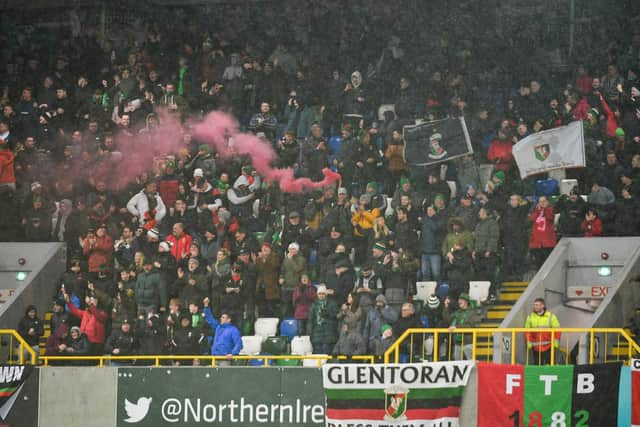

Naomi Long’s department initially said it was a matter for the Department for Communities (DfC) – saying the News Letter should address questions to them instead. However, Gordon Lyons’s department rejected that outright – saying they have no role in banning orders.
The issue was spotted by Jamie Bryson during an appeal he had lodged with the IFA on a related matter. He has described it as an “epic blunder” by the DoJ – who he said had failed to its job to keep the law up to date.
Mr Bryson says that sanctions for offences such as drinking on the way to matches, and banning orders, are therefore unlawful – and DoJ’s position that it is not a matter for them is wrong.
The Justice (NI) Act 2011 included provisions to regulate sport in Northern Ireland – including behaviour at regulated matches and a ban on the consumption of alcohol by fans in vehicles travelling to matches. It also brought in football banning orders to deal with violent or offensive conduct in local grounds.
It specified that in relation to local football it covered the IFA Premiership and the IFA Championship, as well as the equivalent bodies in the Republic, to cover Derry City FC who played in the League of Ireland. The law also makes clear that the Department can amend the rules over which matches are regulated.
However, while the legislation came into force on 1 January 2012, it was not updated to recognise the fact that the IFA Premiership and Championship no longer exist.
Irish league football’s top two divisions began to be operated by the Northern Ireland Football League Limited (NIFL) in 2013, a body independent of the IFA. Yet the regulations were not updated to recognise this change – with the defunct football leagues still listed in the regulations.
Mr Bryson told the News Letter: “This epic blunder demonstrates that the DoJ under Alliance are incapable of even completing the most elementary of tasks, such as keeping up to date regulations to ensure the Justice Act works properly.
“This is an example of incompetence on an industrial scale and in any normal democracy the Minister who had presided over such a fundamental error would resign, or be ejected from office.
“The consequences are that no NIFL matches are in fact regulated matches and anyone sanctioned over the years for drinking on way to matches, flares or who have received banning orders, this has all been unlawful because of a fundamental hole in the legislation.
“The DOJ is regulating two leagues which ceased to exist 13 years ago. It’s a comedy sketch”
Since justice powers were devolved to Stormont, the ministry has been held by two Alliance Party leaders – save for independent unionist Claire Sugden’s brief tenure and periods of suspension.
When the running of the Irish league transferred from the IFA to NIFL in 2013, Stormont’s justice minister was the Alliance Party leader David Ford, who held the post until the May 2016 Assembly elections. When Alliance did not return to the Executive that year, Ms Sugden had a brief period in office before the institutions collapsed the following year.
Naomi Long has been justice minister since devolution was restored in 2020, apart from another period of collapse between October 2022 and February 2024.
The News Letter asked the Department for Justice if it disputes the assertion that the legislation has not been properly updated - and that both the NIFL Premiership and Championship are not regulated under the Justice (NI) Act 2011 – and what action, if any, it will take to remedy the situation.
At the time of writing there was no response – but DoJ initially said it was a matter for the Department for Communities (DfC).
A DfC spokesperson said: “There is no legislative or policy role for the Department for Communities in amending, updating, or administering football banning orders”.