
Government policy on aligning Great Britain to EU rules to avoid NI trade friction is 'inconsistent and unreliable' - Lord Dodds
Avoiding trade barriers within the UK by aligning product regulations in Great Britain with the EU rules applicable in Northern Ireland is an “inconsistent” and “unreliable” policy, DUP peer Lord Dodds has said.
This week, the government hinted that it might align standards on chemicals labelling rules after rejecting a bid by unionist parties to use the Stormont Brake. The mechanism was designed to give a limited input for local politicians into some of the many EU rules which apply here under the Windsor Framework.
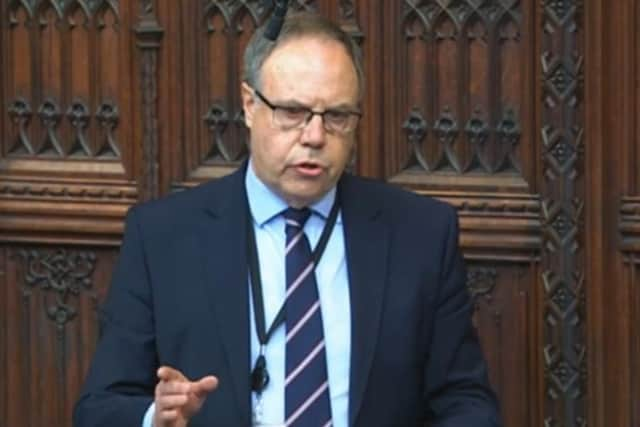

If the government had granted the request – new EU regulations would have been blocked from applying here.
The DUP, Ulster Unionists and TUV argued that new rules on household cleaners and industrial chemicals would add to trade friction, put Northern Ireland at an economic disadvantage and reduce choice.
But the government rejected their bid saying that the tests had not been met – and suggested it may align the regime in Great Britain so that no new regulatory barriers emerge, if it deems that necessary.
Elements of unionism have argued that a form of regulatory alignment is the most realistic prospect of mitigating the impact of the Irish Sea trade border during this parliament, given Labour’s commitment to upholding the trade deal with the EU.
It means that the UK government would mirror EU rules, thereby reducing checks and disincentives to trade between Northern Ireland and Great Britain.
On Tuesday, DUP deputy First Minister Emma Little-Pengelly said the government’s decision this week on the Brake was “wrong” – but that they had committed to avoiding divergence, and that “has only happened because the Stormont Brake was pulled”.
However, DUP peer Lord Dodds says that the government’s approach has not been consistent on alignment – citing a U-turn on a Safeguarding the Union commitment on labelling food products in order to protect the UK internal market.
He said that while the approach “may work on a few occasions”, and this government may be more inclined to do it than the previous Tory administration, it is not something unionists can rely on.
“We can't rely on that, because from issue to issue, it's up to the government of the day – and the government department in Whitehall that has responsibility – to make a decision on that. That’s not the way Northern Ireland's economy and constitutional positions should be decided.
“On this issue, they're saying ‘we might bring the rest of the UK into line’. But take the ‘not for EU’ labelling. This was a specific demand. It was in Safeguarding the Union”, Lord Dodds said.
He said the promise was made that trade flows to Northern Ireland would be protected by having a UK wide approach to labelling products – which meant that there wasn’t a disincentive to companies selling to Northern Ireland
“In that case, they just decided to drop that, because they were lobbied heavily by industry and manufacturers in Britain that this would be very costly”.
The DUP peer said that on one hand the government was saying that on chemicals “we might move the rest of the UK into line – but on the other hand, we have the not for EU labelling where they just cast that aside.
“It's completely inconsistent. It's unreliable. It's not the way forward. And why should the rest of the UK be forced to adopt EU legislation anyway?
“Why should any part of the UK be forced to adopt EU legislation? The way forward is that we should have UK legislation in these areas, applying across the UK. And that's why the solution of mutual enforcement is one that deals with the border issues, but doesn't infringe on the sovereignty matters”.
The current government has made clear that it does not intend to re-open the Windsor Framework. This week in Parliament, Northern Ireland minister Fleur Anderson said “It’s the Windsor Framework that enables the UK internal market to be protected post-Brexit”.
The deal provides some easements for traders moving goods from GB to NI who have successfully applied to a trusted trader scheme, and who sell their goods in physical retail outlets in Northern Ireland. However, materials for manufacturing – as well as online sales – are not covered, and there are growing concerns about upcoming changes to rules on parcels entering NI from GB.