
Harris: I will not exclude unionists from unity debate – but I will not wait for them
Tánaiste Simon Harris insists he will press ahead with preparations for possible constitutional change even if the main unionist parties in Northern Ireland refuse to participate.
Ireland’s deputy prime minister told The News Letter that a united Ireland remains his personal ambition but that unionists “have nothing to fear” from the process.
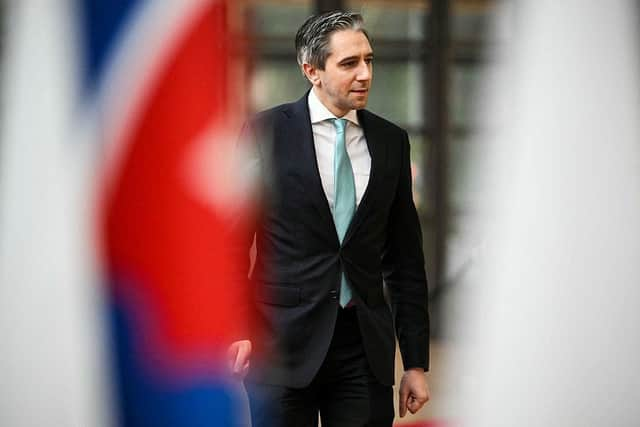

Speaking from his office in Dublin, Mr Harris rejected accusations from unionist leaders that the Irish Government's preparations for a possible united Ireland amount to an attempt to undermine Northern Ireland's place in the United Kingdom, insisting that examining constitutional change “should not be regarded as a threat to unionists”.
In an interview with The News Letter, the Tánaiste made clear that he intends to proceed with the proposed work examining the implications of constitutional change, even if the main unionist parties refuse to participate.
He dismissed suggestions that the exercise was designed to persuade unionists to vote themselves out of existence and argued that opposition to discussing the island's constitutional future was inconsistent with the principles of the Good Friday Agreement.
Asked if main unionist parties refuse to participate in this if he will “proceed anyway”, Mr Harris said: “Yes, is the short answer, but I don't mean that in any sort of hostile or dismissive way.”
“We want to carry out a piece of work that explores, in an evidence-based way, what constitutional change may look like.
"That examines issues like cost, economic development, but also examines issues in the here and now around reconciliation and the likes.
“It would be very weird, quite frankly, for me to want to have an inclusive conversation and only invite those that agree with me to the conversation.
"So the door will always remain open…”
Mr Harris was nevertheless unequivocal about his own political objective, declaring that he wanted to see a united Ireland in his lifetime.
He also acknowledged that there was a substantial amount of work to be done to establish the arrangements necessary to protect those who wish Northern Ireland to remain British.
Asked why unionists should trust him when his stated political ambition was to end Northern Ireland's place in the UK, Mr Harris said the starting point for the discussion should be the Good Friday Agreement, which recognised the legitimacy of competing constitutional aspirations.
“We had the Good Friday Agreement coming up on 30 years, and it recognised that, in the first instance, we all want to live in peace.
"We want to live in an environment where we can have peace and partnership and prosperity.
“But it also recognises that there are two legitimately held views on the constitutional future of Northern Ireland.
"There are those in Northern Ireland who passionately believe that Northern Ireland's place is in the United Kingdom.
"There are those in Northern Ireland who passionately believe that they want to see a united Ireland or a unified island.
“The Good Friday Agreement was a moment where everybody recognised that they were both legitimate views.
"So one person's view is not greater than another's, and they're both legitimate views.”
Mr Harris said many people who voted for the Good Friday Agreement had not regarded it simply as an endorsement of the existing constitutional arrangement, but as a framework within which the future could be debated.
He rejected the suggestion that preparing for constitutional change was inherently threatening to those who opposed it.
“None of us have anything to fear from preparing for various constitutional futures that may arise,” he said.
“It's entirely appropriate for some people to say that's not the future that I wish, just like there are nationalists who live in Northern Ireland now who don't like or support the current constitutional status.
“But we live in a democracy.
"We live in a society that I hope is becoming much more tolerant and inclusive, and we have to try and create space to have those conversations.”
Asked whether he understood why some unionists viewed the preparations as an exercise in persuading them to vote themselves out of existence, Harris said he could understand the concerns expressed by unionist leaders, but made no suggestion that they should determine whether the work proceeded.
He was particularly clear when asked whether he would continue if the main unionist parties refused to participate.
“Yes, is the short answer,” he said, although he stressed that he did not mean that in a hostile or dismissive way.
“We want to carry out a piece of work that explores, in an evidence-based way, what constitutional change may look like.
"That examines issues like cost, economic development, but also examines issues in the here and now around reconciliation and the likes.
“It would be very weird, quite frankly, for me to want to have an inclusive conversation and only invite those that agree with me to the conversation.”
Mr Harris is still hopes to that unionist politicians will engage, but argued that the discussion should not be confined to political leaderships.
“Beyond the leadership level of nationalism, of unionism, there's lots of other people out there too.
"Everyday people, everyday citizens, north and south, east and west, who sometimes are more open and more willing to actually have engagement.
"And I want to make sure there's a space for all voices.”
His comments amount to a rejection of the argument that unionist non-participation should prevent the proposed exercise from going ahead.
They also leave open the possibility that the work could proceed without the involvement of the political representatives of a significant section of Northern Ireland's population.
Mr Harris defended the tone of the debate, however, suggesting that some of the language used by unionist politicians was unhelpful.
Referring to correspondence from Ulster Unionist leader Jon Burrows, he said he was not surprised that a unionist politician wanted Northern Ireland to remain in the United Kingdom.
“That's not news to me,” he said.
But he criticised the use of phrases such as “assisted suicide” and “fairy tale” in the debate.
“I just don't think they have a useful role to play in public discourse because I would never describe his views or the views of those he represents as that.
"Far from it.
“I might disagree with them; they might disagree with me, but I'd never use those words, and I don't think we should.”
Mr Harris also sought to reassure those who fear that a united Ireland would diminish or remove their British identity.
Asked what respect for British identity would actually mean in a future united Ireland, he acknowledged that the practical arrangements still needed to be worked through.
But he said the principle should be beyond dispute.
“If there is a united Ireland, there will always be people within this island who identify as British, just like right now in Northern Ireland, that's currently part of the United Kingdom, there's people who identify as Irish,” he said.
“It's very important, both in law but also in practice and culture, that we recognise different identity and the value of that.”
He also acknowledged that sectarianism remained a problem across the island, rather than being confined to Northern Ireland.
He cited the treatment of Fine Gael's presidential candidate Heather Humphreys during the election as an example of the wider challenge.
“I'm acutely aware of the work that needs to be done around tackling sectarianism and inclusivity, and that's not just a Northern Ireland issue.
"It's an issue right across the island that I think we all need to work on.”
Asked what he would say to a Protestant family in Northern Ireland concerned that a united Ireland would mean losing its identity, Harris responded: “That is not the future any of us should aspire to create.”
Mr Harris said the peace process had required substantial work on both sides of the border and between the two islands, and insisted that there should be no return to the violence of the past.
“We have to continue to build the peace, build the reconciliation, build the trust, get to know each other.
"But no one should have anything to fear from constitutional change. They really shouldn't.”
He added that constitutional change would not be imposed on anyone, but would require a majority vote across the island.
However, Mr Harris was also careful to distance the proposed work from an immediate demand for a border poll.
He criticised what he described as arbitrary calls to hold a referendum now or tomorrow, arguing that the necessary groundwork had not been completed.
“Our document doesn't call for a border poll.
"Our document doesn't say when a border poll should be.
"There's so much work that needs to be done before you get to this.”
He suggested that the question required a more considered approach, rather than political demands for an immediate vote.
“I say to colleagues very respectfully: imagine if Andy Burnham had turned up in Northern Ireland and said, ‘Yes, I am planning on having a referendum.’
"The work isn't done.
“So what I say to people here is: let's have a conversation.
"Let's have it in a respectful, inclusive manner.
"There is nothing to fear from that. Absolutely nothing to fear.”
Mr Harris also rejected the suggestion that campaigning for Irish unity would inevitably reopen old wounds or increase tensions between communities.
He said such criticism began from a misunderstanding of the Good Friday Agreement, arguing that the agreement had never required people to abandon their constitutional aspirations in order to support peace.
“For many people, a vote for the Good Friday Agreement was never a vote for the status quo,” he said.
“It was a vote to recognise that, to bring about peace most crucially, but also to recognise that there are legitimately held views in relation to the constitutional status.
“There are two views, and both are legitimate.”
He said treating one of those positions as dangerous would represent a step backwards.
“If all of a sudden having one legitimate view is viewed as somewhat dangerous, I think that actually would be a retrograde step that really doesn't recognise the word and the spirit of the Good Friday Agreement.”
On the proposed sovereign wealth fund intended to help prepare for possible constitutional change, Mr Harris said it remained a proposal rather than an agreed measure.
He said he and Taoiseach Micheál Martin wanted to consider the next steps in preparing for potential constitutional futures and expected discussions to be concluded in the coming weeks.
The fund, he said, was a proposal from his party which he believed would be sensible, particularly if the island eventually faced a referendum.
“If you ever get to a debate or indeed a referendum specifically, I think being able to address the economic issues and the funding issues will be an important part of that,” he said.
“I think that ring-fenced fund is an intelligent suggestion that’s come through our party’s engagement process.”
He cautioned, however, that the timetable and the question of Government agreement remained unresolved.
Mr Harris also expressed support for extending the right to vote in Irish presidential elections to Irish citizens living in Northern Ireland, saying he hoped the change could be in place for the next election.
He distinguished that proposal from extending voting rights to the wider Irish diaspora, which he described as a much bigger question.
“There is a very significant difference between the diaspora worldwide and Irish people living on the island of Ireland,” he said.
“That’s where my priority focus would be: ensuring that anyone living on the island who identifies as Irish, who’s an Irish citizen, could have a vote.”
Reflecting on his own experience of Northern Ireland, Mr Harris acknowledged that, growing up in County Wicklow, he had not been as familiar with Northern Ireland as he might have been with other parts of Europe.
He recalled family shopping trips across the border and visits to cultural institutions and places of natural beauty, but conceded that many people of his generation in the Republic had not travelled north extensively.
He said improving transport links, encouraging student mobility and increasing co-operation between universities were important ways of bringing communities closer together.
Mr Harris also pointed to the Shared Island Fund and the Enterprise train as examples of practical co-operation which could continue regardless of disagreements over the constitution.
His comments about relationships with unionist politicians were conciliatory.
He said that, despite differences in political outlook, he had found many colleagues willing to engage in good faith.
He also suggested that private conversations between politicians were often more collegiate than public exchanges might indicate.
“I think people are generally decent, and I think people are generally doing their best for the communities and the people that they represent,” he said.
Mr Harris concluded by arguing that the constitutional question, while important, should not overshadow the everyday concerns shared by people in Northern Ireland, the Republic of Ireland and Britain.
“Can I access the health service?
“Can I get a job?
“Can my kids aspire to do better than I did?
“What’s the cost of living like?”
He said there were many opportunities for politicians to work together on those issues, regardless of their position on constitutional change.
But on the central question raised by unionist critics, Mr Harris offered little ground.