
House of Commons vote repeals immunity for Troubles crimes by a landslide - round-up of where the parties stand
The House of Commons has voted to repeal immunity for Troubles-era offences contained in the Legacy Act, and its bar on new civil cases.
It was done via a remedial order – a kind of fast-track mechanism for amending an existing law.
The government is still in the process of trying to enact its own Troubles Bill, replacing the Legacy Act.
It passed by 373 votes to 106.
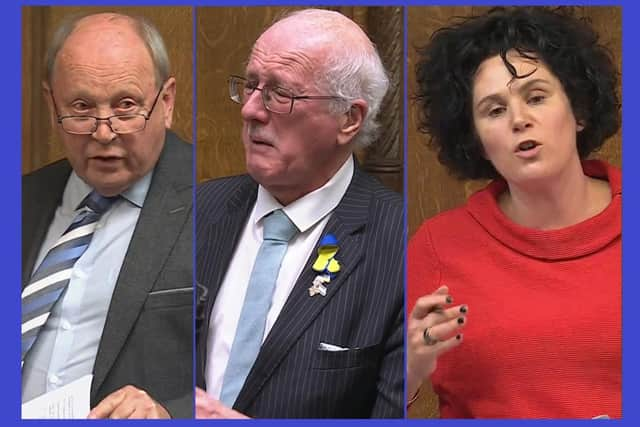

Here is a breakdown of where some key MPs stood on the issue:
Robin Swann (UUP) said that "the question has been raised: why are we rushing this remedial order while there is no troubles Bill to replace it? Why the rush?”
He suggested it was being done to “placate the Irish government and their timeline rather than the timeline of this place” (the Irish government currently has an interstate legal case open against the UK, opposing the immunity of the Legacy Act).
Mr Swann said “throughout this three-hour debate – no harm to the government – their benches were empty,” adding that: “When the bells ring, government members will come and do what they have been bid to do.”
David Davis (Conservative) said that “IRA terrorists and their families will benefit from what we are doing today,” adding that while “there will be some civil claims brought against IRA killers” as a result of the repeal of the ban on civil cases, “they will be rather special circumstances”.
Gavin Robinson (DUP) said: “The decisions being made in this chamber now, and those that will be made in future regarding the Troubles Bill, have a material impact on our ability to move on to the future rather than deal with the past, yet I hear no concern for that.
"I see that 800-odd [existing] civil claims will now be accompanied by an additional 200 claims [as a result of the repeal].
"Who is to pick up the bill, Secretary of State? If it is the people of Northern Ireland – the people who were troubled for 30 years by terrorists – and the fledgling Executive, who are struggling to make public services deliver for their people because of these issues, then that is something I have a responsibility to raise, and it is something the Secretary of State needs to wrestle with and deal with.”
Claire Hanna (SDLP) spoke against immunity and in favour of its repeal, saying: “I can stand here and acknowledge that so many [soldiers] did serve decently – did try to serve decently.
"I can stand here and acknowledge the pride that many members feel in the service given by them and by their loved ones.
"However, I hope that others can acknowledge that that was not the experience that everyone in Northern Ireland had.
"Three hundred thousand soldiers served in Operation Banner, and fewer than two dozen of them have ever faced judicial proceedings.
"We have wasted a lot of the time of victims’ families, and we have wasted money as well. It is time to move forward.”
Sammy Wilson (DUP) said: “Veterans will have heard the honeyed words of the Secretary of State at the start of his speech today, when he talked about the debt of gratitude we owe to those who served in Northern Ireland in very difficult circumstances.
"Yet this order is all about removing protections that would have been available to those very veterans against what is a continued terrorist campaign conducted not through guns, not through bombs and not through killings, but through the courts.
"I have heard many people on the government benches say, ‘oh, we’ve got to uphold the rule of law.’ That is totally naive.
"This is not about the rule of law in Northern Ireland; this is about the abuse of the law by those who cannot accept that they lost in their terrorist campaign, who want to rewrite the history of that terrorist campaign, and who want to put the blame on the forces of law and order who stood between the citizens and the murderers and the criminals.”
Carla Lockhart (DUP) told MPs: “It is clear that any benefit from reinstating civil cases will be accrued by a subset of victims whose claims are directed towards the security forces.
"Once again, the full weight of the state is being aimed not at terrorists but at those who stood against them.
"Where exactly does the right honourable member suggest those who were bereaved at the hands of terrorists can seek compensation from the Provisional IRA?”
Jim Allister (TUV) said: “The common denominator of victims and families such as those is that they not just feel but know that they are the forgotten ones.
"They know that they are not the priority of this government, and they know that it is the country that gives shelter to the murderers of their loved ones that is the priority of this Government.
"Dress it up as he will, the Secretary of State’s remedial order is motivated by one thing and one thing only: appeasing the Government of the Irish Republic, who want to drag this United Kingdom before the Bar of the European Court of Human Rights.
"That is what this remedial order is about.”
One of the most impassioned contributions came from Jim Shannon (DUP), who listed a string of people he had connections to that had been murdered by the IRA, including his cousin Kenneth Smyth and his Catholic friend Daniel McCormick (two UDR men).
"On 9 April 1990, near Ballydugan, Downpatrick, a Provisional IRA bomb blew up four men, three of whom I knew,” he said.
"The explosion was massive, killing the four men in the second vehicle instantly and creating a crater some 50 feet long.
"The point I want to make is that the bill does not protect the RUC officer who shot the man who pushed the button and who blew up those four men.
"I will put it on record in this House that Colum Marks was the murdering scum of an IRA commander in Downpatrick who killed those four UDR men.
"Was he ever held accountable? No, he was not, but he did get held to account at one time.
"In Downpatrick, when he tried to set up a horizontal mortar bomb, he was shot by an RUC officer who was then taken and charged.
"The investigation found that he was not guilty – but the point I want to make is that we need protection.”
He went on to add: "I am sorry, Madam Deputy Speaker. I apologise for my tears.
"I find it very hard to express these things that have happened to people that I served with and knew.”
He indicated that repealing the immunity of the remedial order will “enable the continued persecution of RUC, UDR and British Army veterans, many of whom have had their honourable service doubted and disputed, and who deserve better from this House”.
Sarah Pochin (Reform) said: “The Legacy Act put a stop to lawfare. Although not perfect, it was a step in the right direction as it outlawed lawfare against veterans…
"The government want to reopen inquiries, leading to the return of years of misery and stress for, and the persecution of, our brave veterans in their retirement years, after they served this country so loyally during the Troubles.
"In the meantime, on-the-run letters of comfort remain in place for IRA terrorists—letters sent by Tony Blair and Jonathan Powell, the current National Security Adviser.
"The return of civil suits will lead to the return of slow justice and a cost of millions more to the taxpayer.”
Labour Northern Ireland Secretary Hilary Benn said: “I have listened very carefully to every single contribution, and I think it is fair to say that the majority of people speaking in this debate do not agree with immunity.
"They might not all vote for the remedial order tonight, but they do not agree with immunity, and that is the government’s position.
"I respect those who take a different view, but I think it is a failed policy – it does not exist.
"We are charged with taking away something that does not exist, was never enacted and was found incompatible by the courts.”
He added: “It has been suggested that this is about relitigating who won, but the answer to that question is already crystal clear: peace won.
"Peace won in Northern Ireland because of the Good Friday Agreement.
"This is not about placating anyone; it is about seeking to do the right thing.”