
Jayne Brady u-turn as NI Civil Service staff told not to participate in Pride parades in 'official capacity' - DUP welcome change of heart
Civil servants have been told they should not participate in LGBTQ+ parades this summer, as Jayne Brady’s organisation U-turns on a previous commitment to take part as “an inclusive employer”.
Last year, the civil service faced questions over its involvement in Belfast Pride – which was campaigning against a Supreme Court ruling on the definition of a woman and against the Executive’s ban on puberty blocker drugs for children.
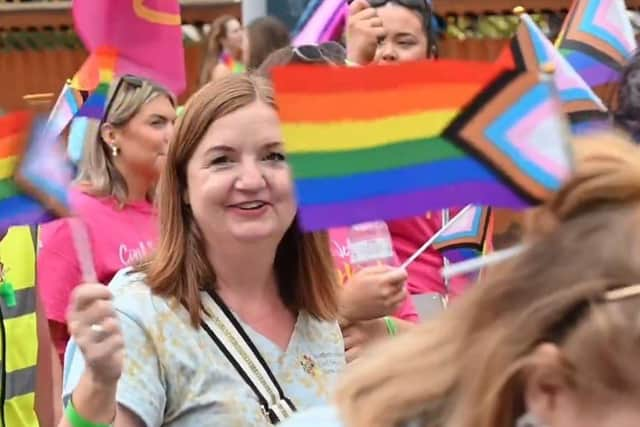

That is despite its commitment to impartiality, and delivering the policies of Stormont ministers.
The DUP has welcomed the decision, saying it is important for public confidence in the service.
When controversy erupted over NI Civil Service (NICS) attendance last year, Ms Brady’s organisation issued a robust defence of the principle of employees attending - with NICS saying the “only reason” they would be there was their commitment “to being an inclusive employer”.
Now, staff have been told that “in the current legal and case law context, the NICS is not in a position to participate in Pride events this year in an official capacity, where colleagues would be identifiable as representing the organisation”.
Employees were also told “the current position in a live and evolving context” and it “does not reflect any wider change in our commitment to LGBTQ+ workplace inclusion”.
The communication was signed off by Ms Brady and the permanent secretaries of each Stormont department.
DUP MLA Jonathan Buckley told the News Letter: “NICS has reached this decision in light of the current legal and case law context. It is important that public bodies act in a manner that is legally robust and consistent with their obligations.
“The Civil Service exists to serve everyone in Northern Ireland, regardless of their background. Its role is not to align itself with overtly political events or campaigning causes such as ‘Pride’, but to deliver public services in an impartial and professional manner.
“Every employee should be treated with dignity and respect, and workplaces should be environments where people can thrive and reach their full potential.
“Public confidence in the impartiality of our institutions is important, and decisions taken by the Civil Service should always be guided by the law and the interests of all those it serves”.
Ms Brady has made no secret of her support for the LGBTQ+ sector – and has previously marched through the streets of Belfast waving a controversial ‘Progress Pride’ flag.
Last year, a High Court case involving Northumbria Police heard that the emblem indicated support for gender ideology. The force was ruled to have acted against its duty to be impartial by attending Newcastle Pride in 2024.
The manner of its attendance – the display of the ‘Progress’ flag and transgender colours – was central to the judgement.
Ms Brady did not attend last year’s Belfast Parade due to “prior commitments”. Unionist parties in the Executive opposed participation in the event, particularly in light of a ban on all government parties due to their support for a ban on hormone drugs being given to children who identify as the opposite sex, to halt their natural physical development.
Questions were also raised over NICS membership of a scheme run by Stonewall – with the TUV questioning whether attendance is being driven by a fear of falling down the LGBTQ+ lobby group’s equality ranking.
NICS pays the group for its advice, despite the fact it lobbies local politicians on contentious issues such as banning so-called conversion therapy.
It was given a ‘Silver Award’ from Stonewall in 2024, and praised for its attendance at Pride. Sinn Fein finance minister John O’Dowd has defended civil service membership of the scheme - describing Stonewall as “subject matter experts”.
Last year, deputy First Minister Emma Little Pengelly formally opposed the involvement of the civil service in Belfast’s Pride parade – with the DUP accusing the civil service of “actively campaigning in at least two directly political issues”.