
Kemi Badenoch backs TUV's Allister over Irish Sea border legislation - as NI Secretary faces Stormont Brake decision by Monday
Conservative leader Kemi Badenoch has backed opposition – led by Jim Allister – to new legislation on the Irish Sea border, as a Monday deadline for the government to make a decision on a Stormont motion to halt EU law looms.
The TUV leader has hailed increased parliamentary support for his anti-protocol fight as a “significant moment” – with 77 MPs backing him in opposition to new Westminster rules which treat Northern Ireland as a separate country from the rest of the UK in terms of trade.
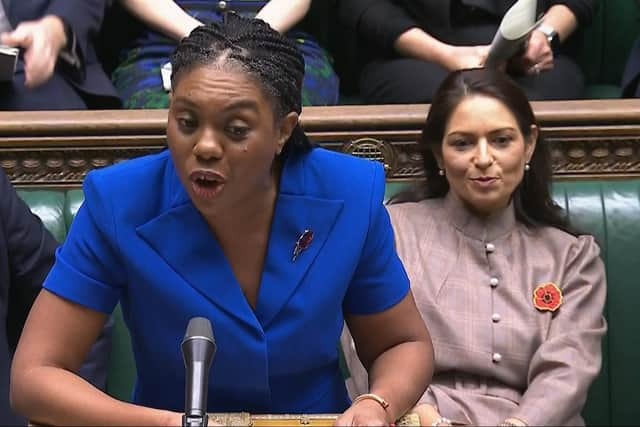

With a huge Labour majority the vote was lost – but it indicates a willingness by the official opposition to oppose embedding the regulatory border through UK legislation, at least in this instance.
It comes as the secretary of state faces an imminent decision about how he responds to unionist MLAs pulling the so-called Stormont Brake mechanism – a decision which must made by Monday.
It was triggered in December, with the support of all unionist parties, in a bid to stop new EU rules on labelling from coming into effect in Northern Ireland. Hilary Benn must decide whether the move was legitimate and whether to support the halt to the Brussels law, which would then go to a form of arbitration.
However, there have previously been warnings from officials and politicians that if the procedure is successful, it could ultimately result in ‘trivergence’ – leaving Northern Ireland isolated outside both EU and UK arrangements.
Mr Allister MP said: “The legislation states that the secretary of state must decide whether to allow the Brake to be pulled within the scrutiny period which lasts for two months, in this case between 20 November and 20 January. That means Mr Benn must make his decision by this coming Monday.
“While it was important for unionists to stand together to pull the Brake, it is also important that we have no illusions about its limitations.”
He said that even if unionist politicians are successful in using the mechanism, it provided “no right to make an alternative law to replace the law we block”.
He added: “In pulling the brake we had to demonstrate that doing so was ‘a last resort, having used every other available mechanism’ as if in Ulster is it ok to treat democracy as a last resort.”
In Westminster, the TUV leader has welcomed support from both the Reform UK and Conservative Party leadership for his position on new Irish Sea border legislation. He raised opposition to the latest legislation which recognises the new regulatory border between NI and GB last week, forcing a division on the issue on Wednesday.
It received the support of the vast majority of Tory MPs who voted, significantly broadening the anti-protocol coalition in parliament beyond Northern Ireland’s unionist parties and Reform. What that means for wider Tory policy on the Windsor Framework in future remains unclear.
The North Antrim MP said: “It is vital that we force votes of all legislation that gives effect to the construction of the Irish Sea Border, regardless of numbers, because anything less communicates the message that we are prepared to live with the Irish Sea Border dividing our country.
“In the context of Labour’s massive majority, I never expected to win. That wasn’t the point.
“Rather Northern Ireland unionist MPs needed to demonstrate that Northern Ireland has not given up and has the resolve to continue as part of the United Kingdom, despite the best efforts of the EU.
“In taking that stand … a significant moment was reached.
“Whereas up until that point it has never been possible to persuade more than 30 MPs (including those of us from Northern Ireland) to stand with Northern Ireland on border legislation, yesterday we broke through what had felt like a glass ceiling and more than doubled that number to 77.
“The injustice of the Irish Sea Border both constitutionally and economically render it morally completely unsustainable.
“Our task responding to this is twofold. First, we must call out and expose this injustice ... Second, we must provide a viable alternative which is what I am doing through my Mutual Enforcement Bill.”