
Loyalist survey finds 'some support' for return to street protests over Irish Sea border - 'both lawful protests and more disruptive ones'
There is "some support for the re-emergence of organised protests" over the Irish Sea border, according to a poll of loyalist attitudes.
It is one of many findings from the group Let's Talk Loyalism, which has produced a 60-page document based on a survey with "over 50 selected loyalists".
Each respondent provided answers, mainly by e-mail and WhatsApp, to "five key questions about critical issues facing unionism today," it said.
The responses were then summarised by Let's Talk Loyalism.

Let's Talk Loyalism was founded in 2021.
At the time it said it was "a small group of young loyalists" who aimed to “research, recommend and lobby for policy change which positively impacts the loyalist community and NI”.
Arguably the best-known member is Moore Holmes, though DUP Belfast councillor Dean McCullough is also involved.
Asked how the survey participants were selected, Mr Holmes said: "Over 50 loyalists were individually approached by members of Let's Talk Loyalism, representing a broad cross-section of the community including youth workers, community workers, members of the loyal orders, activists, women's groups, bandsmen, ex-prisoners, and people with deep roots in their communities".
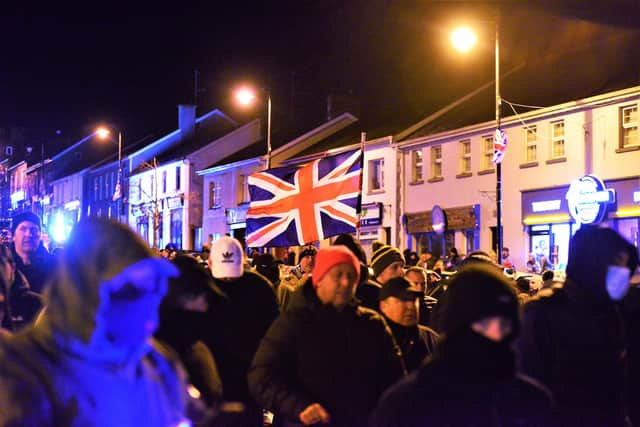
The summary of responses to this said: "There is some support for the re-emergence of organised protests, both in Northern Ireland and in the Republic of Ireland, similar to tactics used by other groups, like French farmers.
"This includes both lawful protests and more disruptive forms of civil disobedience to draw attention to unionist concerns…
"There is a call to build alliances with other political and social groups both within Northern Ireland and across the UK, particularly by creating connections with Reform UK and challenging EU policies through united fronts."
It adds: "A smaller group of responses suggest a more resigned approach, arguing that the situation may be irreversible, and that unionism should either accept the Irish Sea Border as part of the current political reality or shift focus to making it work within the existing framework."
Among other things, the report recommends "all unionist parties should publish a new up to date policy paper outlining their current position on the Northern Ireland Protocol/Windsor Framework";
That "Arlene Foster’s position as chairperson of InterTrade UK should be leveraged and other instruments must be influenced to unionism’s advantage";
That loyalists compile "a database of businesses and individuals who have been negatively impacted by the Windsor Framework/Protocol";
That "activists should continue to stage creative, artistic and effective demonstrations... demonstrations could include artistic murals, poster messaging, satirical images, flash mobs, flare/light protests, and other creative demonstrations";
And that activists should "make a case" for the invocation of Article 16, which allows for suspension of the Protocol in the event of either “serious economic, societal or environmental difficulties” or a “diversion of trade”.
The other four questions asked of loyalists were:
– How can Unionism mobilise its community to come out and vote?
– How can Unionism create greater co-operation and collaboration across Unionist parties?
– How can Unionism become more appealing to and effectively engage young people?
– And how can Loyalism contribute more effectively to political affairs?
Among the other recommendations in the report are getting shops to offer a "customer discount and special offers exclusively to those who are either registered or have voted on election day" to increase turnout;
Creating a "new pro-union coalition party at Westminster" which "could better consolidate the pro-union vote and prevent further fragmentation";
"Modernising cultural and traditional events... for example, music festivals that blend classic pipe bands with local modern bands or DJs could provide a space for young people to experience their cultural heritage in a way that feels current and exciting";
And promoting "positive loyalist culture" while "combating negative stereotypes".
The document is being formally launched at a meeting in Brownlow House, Lurgan, tonight.