
Mother and baby homes in Northern Ireland: Truth Recovery Independent Panel publishes interim report
An independent panel investigating mother and baby homes, Magdalene laundries and workhouses in Northern Ireland has recovered more than 3,000 records and archive items from institutions involved.
The panel said while a significant number of institutions have handed over information related to the women and children who passed through their facilities it noted that some organisations have not yet shared their records.
In 2021, Stormont-commissioned experts recommended that a public inquiry be established to investigate mother and baby homes, Magdalene laundries and workhouses in Northern Ireland.
Alongside the inquiry, the experts also called for a non-statutory independent panel to be set up to allow those who were sent to the institutions, and their families, to give testimony in a less adversarial format.
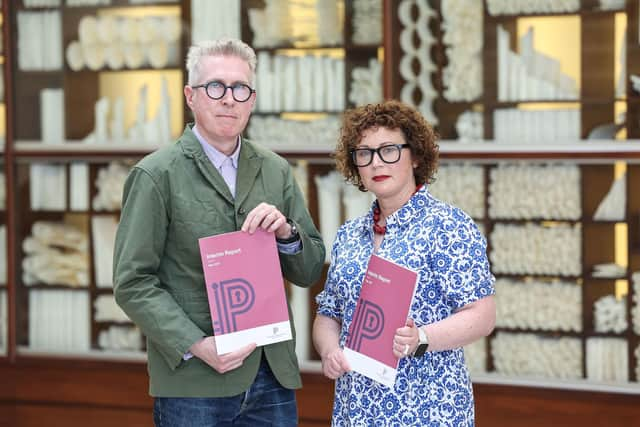

On Wednesday, the Truth Recovery Independent Panel published an interim report on its work to date, including its efforts, in conjunction with the Public Record Office of Northern Ireland (PRONI), to secure and digitise records.
In 2022, in response to a recommendation in the initial expert report, Stormont passed a law compelling the institutions involved to preserve all their files.
The panel said, as of last month, 3,000-plus items have been received by the PRONI.
They include 178 volumes/registers; 43 annual reports/accounts; 350 case files and 2,550 index card case notes.
The panel said it would encourage the institutions that have not yet shared their records to do so.
It said organisations that have shared their records include the Catholic Church, the Church of Ireland, the Good Shepherd Sisters and the Sisters of Nazareth.
It said records held by some institutions do not require relocation to the PRONI for digitisation – these include files of the Salvation Army and Barnardo’s, which are held in the national archive centres of both organisations.
The panel said negotiations were ongoing to facilitate the digitisation of those records on-site to enable their onward sharing.
The panel said discussions were “ongoing” with institutions and organisations that have not yet agreed a process to facilitate digitisation and unfettered access to records.
It said discussions were continuing with Family Care Adoption Services in relation to the digitisation of records it holds on former institutions and organisations, including the Mater Dei home and St Joseph’s home in Belfast.
The panel said work was also ongoing with the Sisters of Mercy in relation to access and digitisation of records related to an institution it ran in Newry.
It has also emerged that some Stormont departments also hold records relevant to the panel’s work.
The panel highlighted that departments had previously indicated that they did not hold any records other than those in the possession of the PRONI.
The interim report said that assertion was inaccurate in relation to at least one home – the mother and baby institution at Mount Oriel in Belfast.
Prior to the publication of the expert report in 2021, a major academic research study outlined the scale of mistreatment endured by thousands of women and girls in the institutions.
The work, by Queen’s University and Ulster University, found that more than 14,000 girls and women went through the doors of mother and baby homes, Magdalene laundries and other institutions between 1922 and 1990.
It found that women were mistreated, held against their will and forced to give up children for adoption.
A main task of the 10-person independent panel has been the collection of testimony from victims and survivors of the institutions.
To date it has prioritised hearing from individuals aged 70-plus, or those with a health issue.
Once those people have engaged with the panel, the next phase of testimony collection, which will take place in the coming months, will see approaches made to the remainder of those who have declared an interest in sharing their stories.
A wider appeal for others to come forward will begin in the summer, with those testimonies being collected from October.
The panel also has a role in helping victims and survivors source information and records held about them.
It has begun to prepare guidance on accessing records and has also engaged with Stormont’s Executive Office and Department of Justice to recommend changing the law to provide free legal advice and assistance to victims and survivors in their applications for access to information.
The panel is also investigating the pathways through which women and children left the institutions – work that will examine adoption practices and cross-border and international transfers of children and women.
The panel is due to publish a final report in 2025.
That will include recommendations for the planned public inquiry.
Co-chairs of the independent panel, professors Leanne McCormick and Sean O’Connell, said the work to date was laying “strong foundations” for the public inquiry.
“Our report outlines our trauma-informed testimony collection process, which ensures that individuals who chose to share their experiences with us, can do so in a safe, respectful and supportive environment,” they said in a joint statement.
“We are indebted to the victims/survivors who helped us to shape this and want to thank those who have come forward to share their testimony with us so far. We hope they have found this to be a positive experience.
“This work is laying strong foundations for the public inquiry, enabling it to carry out its work more effectively and we look forward to engaging with the inquiry.
“We know that those seeking the truth about themselves have faced significant challenges and this report outlines our dedicated efforts to support victims/survivors and their families in that journey by making it easier to access their records.
“As we move forward, we will continue to build on this work, ensuring a victim-survivor centred approach.”