
New book on David Trimble's life details a complex character - revealing a 'gracious' gesture towards former rival Arlene Foster
A rapprochement between David Trimble and Arlene Foster – and the respect both figures had for each other towards the end of his life – has been detailed in a new book on the life and legacy of the former Ulster Unionist leader.
The pair parted ways over the Belfast Agreement, with Mrs Foster defecting to Mr Trimble’s bitter rivals in the DUP and later going on to lead that party, and serve as First Minister over a decade after her former leader.
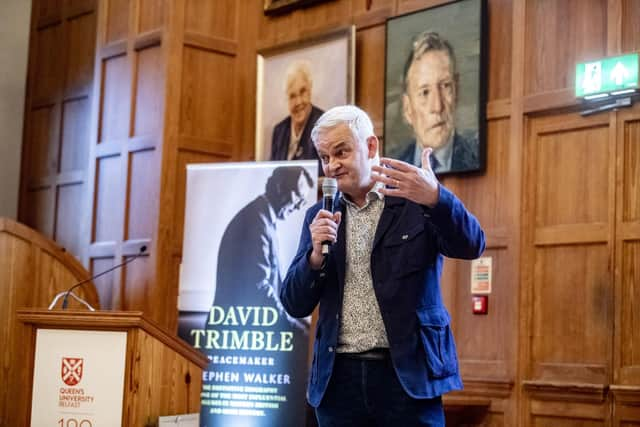

In a new book by the former BBC political correspondent Stephen Walker, it is revealed that Lord Trimble had insisted on Baroness Foster being invited to an unveiling of a portrait of the Nobel Laureate at Queen’s University.
The former DUP leader – once described as a thorn in the side of Mr Trimble, quit his Ulster Unionist Party in 2004 to join the DUP, together with fellow MLAs Jeffrey Donaldson and Norah Beare.

The book, David Trimble: Peacemaker, documents the unveiling of a portrait in June 2022 at Queen’s University, attended by the Trimble family, invited guests and the media.
It is described as a star-studded affair, featuring video messages from former US president Bill Clinton, former prime minister Sir Tony Blair and Prime Minister Boris Johnson. The event at Riddell Hall was attended by numerous politicians, including former Irish prime minister Bertie Ahern.
It details that, on Mr Trimble’s request, Arlene Foster was invited to the event, which she says, “was most gracious of him”.
“It was a very emotional night, because we could all see he wasn’t well, and it was really important for him that he was recognised in the place that meant so much to him, because he’d been a law lecturer there and because of his friendship with Edgar Graham. I think it was a really emotional night for him and the family”, Baroness Foster says.
Stephen Walker was a journalist at BBC Northern Ireland for over three decades. During that period, he reported on the highs and lows of David Trimble’s political career. He says that while writing a book on the career of former SDLP leader John Hume, he had come across countless stories about the former UUP leader and decided to write a book on his life.
He is keen to point out that while the Trimble family co-operated with him in the writing of the book, it is not an authorised biography and attempts to give a full account of a complex man.
Mr Walker told the News Letter: “I subscribe to George Mitchell's view that there would have been no peace process without John Hume, and no Good Friday agreement without David Trimble.
“David Trimble was there on that snowy afternoon in April 1998 and he had a very fundamental decision to make. Is this deal going to make life better for people in Northern Ireland? And he chose yes. He could see where the problems were. He could see that there were problems with policing reform, with prisoners – decommissioning was a big issue.
“But ultimately he had to look at it like a balance sheet. Are there more positives here than there are negatives? And can we work at the negatives? And he made that big call – he said yes, we're going to go for this.
“And his legacy is divided. He lost friends. The party divided – it is now a shadow of what it once was, and he ultimately lost his seat in 2005 he came under the most intense pressure on a daily basis. Graffiti at the bottom of the road, bomb scares to his office, crowds outside his house, being jeered at public events, just relentless pressure.
“But he had bags of courage. He was a very complex man – could be difficult, could be rude, could be visionary, could be funny. And the joke is that's just one morning.
“Seamus Mallon famously said there were seven David Trimbles, one for every day of the week. You just didn't know which one you were getting. We're all complex. He was particularly complex and and difficult to deal with, and had difficult relationships with civil servants and with journalists and fellow politicians. But he was an intellectual, and he understood the history of this place”.