
Northern Ireland unionists and Tories join forces to attack Labour policy on Troubles legacy ahead of vote to repeal bits of Legacy Act
A move by the government to repeal parts of the Legacy Act has come under fire from unionist MPs and Tories.
The government is tonight moving to disapply bits of the 2023 Legacy Act – firstly, the bits which grant immunity to those who confess truthfully to Troubles crimes, and secondly the parts which prohibit civil cases concerning the Troubles.
The government says it is doing this because these segments had been ruled incompatible with existing human rights law.
The means by which it is repealing them is called a remedial order – a kind of fast-track instrument for amending existing laws, as opposed to a full-blown bill.
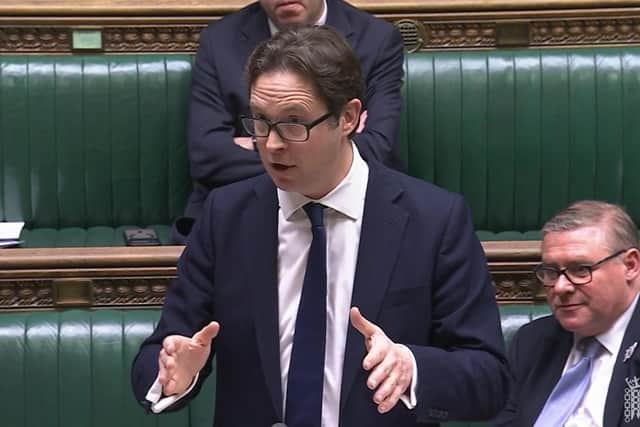

Separately, the Labour government is still in the process of bringing in its own Troubles Bill through Parliament to replace the Legacy Act.
In a statement as debating got under way, DUP leader Gavin Robinson said that while “the removal of amnesty will be welcomed by the vast majority of people... other aspects of the remedial order are more concerning”.
He went on to say: “The reinstatement of civil cases will once again see a disproportionate focus on the security forces, as the vast majority of such cases are directed towards the state.
"The financial pressures created by such cases will be immense, but without any funding stream to address that.”
TUV MP Jim Allister told the News Letter just ahead of tonight's debate: "The remedial order is patently to placate Dublin as a means of encouraging it to terminate its case against the UK.
"Everything that the remedial order repeals can be formally removed in the NI Troubles Bill, but, instead Secretary of State Benn is rushing it when such is not necessary, thereby confirming the suspicion of ulterior motive.”
Dublin currently has a live interstate court case against the UK over the Legacy Act, lodged with the European Court of Human Rights.
Making the case for the remedial order, Northern Ireland Secretary Hilary Benn told MPs “the last government's Legacy Act was incompatible with the European Convention on Human Rights”.
He went on: “My job, the government's job, is to make sure that the legislation is made compatible so that everyone in Northern Ireland can have confidence in the framework we are trying to put in place with as much support as possible – and, at that moment, there is no basis for the interstate case anymore.
"It's a matter for the Irish government as to what they do with it, but it will have no basis, and it will not be able to go anywhere, because the House of Commons and the other place will have remedied the incompatibilities.”
Tory Shadow Secretary of State Alex Burghart responded to Mr Benn by saying that, by shutting down Troubles cases with its Legacy Act, the Conservative Party had sought to “move on from a new phase of the Troubles conflict which was being fought in the courts”.
On the question of immunity for Troubles crimes, Mr Burghart said that “it has always been one-way traffic”, citing the comfort letters issued to on-the-run suspects, the royal pardons, and the decomissioning of paramilitary weapons which destroyed forensic evidence that could have been used against paramilitaries.
He said that “when we introduced conditional immunity for veterans, in the same way that conditional immunity had been used time and time again after 1998, the Labour Party opposed us – [it has an] incredibly selective memory over the issue of conditional immunity”.
Fellow Tory MP David Davis spoke about “asymmetry built into the system” on legacy.
"Government policy does not differentiate between real victims and terrorists,” he said.
"It will allow IRA sympathisers to continue their campaign of vexatious lawfare, hauling our brave veterans into court.
"I’ll remind the House: in 2006 the Blair government passed a law which said anyone hurt in the Troubles was classed as a victim.
"That means a proven murderer – a proven serial murderer – killed in the process of carrying out another murder, is classed as a victim…
"So when the secretary of state talks about victims’ families, he’s actually in many cases referring to families of IRA terrorists.”
The debate is ongoing at time of going to print, but with the mathematics of the chamber heavily favouring Labour (404 MPs out of 650 in total) the remedial order is expected to pass.