
Northern Ireland universities facing death by a thousand cuts, MLAs warned
Universities in Northern Ireland are facing “death by a thousand cuts”, leading professors have warned MLAs as they outlined the impact of cuts and ongoing financial uncertainty for the sector.
Professor Sir Ian Greer, vice-chancellor of Queen’s University Belfast, said in the 26/27 academic year, 500 students from Northern Ireland were not able to study at home due to lack of funded spaces.
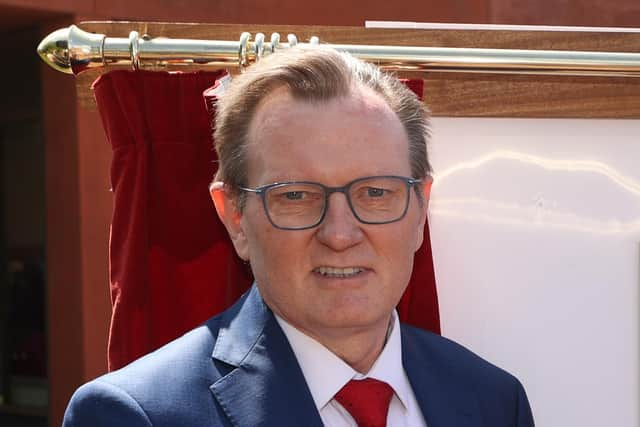

Sinn Fein Economy Minister Caoimhe Archibald has previously defended maintaining the £4,750 cap on fees for local students.
The Stormont Executive has still not set a budget for the region six months into the financial year, leaving departments operating on contingency budgets of 95% of last year’s spend.
Speaking to the Stormont economy committee, Sir Ian said this left Queen’s with a teaching grant reduction of around £4 million and an £8 million capital reduction, which he described as a “sizeable and chunky cut in our funding”.
Maximum aggregate student number (MaSN) relates to the number of publicly funded undergraduate places.
Sir Ian said in the current academic year, Queen’s accepted around 3,400 students from Northern Ireland filling its MaSN allocation.
He added: “Most importantly, perhaps and unfortunately, Queen’s had to turn away 500 students from Northern Ireland, who, under different circumstances, we could have taken in.
“They wished to stay here, to study here, and to build their lives here, but we weren’t able to take them.”
Sir Ian said they received an “unprecedented” number of 5,500 applications from the Republic of Ireland.
He added: “If we put these into MaSN we would have displaced an enormous number of NI students of the order of 1,000.
“So we treated them as a separate cohort, with no disadvantage to them, we didn’t change the funding, didn’t change the tariff which they had.
“So there was no impact on the Republic of Ireland students, but it allowed us to maximise Northern Ireland recruitment. So our total Northern Ireland MaSN intake for 26/27 is 3408, almost precisely on our target.”
Sir Ian said they received revised figures from the department in relation to their allowance for funded places for Northern Ireland students in mid-August when preparing to admit students following A-level and leaving cert results days.
“We were informed that, because of ongoing budgetary challenges, there remained a possibility that further reductions in teaching grant could occur during the financial year,” he said.
“That’s absolutely impossible for a university to manage. Our only lever is student numbers, once they’re in, they’re in, and the costs are fixed.
“So having reductions in funding to support these students after we admit them is a nonsense from our perspective.”
He added: “We’ve got a system which actually underfunds the cost of delivering higher education.
“So the price is set by the department, the numbers are set by the department, but the price they set is actually lower than the cost.”
Sir Ian concluded: “We absolutely understand that the budgetary situation for (Department for the Economy) and indeed all departments is really difficult to manage, but from a higher education perspective, we have really got to move away from this short-term financial planning, which can be rather chaotic, to develop a sustainable, stable, and fit-for-purpose HE sector for Northern Ireland to avoid disadvantaging both our economy and our young people.”
Professor Paul Seawright, deputy vice-chancellor at Ulster University, described the funding situation for universities as “dire”.
“It’s a threat to Northern Ireland’s future capacity and capability, to economic growth, productivity, the resilience of our public services, strength of our communities, regional balance, social mobility, ability to retain talent in Northern Ireland, and attract investment and compete internationally,” he said.
He added: “When higher education is weakened, Northern Ireland loses far more than university capacity. It loses graduates who sustain employers and public services, and that’s what’s happening I think with the unrelenting erosion of funding to the universities.
“Since 2011, our shared investment model has combined regulated tuition fees with public funding, and both components have been eroded – with fee increases not taking place with inflation, and and and the long term picture of that is quite stark.”
A voluntary redundancy scheme is currently open for staff at Ulster University which could see the loss of 450 roles, making up 15% of the current workforce.
“That’s not something that was our preferred choice, but we really don’t find any other way to deal with that,” he told MLAs.
“I think we are making the difficult choices. I think our actions on their own, aren’t going to repair what’s a broken funding model or sustain the regional ambition that we have in Northern Ireland.”
Expansion of the University’s Magee Campus in Co Londonderry was a central commitment in the Executive’s Programme for Government 2024-27.
“We’re still in the situation we’re in, and we’re going to see good jobs lost across our university, and that is an awful prospect for us and for those people who will exit the university,” Mr Seawright said.
“We have to be accountable for how we use public money, but political leadership also needs to be accountable for whether the ambitions it sets are actually funded, and that’s something I think we are struggling now at this stage to see how we go forward in relation to that.
“So if the choice is to fund less we must be honest to the public about the consequences of that.
“Sympathy and protest are not a substitute for decisions that align the expectations with the actual resources.
“I’m just appealing for cross-party commitment to protect higher education to avoid further cuts and establish a clear timetable for doing something different in relation to this, because it is death by a thousand cuts, as we currently are.”