
PSNI 25th anniversary: Nationalists expected a massacre of the RUC, said Maurice Hayes
/
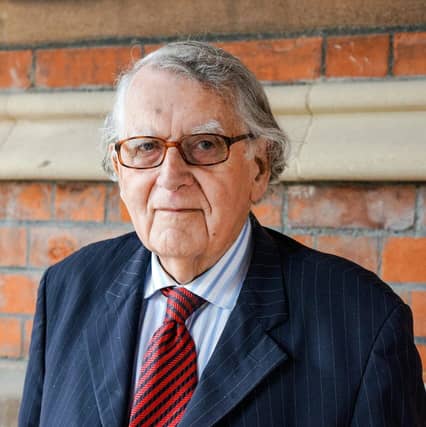

This is an edited interview with Maurice Hayes, published as part of a collection of essays this week to mark 25 years of the PSNI.
Professor Graham Spencer is Emeritus Professor at Portsmouth University, and interviewed Mr Hayes in 2015. The late Mr Hayes was a member of the Independent Commission on Policing for Northern Ireland.
THE REQUEST
“A key person in the process was John Steele who was Mo Mowlam’s right-hand man. Steele had previously asked me to do a review of the police complaints process.
"I completed and produced a report on that which resulted in the police ombudsman and that put me in the frame on policing, so to speak.
"Chris Patten was tasked with putting the Commission together and also asked me to do it but ultimately it was Mo’s decision. Patten was keen that I should be on it because we had worked together before but I wouldn’t have done it without his involvement.
"I made it clear that I was not to be regarded as a representative for anybody and I didn’t want to be there representing the Catholic or nationalist side. The whole point of the Commission was to depoliticise it because the politicians simply couldn’t deal with it”.
PUBLIC MEETINGS
“The public meetings were incredibly important. It was clear that we couldn’t sit in an office in the middle of Belfast and that we had to go out and meet the people, which is indeed what we did and it was a fairly harrowing thing.
"We did something like twenty meetings in three weeks and were getting pasted at most of them.
”If you provide a public opening people have to get rid of the anger a bit and then they start talking sensibly. I thought those meetings were also hugely important for our credibility and they gave a texture to the report and what we were doing.
"People could read into it that you had been there and listened and they could hear some of their own words coming back, so their concerns were getting some acknowledgement.
MEETING OFFICERS
“At the same time we were meeting police families and police widows and I reckon that over that period I was personally in contact with about twelve hundred police. We went to every police station.
"Those meetings often began with a presentation from the local commander but once he had gone and we would talk to others over a cup a tea. That was very helpful in getting a more realistic picture of concerns and issues”.
VICTIMS and SURVIVORS
“I remember in Derry a man had been shot when other guys were being chased by the police. The police had run through his front door and out the back door and in those seconds had shot him and run on.
"It was accepted that his death was caused by a group of RUC but you couldn’t say which one. Nobody was in charge of the thing.
"In one of the early inquires a policeman from Scotland was brought over to look at it and cleared the police. The man’s daughters came to the meeting and Chris saw them afterwards and they felt someone had spoken to them and listened to them, which was helpful.
"Another night we were in Kilkeel and it was a rough meeting in a very split community with half Orange fishermen and Evangelical Protestants and the other half hill farmers who were right-wing Catholics. It was in a local cinema and hotly contested.
"Eventually this older middle-class lady came up and said I hear what you say Mr Patten and I voted for the Agreement but my son was murdered and you see that man sitting over there well that is the man that shot him. That was certainly a showstopper for us.
“On another occasion there was a terrible case where these parents had been out to do their shopping on Halloween and they came back in they found their three children shot in front of the television.
"This man came up and started talking about it and they felt the police had not done enough, which they hadn’t, and he went through this bit by bit, where the police lines were, how they had come in and so on and you could have heard a pin drop for about ten minutes. Then, when he finished, he looked up and said ‘What do you think of that Maurice?’
"The meetings were quite different from “don’t touch a button on the uniform or a belt” to “abolish the entire force”. I particularly recall we were at a meeting upstairs at a leisure centre which was very difficult and when we were coming down the stairs after a little old lady was standing there and she said to me ‘Son, you can only do your best.’
"That really has stayed with me. So the public meetings were integral if understandably demanding. Sometimes we did two or three a day.
STARTING and PLANNING
“We started around the middle of August and asked for submissions from the political parties by the end of September. But we also faced questioning from the British and Irish governments about how we might interpret the criteria drawn from the Agreement and how we might seek to apply it.
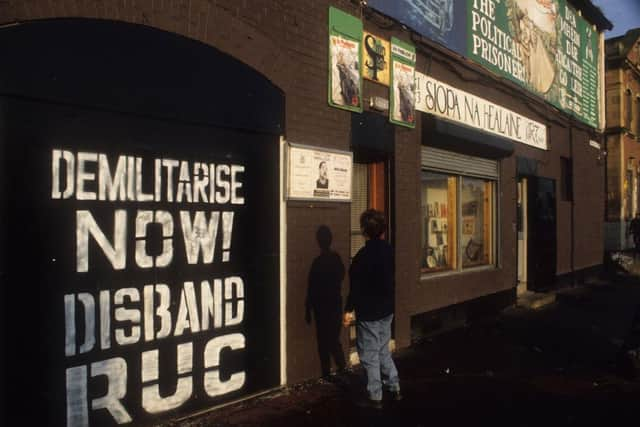
“A number of nationalists expected it to be a massacre of the RUC, but what we were tasked to do was to make proposals for a broadly acceptable police force.
"Bear in mind that some 60 per cent of the people thought they already had a perfectly acceptable police force and you had to take that into account too. Then there was the question of the morale of the police and how that might be dealt with.
"Some people tried to turn us into a commission of inquiry into police behaviour which we resisted for the simple reasons that we didn’t have the power to compel witnesses to appear and that if we got involved in that would be bogged down forever.
"Also if there is a provision made in the Agreement to release prisoners, people who had committed serious crimes it didn’t strike me as very logical to say that they were let out of jail to make room for policemen to go in there.
"Our feeling was that, as far as we could, we had to draw a line. A lot of people from the unionist side said we did not give enough credit to the police and that we should have paid more of a tribute, but what we were picking up from RUC people all over the place was that Special Branch was a force within a force run by its own rules and leaving the poor old plod to pick up the pieces of animosity in the community and that this had to be dealt with.
“Republicans were very suspicious because they did not know what there were going to get out of it, especially in the early stages. One of the first submissions we got was from Sinn Fein and it was about eighty pages long.
"The first forty pages were rhetorical and quite useless but in the last forty pages a lot of sensible things were said about the organisation of policing and relations with the community.
"One of the things they had to say was that before anyone was allowed to move from the RUC to a new police force they would have to go through a period of ”lustration”. That was the phrase they used. They didn’t define it any more than that.
"It gave me the opportunity to show off my small touch of classical studies and talking about the vestal virgins in preparation for the lustral gains, which were held every five years when they had to be purified.
"It was an interesting sophistication and the last place you would expect to see it. I think it was a term that came from some of the South American liberation stuff.
“But there were a few of them who wouldn’t be satisfied until every policeman was hung from a lamppost. I remember senior republicans saying to me after we published the report, we can’t take this because you have left Ronnie Flanagan in place and I said to them did it ever strike you how much easier the whole thing would be if you had a police mutiny?
"But they changed their tune after that and they stopped making attacks on Flanagan. Interestingly enough the SDLP didn’t.
UNIONISM
“One of the things the unionists particularly objected to was a proposed quota for recruitment. However, one of the first people to suggest something like that was Ken Maginnis.
"That said, I think Trimble had taken his eye of the ball a bit. He thought that Ken Maginnis was watching it for him and he wasn’t. I recall going to brief Trimble about half way through the process and we knew he would be edgy about the name and the badge and the uniform; the ‘sacramentals’ if you like.
"I said this is where we are and this is the sort of stuff we are hearing. It’s not going to be widespread disbandment, or denigration, of the RUC but it is going to be changed.
“I think Trimble felt they had to win something out of the whole thing but one of the problems David had was that he didn’t realize how good a deal he had got in the Agreement.
"He got the principle of consent, the repeal, or the alteration, of the claim on the Irish constitution which had been galling unionists for fifty or sixty years, and he had got them by and large to lay down the guns.
"Instead of apologising for the Agreement he should have got out and sold it a bit more. He was a courageous fellow to go as far as he did but I thought that was a lack of judgement on his part. And then I think he thought he could maybe salvage something by getting back ‘our’ police force, as he would have seen it”.
“We had to ask ourselves what would need to happen for young working-class Catholics, republicans and Protestants to join it the police, and it was quite clear that hardly any of them would join anything with the name RUC on it.
"That very few would want to join with the cap badge or uniform unchanged, so there was no point in saying you could leave it as it was. But there was game playing on this. I think Mandelson thought he could throw a lifeline to Trimble on it.
"I had an awful row with Mandelson saying I had not wasted twelve months going around the place to simply reiterate what was in the Police Bill. No doubt too they were against the Policing Board and the powers and independence of that Board.
SEPTEMBER 1999
In the end we did the report in about a year and, as said, finalised it in London. We could have reported then but I said Ronnie Flanagan is not going to thank us for dropping that on his desk in the run-up to the 12th and it’s not going to do us any good either if we produce the report that is then going to be trotted out on every Orange platform on the 12th July so we didn’t release it until September. One thing that I think was a terrible tragedy was that they messed around with the police college. Today, some fifteen years after the report was released we still do not have a police college.
“Policing the Peace. The Burden of Duty” is a collection of 50 essays on policing.
Contributors share their lived experiences with essays from victims and survivors, police officers, journalists, members and staff at the Policing Board and local partnerships, oversight agencies, rights advocates, government officials, community activists and from America and Canada.
The collection will be published at policingthepeace.com on a rolling basis over the coming days.
The project was managed by Dawn Purvis, Alan McFarland and Alex Attwood, each former MLAs and members of the NI Policing Board, and Richard Buchanan secretary to the 1st NI Parades Commission.
l Professor Graham Spencer is Emeritus Professor at Portsmouth University, and interviewed Mr Hayes in 2015. The late Mr Hayes was a member of the Independent Commission on Policing for Northern Ireland.