
Public meeting hears of opposition to Irish language school in east Belfast
Opposition has been voiced to an Irish language school in east Belfast at a public meeting.
One of the attendees, loyalist activist Moore Holmes, said about 350-plus people had been present.
A statement afterwards said there is a lack of demand for the school in the area, and that it is taking away space that’s meant to be for commercial business.
The News Letter has contacted Linda Ervine, who is behind the project, but she said she is not giving any statements.
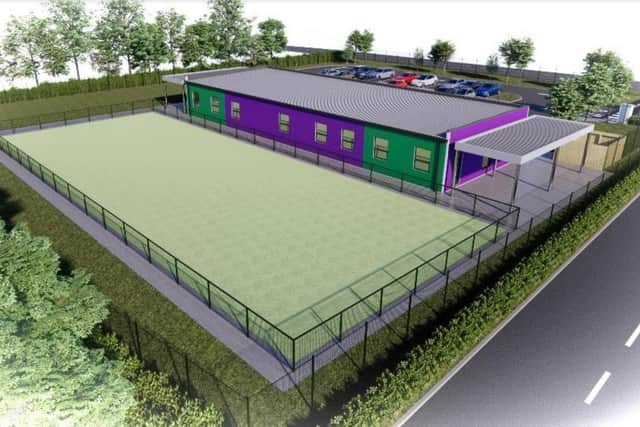

The gathering at Clonduff Community Centre last night concerned plans which have already been given “temporary” permission by Belfast City Council.
The permission was granted last month, lasting three years.
The applicant is listed as Bunscoil na Seolta, which gives 84 Glenmachan Road as its address – the address of Garnerville Presbyterian Church.
The site is 44 Montgomery Road, next to a police station.
The empty land had been set aside by the council specifically for business purposes, but this zoning was set aside by the council when it approved the school plans.
Although the plans are “temporary”, the blueprints involved the construction of a school building and playground.
A Facebook page called Clonduff Community posted up a message on behalf of “Clonduff Concerned Residents” following last night’s meeting.
-
‘THIS IS MEANT TO BE FOR BUSINESSES ONLY’
At a council meeting in June, Ms Ervine said that some 17,000 leaflets had been distributed around east Belfast about the project, and that there had been “over 200 expressions of interest from parents in the local area” (with some 60 or so children to start in September).
But the post from the residents group complained that residents in the surrounding Clonduff area had been left out.
Given this, the meeting had been arranged “to allow people in the area to voice their views on the proposal”, and “the fact that hundreds of people from Clonduff and beyond turned out in the rain to have their voice heard demonstrates the inexcusable and unjustifiable lack of engagement with the local community thus far”.
It continued: “Irish language is clearly a politically-sensitive issue and the failure to properly consult with local residents has undoubtedly angered many people within the area.
"No-one in the room this evening was against education and if people want to learn or speak Irish then they are entitled to do so.
“The concerns of people this evening were mostly about the lack of local community need or desire for an Irish language school on the proposed site, which is meant to be preserved for business purposes that will materially benefit the local area."
It added that “there have also been multiple school closures in east Belfast over the past number of years, not least Cregagh pre-school which has been forced to close this year due to lack of funding”.
It ended by saying “this is just the first step in a process of speaking out for the material needs of our community and challenging the unfair prioritisation of political projects over local community needs and services”.
-
‘IRISH HAS BEEN WEAPONISED’
Moore Holmes gave the News Letter his impression of the mood at the meeting.
“One female English teacher outlined the need for better English literacy and literature skills for children in the area, arguing that learning the Irish language would not be advantageous in the real world and should not prioritised in the area,” he said.
“Another person wanted to hear from the organisers of the school. They wanted to ask where applicants for the school were coming from, giving the lack of desire or need for Irish in the immediate area.
"Unfortunately, representatives from the school declined an invitation to attend.
“The most common criticism of the school was focused on how the Irish language has been heavily politicised in Northern Ireland.
"It has been weaponised by others who seek to advance Irish identity and culture into areas that do not identify with it and do not want or support it.
"It was claimed repeatedly that if people wanted an Irish school, that every right to pursue one, but it would best served in an area that had a demonstrable need for it and local community support.”
-
WHAT IS THE LEVEL OF DEMAND FOR IRISH?
The council district in which the school would stand is a largely-Protestant one called Lisnasharragh, taking in much of south-east Belfast.
According to the 2021 census, some 10% of people in the district of Lisnasharragh said they had "some ability" in the Irish language (about the same as said they had "some ability" in Ulster-Scots).
However, it is highly likely that the number who actually use Irish day-to-day in the district is far, far smaller.
For example, the census showed that across the whole of Northern Ireland 12% of people claimed to have "some ability" in Irish.
But when asked if they spoke Irish daily (which could be interpreted as meaning a single colloquial Irish expression), only 2.4% of people said they did.
And when asked if Irish was their "main language", a mere 0.32% of people said it was.
No figures on the use of Irish as a main language are readily available for Lisnasharragh district specifically.
But since its proportion of residents with "some ability" in Irish is below the Northern Irish average, you would expect the figure to be smaller than 0.32%.