
Sean case latest: PSNI deputy chief praises 'integrity' of falsely-maligned police unit - but says staff survey still going ahead
The deputy chief of the PSNI has addressed the collapse of allegations of sectarianism against the PSNI’s Tactical Support Group – known as the ‘Sean’ saga.
Bobby Singleton was speaking at the latest meeting of the Policing Board today.
He faced zero questions on the issue from anyone on the board during a session that lasted two hours and 15 minutes.
It was the first meeting of the board since the News Letter revealed that ‘Sean’ – the anonymous former officer who alleged sectarian behaviour in the police – had confessed to making all his claims up.
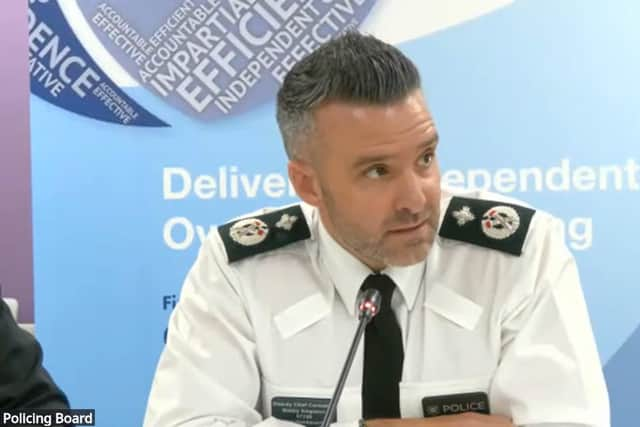

When the sectarian claims were first published back in March, Mr Singleton had said such behaviour is “disgraceful and has no place whatsoever in the PSNI... [I] accept that there have been instances where the biases and prejudice that exist within our society have manifest in our workplace".
The chief constable Jon Boutcher later went on to say he was “absolutely satisfied” that Sean had not suffered sectarianism, but went on to praise Sean’s “exemplary” background and “decent, decent” character – adding that an anonymous staff survey was going to be carried out to uncover sectarianism, sexism, racism, etc, within the police.
Mr Singleton was speaking today in the absence of the chief constable, who is out of the country.
He told the board: "Sean's claims understandably caused great public concern. The type of behaviour that was alleged was, as I said at the time, absolutely disgraceful and not reflective of our culture.
"The claims caused great distress too to many in the organisation, but in particular, to those who were closest to the claims and the officer himself.
"And since the last board meeting Sean has of course now unequivocally retracted his allegations. He's acknowledged that they were unfounded and he's expressed deep regret for the distress that's been caused.
"I'm relieved that Sean has done this and I think, to be honest, it's the best possible outcome for everybody including Sean himself.
"I want to place on record my own as well as the chief constable's appreciation for the professionalism, the integrity and the dignity that was displayed by Sean's serving and his retired colleagues from the 012, or the black TSG as they're known throughout this entire incident.
"We're also really grateful to them for their continued contact and support to Sean. And Sean has now asked for privacy and we would ask today that that's respected.
"I want to take the opportunity, however, to reassure the board that we're in no way complacent or defensive about the potential for wrongdoing or poor behaviour within our workplace.
"As we've told you previously in line with our commitments to be workforce focused under the policing plan we are actively developing a deep dive survey that will allow us to better evidence culture within the organisation and hopefully provide you and the public with reassurance.
"In the last two months as well, the chief constable has personally convened four fast track special case misconduct hearings.
"Three of these hearings were in respect of inappropriate material on private WhatsApp groups, discovered as part of a Police Ombudsman investigation, and a further hearing related to substance misuse.
"All four officers were dismissed by the chief constable – a strong demonstration, I feel, that we remain absolutely committed to maintaining the highest standards in policing and speeding up misconduct processes.”
At one point in the meeting, DUP MLA Keith Buchanan said “the recent Supreme Court ruling on the definition of a male and female”.
This refers to the findings of the UK’s highest court in April that, for the purposes of the Equality Act 2010, “woman” means someone who is actually biologically a woman, not someone who merely “identifies” as such (with the same applying for men).
It basically means that only people who were born female can use women’s toilets, and vice-versa for males.
"Surprisingly it took a Supreme Court to find that,” said Mr Buchanan.
"Most people at P1 or P2 had that worked out – but we'll leave that there. So my question is: what implications will that have on the PSNI, that court ruling?”
Mr Singleton said: “In terms of the operational impacts, it will certainly impact in terms of how we approach strip search, stop and search, in addition to many other aspects of PSNI policy in regard to gender determination.
"We as I say, aren't alone in terms of having to grapple with the findings of the Supreme Court. We're assessed by a National Police Chiefs' Council coordination group which has been established.
"The first meeting of that group was held back on the 30th of April and PSNI continue to be represented at the meeting.
"An internal working group has been established under Assistant Chief Constable Anthony McNally... [who is] assessing the cross-cutting impacts of this for PSNI and will develop any required adjustments to our policies and processes.”
He said the working group “has a broad representation of officers and staff from across PSNI and does include staff association representatives as well”.
Staff associations are networks within the PSNI such as the National LGBT+ Police Network – which takes a pro-transgenderism stance.