
'Sorry state of affairs' - MP blasts Equality Commission's legal bid over the definition of a woman
The Equality Commission’s attempt to get the High Court to clarify if the definition of a woman in Northern Ireland differs from the rest of the country is “a sorry state of affairs”, Jim Allister has said.
The TUV MP was responding to an announcement this week from the equality watchdog that it has formally applied for leave to apply for judicial review – the latest step in a protracted process to seek “clarity” on the law.
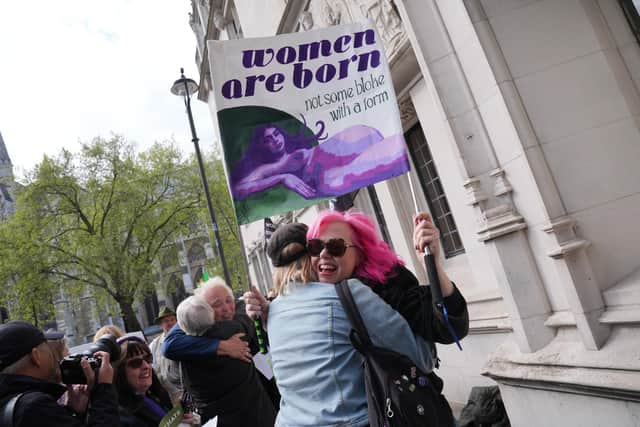

It follows a landmark ruling by the UK Supreme Court in April which stated that terms such as ‘man’ and ‘woman’ are defined in law by biological sex, not someone’s preferred gender.
After calls by Sinn Fein and Alliance ministers for the Equality Commission (ECNI) to interpret how the ruling would impact Northern Ireland, the public body dodged giving its own view – and set out a “roadmap” of steps it would take, leading to asking the courts to clarify the law.
DUP ministers in the Executive said this was not necessary – and called for the Supreme Court ruling to be followed. Citing the judgement, education minister Paul Givan wrote to the Education Authority telling to scrap transgender guidance in schools – and requiring sports, toilets and changing facilities to be segregated by biological sex.
Mr Givan’s department also told ECNI it would not assist or encourage the “improper” legal action. For Women Scotland – the group which took the original case – said there is nothing in the EU law applicable under the Windsor Framework which would “make any difference to the interpretation and application” of the UK court ruling.
However, ECNI has pressed ahead. This week, its Chief Commissioner Geraldine McGahey said that “by seeking clarification from the Court at this stage, we aim to avoid prolonged periods of litigation once we provide our advice”.
TUV leader Jim Allister rejected the commission’s view, telling the News Letter: “It is clear the Equality Commission is trying every trick to avoid the plain finding of the Supreme Court on the primacy of biological sex in determining rights.
“Hence, its attempt to try and obtain a High Court ruling that Article 2 of the Windsor Framework has superiority over our own UK Supreme Court. Any such declaration would again underscore the constitutional vandalism wrought by the Windsor Framework.
“It is a sorry state of affairs when the so called Equality Commission sees its priority as upholding EU diktat over the Supreme Court’s emphatic finding”.
ECNI argues that the requirements of the Windsor Framework may mean that terms like ‘man’ and ‘woman’ may have a different meaning in Northern Ireland than in the rest of the UK.
Maya Forstater, CEO of human rights group Sex Matters, earlier this year rejected ECNI’s position that the Windsor Framework creates “a more ambiguous and uncertain picture” about the meaning of sex in Belfast than in Birmingham.
She said: “We say that, on the contrary, any interpretation of the law that leads to an ‘ambiguous and uncertain’ position with regards to the protection of women (and men) against sex discrimination would itself be a diminution of rights contrary to the Windsor Framework. The For Women Scotland judgment protects everyone’s rights and should be applied clearly and simply across the UK”.