
Starmer rows back from pledge to back Union - saying government is an 'honest broker'
Sir Keir Starmer has declined to repeat his previous assertion that he would campaign for Northern Ireland to stay within the UK if a border poll was called – instead he says the role of the government is that of “the honest broker”.
His comments appear to show the new UK government taking a much more neutral position on the Union than has been in the case under previous Tory administrations.
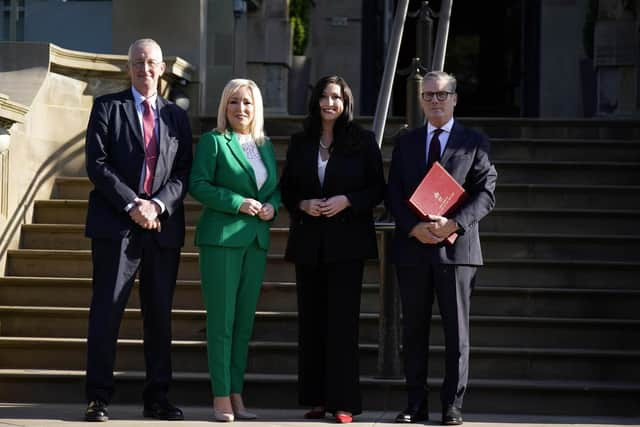

The new prime minister was asked by the BBC about comments he made in the past in which he said he would campaign for Northern Ireland to remain part of the UK if a border poll was held in his lifetime – and whether he is a unionist at heart.
Sir Keir did not repeat his past view that he would campaign for Northern Ireland’s place in the Union.
He said: “This is provided for by the Good Friday Agreement, the framework is set out and I am absolutely committed to the Good Friday Agreement.
“Today is a recommitment to that and to the approach and the role of the UK government in that as the honest broker.
“I am the prime minister for the whole of the UK, elected into office just a few days ago.
“But to reaffirm the importance of the principles of the Good Friday Agreement is part and parcel of why I am here today.”
His remarks came as Sinn Fein president Mary Lou McDonald repeated her prediction that there would be a border poll by 2030, adding the issue of Irish reunification has “has never been more alive”.
She said she used her meeting yesterday to urge Sir Keir not to “bury his head in the sand” on the question of Irish unity.
The Sinn Fein president has used the general election results – in which her party retained seven out of Northern Ireland’s 18 Westminster seats – as an opportunity to claim that the new PM must “embrace the right of Irish self-determination and constitutional change toward Irish reunification”.
However, DUP leader Gavin Robinson said there was no mood in Northern Ireland for engaging in a “never ending, repetitive psychodrama” about a border poll.
The East Belfast MP laughed when Ms McDonald’s belief that a border poll will happen by 2030 was put to him.
He said: “We have heard plenty like that before and we’re still waiting.”
Mr Robinson added: “Keir Starmer is a unionist, Keir Starmer is somebody who has indicated a border poll is not on the horizon.
“Anybody who studies the outcome of the election on Thursday will see that the combined unionist vote still outstrips the combined nationalist vote.
“There is no mood for constitutional change, but more than that, there is no mood for engaging in this never ending, repetitive psychodrama when it is not where the people are.”
The 1998 Good Friday Agreement sets out that the current Northern Ireland secretary can call a border poll when he or she believes a majority of people in the province support a change to the constitutional status.
Sir Keir has previously stated that the issue of a united Ireland is not on his horizon and at the weekend the new Northern Ireland Secretary Hilary Benn said he believed the prospect of a vote on Irish unity is “off into the distance”.
At the weekend, Irish Prime Minister Simon Harris said the question of a referendum does not “arise currently”.
The taoiseach said it was more important for the new UK government to work with Ireland in supporting the power-sharing arrangements at Stormont.
He said: “The fact that we have different views on the constitutional future of Northern Ireland is not earth shattering news.
“And actually it’s because we have differences in relation to the constitutional question that we must find practical ways of working together.
“The Good Friday Agreement allows us both have those legitimate, differing aspirations, and there’s a structure in place to address that.
“For me, though, the focus and priority isn’t on a referendum, the focus on priority has to be on delivery.”
After the general election, nationalists hold one more seat than unionists with Sinn Fein becoming the largest party with seven seats. Unionism moved ahead of nationalism in terms of total votes cast.