
Stormont backs continued trade barriers within the UK - despite unionist MLAs unanimously rejecting the Windsor Framework
Unionism put on a united front in the assembly on Tuesday, in opposition to the continuation of the current Irish Sea border arrangements – with MLAs branding the vote “rigged” as cross-community voting was set aside.
MLAs voted 48-36 to continue with the controversial post-Brexit trade arrangements – which don’t have the support of any elected representatives from one side of the political divide in Northern Ireland.
An endorsement of the Windsor Framework at Stormont was always inevitable, as Sinn Fein, Alliance and the SDLP have expressed their support for the Tory-EU deal.
However, unionists displayed a rare unity on the matter – with all parties opposing the current arrangements and backing mutual enforcement as an alternative.
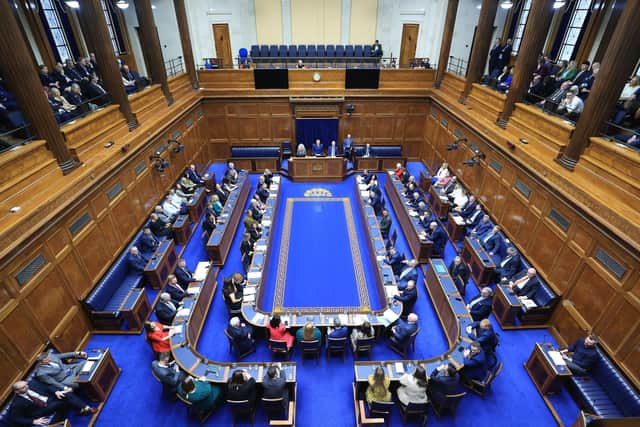

Deputy First Minister Emma Little-Pengelly said it had provided an opportunity for unionism “to unite and to send a very clear message to London and to the EU” about the continued application of the protocol.
Party colleague Jonathan Buckley said it was a “rigged vote” and an “illusion of democracy” as the European Union already knew what the outcome would be – and said Brussels would not allow it to happen unless it knew who would win.
He said it was a “zombie assembly” as MLAs prepared to hand over powers on decisions to others – and said unionists had been “humiliated” and discriminated against by the way Brexit had been handled.
The Upper Bann MLA quoted the late Lord Trimble – an architect of the Belfast Agreement – who said the protocol “amounts to a seismic change in the constitutional position of Northern Ireland. The central pillar of the agreement is the principle of democratic consent to any change in the constitutional arrangements of Northern Ireland”.
Accusing the Alliance Party of cherry-picking the agreement, he said: “If Brussels was to self-identify as a plug, the Alliance spokesperson Mr Tennyson at the Windsor Framework committee would self-identify as an EU adapter.”
TUV MLA Timothy Gaston said the vote had been “gerrymandered”. He added that he found himself in an “odd position” – as part of “a minority arguing for the fundamentals of the Belfast Agreement, arguing that its protections for minorities should continue to apply”.
The North Antrim MLA added: “In another sense, I find myself validated because I and my party have always argued that the supposed guarantees of the Belfast Agreement were always a sham.”
Sinn Fein’s Philip McGuigan, who brought the motion to the assembly as the DUP wouldn’t sign it off in the Executive Office, said that Northern Ireland had benefited from ‘dual market access’.
Mr Buckley said that dual market access is a myth – and trade divergence is a reality. He pointed to an admission by Invest NI officials that there hasn’t been any foreign direct investment relating to ‘dual market access’ under the Windsor Framework.
During the debate, a furious Naomi Long objected to DUP MLA Diane Dodds, who questioned the legitimacy of the vote. The Alliance leader raised a point of order, claiming that the Upper Bann MLA was challenging the authority of the speaker.
Mrs Dodds also raised parts of the deal which the Stormont vote wasn’t covering – warning MLAs “should not be blind to the far reaching impact of article two”.
The former MEP said: “The courts and the rights industry have taken an expansive approach to this article and the interpretation of the no diminution of rights race and this is constrained the government in legislating for Northern Ireland and such fundamental issues as immigration. It is an area of influence of the protocol that is set to grow and grow in its impact on our daily lives.”
Ulster Unionist Party MLA Steve Aiken said he had sympathy with the argument that the framework undermined the United Kingdom.
However, he said the “real reason” MLAs should be voting no was because the sections of the framework being debated “fundamentally undermine the competitiveness of our economy”.
“They work against our customers, our farmers, our hospitality sector, our green targets, and even our livestock and domestic animals,” he said.
“These articles remove this place’s role in democratic accountability.”
He added: “Supporting the retention of articles five to 10 (of the framework) shows that narrow ideology supplants the needs of our people.
“Maybe not now, but soon the electorate will realise the severe long-term implications of this vote and note who voted for the needs of the people rather than those of the EU and, may I even dare say, the British government.”
North Antrim MLA Philip McGuigan said the protocol had protected the province, but there are still concerns including the Erasmus scheme and certain trade sectors. He called for an SPS deal between the UK and EU and closer relations between the two.
The Sinn Fein MLA told the chamber: “I don’t intend to rehash the vote on Brexit but it is important to set today’s vitally important debate and vote into context. In 2016 the vast majority of citizens in the north voted to remain in the EU. They did so in the knowledge that politically and economically it is in our best interests.
“Those who say they don’t consent to the protocol seem to forget that the north never consented to Brexit in the first place.”