
Supreme Court finishes taking evidence on RE in schools
The Supreme Court today finished hearing two days of arguments from lawyers for parents who are challenging mandatory religious education in Northern Ireland controlled primary schools.
The case relates to a non-religious couple who objected to their child being part of RE and collective worship.
In May last year the Court of Appeal found that exclusively Christian RE in NI primary schools was legal.
The parents argued that excluding other worldviews breached their child’s human rights.
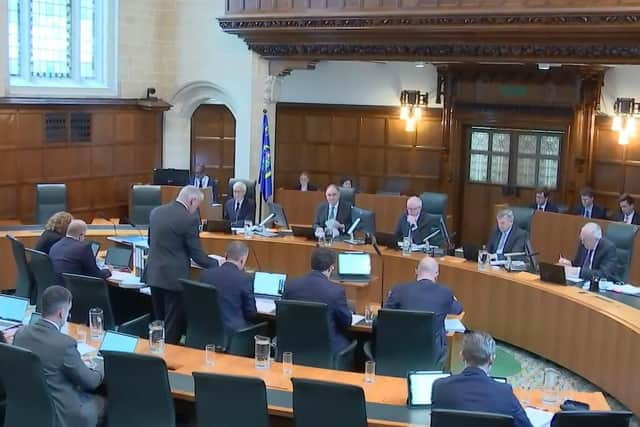

The non-religious family said they were concerned the focus on Christianity meant their child might adopt a Christian worldview, and said no meaningful alternative teaching was given at primary level.
In July 2022 a High Court judge ruled in their favour.
The Department of Education argued that the parents are able to withdraw their child from RE, and that other religions are taught - at secondary level.
While the senior judges upheld the earlier ruling that there is a lack of pluralism in the core curriculum, they said no human rights had been violated because parents had the right to withdraw their child from RE and worship – but had not done so.
Boyd Sleator, Northern Ireland Humanists Coordinator, said: "The core argument is that the [RE] curriculum is not plural, objective or critical, and that ultimately that can lead to indoctrination or proselytization," he said.
During the hearings, he said, one judge pointed out that if a school has Christian ethos, worship and curriculum, this may lead to a problem of potential indoctrination.
While it is argued that the Christian faith is taught as objective facts in school, Mr Sleator said, this case arose because the young girl "started reciting grace" at her family dinner table.
While the arguments were presented that world religions are taught in RE at secondary level, he said, at primary level the curriculum has a mainly Christian focus.
The parents are of the view that opting their child out of RE will make them feel excluded - although it was contested that there was no evidence of this.
In court, the Department of Education said that the European Court of Human Rights has never found that the human right to education was violated when parents or a pupil had an easy way to opt out without any need to explain themselves.
"And we say, when one analyzes the statute scheme that applies in Northern Ireland, that's exactly what we're dealing with," the department's lawyer argued.
This right to opt-out right existed in law from the beginning of Northern Ireland, he said, and has "anticipated, in many ways", the principles of the European Court of Human Rights today.
He noted that controlled primary schools in NI were historically run by the three main Protestant churches, but were brought under state control in the early 20th century after an agreement was reached about maintaining their Christian ethos, he said
This has been reflected in education legislation in Northern Ireland ever since, he added.
The Transferor Representatives’ Council (TRC), which represents the Church of Ireland, Presbyterian and Methodist Churchs, made a submission affirming the same point. TRC Chairman Dr Andy Brown said it has been lobbying hard for world religions to be taught in primary schools in a similar manner as in secondary schools.
The court will publish a judgment in due course.