
Timothy Gaston criticises government forms which let people identify as 'neither gender'
Timothy Gaston has criticsed the fact that people can identify themselves as being neither male nor female on government forms.
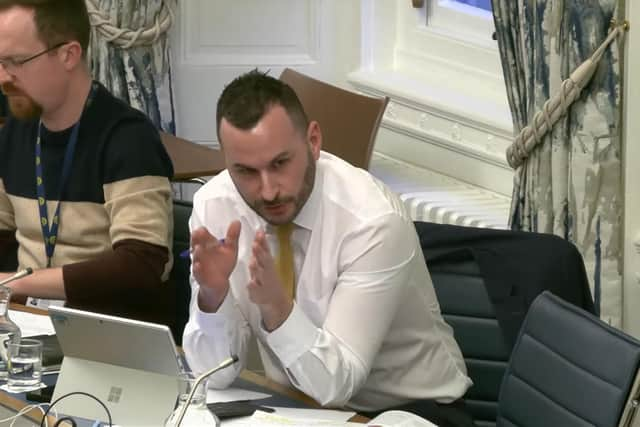
The TUV MLA made the comments in Stormont during a discussion about domestic violence.
In an exchange with officials from The Executive Office (TEO), he was told that three categories of gender were recognised on the forms, with the civil servants saying they were just following the advice of statistics experts about what should be on them.
The session of the Executive Office Committee had focused on money which is parcelled out by TEO to groups so they can run things like courses about domestic violence.

It appears that feedback forms are then filled in afterwards with boxes to tick detailing whether those taking were “men, women, or neither” – with the additional option of “I would rather not say”.
Mr Gaston asked: “What is ‘neither’? Biology dictates you're a man or a woman. So what is ‘neither’?”
An official replied that this is “the recommendation from the statisticians”.
Mr Gaston said: “You can’t tell me what ‘neither’ is?”
At that point committee chairwoman Paula Bradshaw, with whom Mr Gaston has repeatedly clashed over trans matters, interjected to say: “They've explained why.
"People will complete these forms themselves, so it's how they will identify.”
Mr Gaston has now said: “My colleague councillor Ron McDowell previously exposed the fact that money from this much-publicised scheme to combat the scourge of violence against females is going to groups including transgender women in Belfast – that is, biological men.
"After Wednesday’s meeting, we now know that funding is being distributed province-wide on the basis that recipients are classified not into two genders but into three: men, women and ‘neither’. People are also given the option to say they would rather not state their gender.”
He questioned why TEO, jointly run by the DUP and Sinn Fein, permits this, and added: “I have today submitted a series of questions to all Executive ministers asking how data collected by their departments and arm’s-length bodies is broken down by gender, specifying each category used, outlining the definitions applied to each category, and stating whether each category is recorded on the basis of biological sex or self-identified gender.
“This is a matter of considerable concern to the public – particularly when it comes to a scheme which is specifically designed to tackle the issue of violence against women and girls.
"If Stormont cannot even define what ‘neither’ means in a gender category, how can the public have confidence that a scheme designed to protect women and girls is actually being targeted at women and girls?”
The Executive Office was invited to respond, but no reply had been forthcoming at time of writing.
The News Letter has previously reported on the fact the civil service advises its staff to be aware that some people now identify as genders including “gender-queer, gender-fluid, non-binary, gender-variant, crossdresser, genderless, agender, nongender, third gender, two-spirit, bi-gender, trans man, trans woman, trans masculine, trans feminine, and neutrois”, and to accept their preferred names and pronouns accordingly.