
Toxic blue green algae: Hillsborough Forest Park latest public facility to be hit by warnings
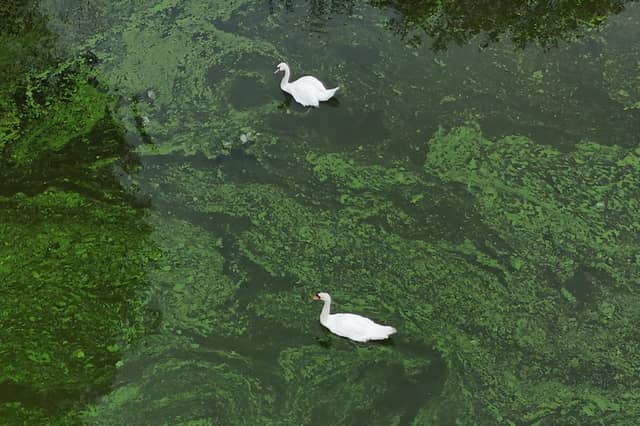

The lake in Hillsborough Forest has become the latest waterway hit by toxic blue-green algae – with warning signs having been erected in recent days.
A local councillor said that people should avoid entering the water, eating fish from the lake, or allowing their dogs to enter the water.
Noxious blooms of blue-green algae have covered large parts of Lough Neagh during the past two summers and once again this yea, and also affected other waterways and beaches.
A spokesperson for Lisburn & Castlereagh Council said: “We placed signage in Hillsborough Forest on Friday June 20 to advise of the presence of blue-green algae in the lake.

“This algae is known to be toxic and thrives in warm water. Its growth is significantly enhanced by warmer temperatures as it multiplies and form blooms, which can be harmful to humans and animals.”
DUP alderman Allan Ewart told the News Letter that the algae has been found occasionally in the lake for several years.
“We don't know really where it's coming from,” he said of the pollution normally behind it.
“But I think it's better that we warn the public to be careful, rather than just let it go and then find it causes a problem.
“You don't like to disrupt people's pleasure, but if it's toxic, you're better off warning people.”
The News Letter asked the council where the pollution might be coming from that is causing the algae, as the lake is surrounded by forest. However, it had not responded at the time of going to press.
Meanwhile, Newry Mourne and Down District Council told the News Letter that algae warning signs that had been in place at Castlewellan lake in April have since been removed as there is no evidence of algae at present.
The Department of Agriculture was invited to comment but had not done so at the time of going to press.
Nitrogen and phosphorus from agricultural fertiliser running off fields and from wastewater treatment is a contributory factor in the blue-green algae blooms.
Climate change is another factor cited, with rising water temperatures.
The Stormont Executive last year launched an action plan to deal with the environmental crisis.
The Department of Agriculture says algae has already been confirmed after 24 reports this year.
Following are the main reports starting with the most recent: Upper Lough Macnean (Fermanagh and Omagh), Black Glen Lake (Castlerock), Lough Neagh/Scaddy Island (Mid Ulster), Lower Lough Erne – Tully Castle, Portmore Lough, (Armagh, Banbridge and Craigavon), Lower Bann – Seatons Marina, Craigavon lakes, Lough Aghery (Lisburn and Castlereagh), Lough Neagh – Curran's Quay (Mid Ulster), Lough Neagh – White Horse Flats (Antrim and Newtownabbey), Ballysaggart Lough (Mid Ulster), Lough Neagh – Traad point (Mid Ulster) and Martray Lough, Ballygawley (Mid Ulster).
A Spokesperson for the Department of Agriculture responded that the Northern Ireland Environment (NIEA) confirmed the presence of blue green algae at Hillsborough Lake on 17 June 2025. No confirmed reports have been received in relation to Castlewellan Lake.
"The Department published an Inter-Agency (IA) Blue Green Algae Monitoring Protocol in May 2024 which details the department’s response protocol for surveillance and monitoring for blue green algae and also outlines the bathing water monitoring protocol.
"NIEA uploads all notifications to the DAERA Blue-Green Algae Confirmed Locations web viewer Blue-Green Algae - Confirmed Locations on a weekly basis. Where a location has been confirmed, landowners or bodies with site management roles are advised as soon as possible, and have responsibility for warning and advising users of any potential dangers from the presence of blue green algae which can include the erection of signs and restricting access.
" They are also responsible for deciding when restrictions can be removed. More information is available at Blue-Green Algae - Roles and Responsibilities | Department of Agriculture, Environment and Rural Affairs.
"Members of the public are encouraged to take personal responsibility for themselves, their children and pets, and heed any signage at water bodies regarding risks of blue-green algae or specific signs with ‘advice against bathing’.
"Algal blooms are often associated with warmer conditions coupled with longer day light hours, hence their appearance in spring and summer months. Algal blooms occur naturally due to the combination of factors such as water temperature, water clarity, sunlight and nutrient availability.
"However, excess nutrients primarily from agricultural land use activities and from waste water pressures, can compound blooms and lead to the growth of blue-green algae.
“NIEA encourages members of the public to report a suspected bloom through the Bloomin’ Algae App or e-mail [email protected] with a photo, if possible, and details on the location of the potential bloom.“