
UK-EU deal: Allister says the government is talking 'nonsense' on EU customs declarations for Northern Ireland
The government’s inability to be clear about the impact of its new deal on EU customs declarations is “nonsense” – and Northern Ireland will still be subject to Brussels rules, Jim Allister has said.
Customs declarations will be required for goods covered by the government’s deal with the EU, however the secretary of state has appeared to suggest that they won’t.
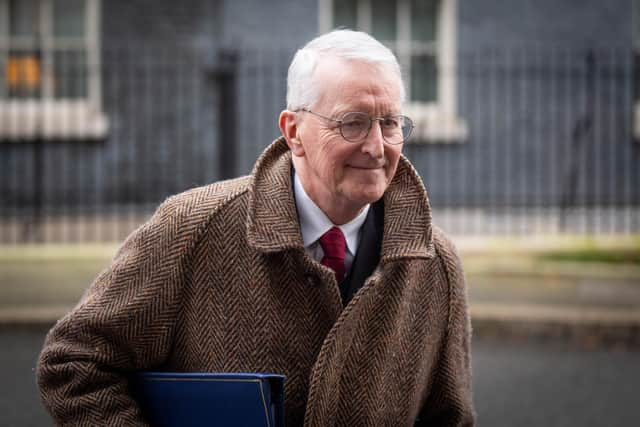

The prime minister has also dodged answering the question directly after being challenged on the matter in the House of Commons by TUV leader Mr Allister.
On Monday, the UK and EU signed a deal which will mean the UK follows EU rules on plants, food and drink – removing paperwork for businesses in Great Britain selling into the EU, and by extension Northern Ireland.
However, the Windsor Framework remains intact, and there is no suggestion that it will disapply its customs rules for GB trade into Northern Ireland.
That means while there will be a significant reduction in Irish Sea border bureaucracy, Northern Ireland is still treated as part of the EU’s customs territory, and customs declarations will apply.
New Windsor Framework customs arrangements introduced on May 1 will remain in place in future, in addition to the arrangements agreed in the SPS deal.
Mr Allister has criticised the government for not being clear on what its deal with Brussels will mean for custom requirements on goods coming into Northern Ireland from the rest of the country.
The North Antrim MP told the News Letter: “Their unwillingness to clarify the deal’s impact on customs is nonsense.
“Despite the new agreement, Northern Ireland continues to be subject to the EU Customs Code, with no reduction in customs procedures or paperwork.
“The deal does not alter the status quo for non-food goods moving from Great Britain to Northern Ireland, leaving existing trade barriers intact. When it comes to food goods they remain subject to the customs paperwork.
“This agreement does not restore Northern Ireland’s full place within the United Kingdom. Instead, it reinforces our position as a de facto EU territory, undermining the sovereignty promised by Brexit.
“Tellingly, this deal was not between the UK and the EU but between Great Britain and the EU – confirmation in and of itself of the magnitude of the sell out and that Northern Ireland is to a large extent already regarded as EU territory.”
Speaking to the BBC yesterday, NI Secretary Hilary Benn said customs paperwork would continue to exist “for goods not covered by the SPS agreement”.
Pressed on the matter by presenter Chris Buckler, about whether there would be no customs declarations on agri-food products, Mr Benn avoided the question. He said “no longer will you need paperwork” for goods being moved back and forward for processing.
Mr Benn said: “There was a fundamental problem when we left the European Union, and it was this, you have the United Kingdom with one set of rules. You have its biggest trading partner, the European Union, with another set of rules. And in Ireland, we have an open border.
“Now there's nowhere else in the world where such a situation arose. And the question was, how do you manage it? How do you deal with it? Because just as we have a right to ensure that goods that come into the United Kingdom meet our rules – the EU has the same right to ensure that goods coming into its jurisdiction meet their rules.
“And that is what the Windsor Framework was put in place to deal with. But we've seen a significant easing of the need to fill in customs paperwork for the other things that aren't covered by the SPS deal that we've agreed.”
Mr Buckler asked: “So customs paperwork will still exist, won't it?”
The Labour minister said: “For goods not covered by the SPS agreement, that is correct. On the first of May, the number of lines you have to fill in has gone down from 75 to 21. Many of those can be pre populated, because if you're selling the same stuff across the Irish Sea on a regular basis, the form will come up, you put the stuff in. So it's made it easier for that process to take place.”
Asked again if he was saying there would be no customs declarations for agri-food, Mr Benn said: “For agri-food, that will mean that will move without the need for SPS paperwork. There will be no mandatory checks. There will be no need for plant health labels, no bans on high risk plants, no bans on chilled and frozen meats. No more paperwork. This is really important for agri-food products that go back and forth for processing. No longer will you need paperwork to move it back and forth until you produce your final product for sale to market.
“That is why the businesses that know about this, including the supermarkets, have all given the deal that was reached yesterday, such a warm welcome, and I will judge the deal by what they say,” he said.
• Morning View, page 14