
UK-Irish accord 'overlooks the fact Dublin is shirking its responsibilities on the legacy of the Troubles' says Jim Allister
A major accord struck between London and Dublin overlooks the fact the Irish state is “shirking its responsibilities” on the legacy of the Troubles, says Jim Allister.
He was reacting to the outcome of a summit between Prime Minister Keir Starmer and taoiseach Micheal Martin – a meeting which was billed as “resetting” the relationship between the two countries.
The result of the meeting was a lengthy statement from the two leaders setting out ways in which the two nations can work more closely together. It included a pledge to “remove barriers to trade”.
Mr Allister said that the “obscenity” of the Irish Sea border, which has created barriers to trade between Northern Ireland and Great Britain, likewise went unaddressed by the leaders’ statement.
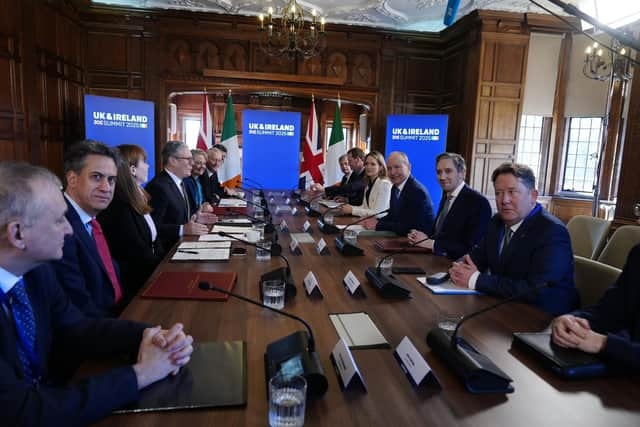

The joint UK-Irish statement set out an "ambitious programme of co-operation between our two countries through to 2030".
It said: "We will support this intensification of our co-operation on foreign and security policy issues through annual political consultations."
Their statement mentioned working together on "critical undersea infrastructure" (meaning protecting internet cables on the seabed), "military training", and "co-operation on criminal, civil and family law matters".
The statement also added: "In order to meet our ambitious decarbonisation targets, we have agreed today to work together to mobilise investment into strategic infrastructure in the Irish and Celtic Seas by establishing frameworks to guide private investment and removing barriers to trade and investment."
Other things include:
“New joint initiatives on mapping the sea basin”;
Creation of “an Economic Security Exchange to share good practices”;
Convening “regular meetings between UK Research and Innovation and Research Ireland to discuss issues of mutual interest”;
Establishing a “strategic partnership to deepen and amplify co-operation between our leading cultural institutions”;
Setting up “an Ireland-UK Youth Forum to bring together young people across these islands on an annual basis to discuss issues of importance to them”;
Encouraging “greater co-operation and contact between our schools and education systems”;
Minimising “barriers to work or travel”;
And setting up “a UK-Ireland 2030 Steering Group led by the UK Cabinet Office and Department of the Taoiseach in order to take forward the range of commitments we are making today”.
M Allister told the News Letter: “I note the absence of any commitment from Dublin on a key issue going forward – legacy.
"At the moment we have a stark example of how the Irish Republic is shirking its responsibility when it comes to this matter with the Omagh Inquiry.
"Much of what needs to be examined took place in the Irish Republic and will never be properly investigated unless or until a parallel inquiry is set up in the south.
“Of course, Omagh is but an example of a wider issue of Dublin refusing to face up to its responsibility on legacy.
"The vast majorly of terrorist offences in border areas were planned from the safety of the Republic and it was to the Irish Republic that the terrorists fled for sanctuary once their offences were carried out."
He added: “It is of course at Dublin’s insistence that there is now a hard border dividing the United Kingdom. "It would appear from this statement that both governments are interested not in addressing the obscenity of part of the UK being part of a foreign customs union and single market for goods but rather easing the flow of trade between the island of Ireland as a unit and Great Britain.”
Meanwhile DUP East Londonderry MP Gregory Campbell said that the two nations “are near neighbours” and “it is in everyone’s interests that we work constructively together” but he added: “There is a clear and ongoing need to address the legacy of the past.
"We continue to support the long-standing calls for the Republic of Ireland to hold a full inquiry into the Omagh bombing, ensuring that all aspects of this atrocity are fully investigated. Truth and justice are crucial for victims, and transparency on both sides of the border is essential to ensuring that.
"Whilst the summit was between the UK and the Republic, we continue to campaign for the Government to ensure barriers within the UK internal market are removed. Northern Ireland should be able to trade freely with the rest of the United Kingdom.”