
Unionists quiz Labour government over its Northern Ireland Troubles Act debated on second reading in House of Commons
The government is in the process of defending its Northern Ireland Troubles Bill in the House of Commons, with MPs sceptical of the bill peppering the Northern Ireland Secretary with questions.
DUP leader Gavin Robinson began the questioning of Hilary Benn, pointing out that the definition of the Troubles being used by the government – the violence between 1966 and April 10, 1998 – excludes the worst single atrocity of the Troubles: the Omagh bomb.
He said “nothing within this bill will make provisions available for those families... will he consider extending the dates to include the largest atrocity from the Troubles?”
Mr Benn replied that “there is currently a public inquiry set up by the last government into the terrible events that occurred at over and I think the right and proper thing to do is to let that inquiry proceed with its work and hopefully provide the answers that families are looking for”.
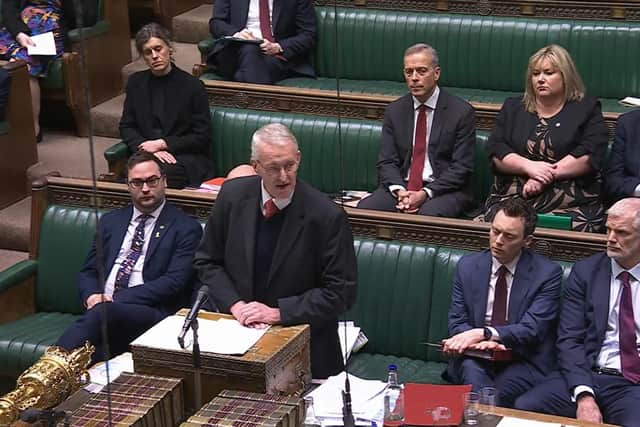

When Mr Benn went on to speak about the “six new protections for veterans” which the government has touted, he told the house that the same protections would apply to others too, like RUC officers.
At this point he was heckled, with one MP shouting: “And paramilitaries!”
This is a reference to the fact that, by the government’s own admission, many of these “protections” are going to apply to anyone giving evidence to a legacy process, and not just ex-soldiers, despite being billed as “veterans protections”.
Pressed by another MP on whether troops will still face prosecuction for “simply carrying out orders”, Mr Benn replied that decisions are taken “by prosecutors based on the evidence, and if one looks at the facts in the last 27 and-a-half years since the Good Friday Agreement, one one veteran has been convicted for a Troubles-related offence... he received a suspended sentence”.
Mr Benn went on to add that “the majority of those who had been convicted, or indeed those currently facing live prosecutions, are paramilitaries, including republicans”.
TUV leader Jim Allister asked Mr Benn what would stop a former paramilitary being appointed to the victims and survivors advisory body of the new Legacy Commission, saying there is nothing in the bill that would prevent that.
"I've told the house that anyone who was previously involved in paramilitary activity will not be appointed to the victims and survivors group,” said Mr Benn.
"I'm giving the house that assurance as the Secretary of State.”
Mr Benn went on to tell MPs: “We must be clear that terrorism is always wrong, and just as we have to recognize that while the vast majority of those who served in Northern Ireland did so with distinction and bravery, in the words of the apology offered in this house by the former Northern Ireland Secretary Brandon Lewis following the Ballymurphy inquest, he said it is clear that in some cases, security forces and the Army made terrible errors.”
He added: “I believe this legislation represents our best and possibly our final chance to fulfil the unrealised ambition of the Good Friday Agreement.
"I accept that nobody will like everything contained in the bill, and that's inevitable given the differing views held by many.
"If fixing legacy was easy, we wouldn't be discussing it 27-and-a-half years later.”
Alex Burghart, the Tory shadow Northern Ireland Secretary, told the house: “The last government chose to draw a line under the litigation of the Troubles, and today that line is being erased.
"Our Legacy Act was a response to the emerging legal reality, no less true than it was three years ago: that the legal system was ceasing to provide meaningful answers to victims whilst [putting] veterans through the courts in clearly vexatious cases.”
He said that while the High Court in Belfast had struck down the immunity in the Legacy Act, that court “is not the summit of the UK legal system and that the last Conservative government was appealing its finding, and when the Labour Party came into power in July 2024 they dropped that appeal – they have never explained why”.
He said that “the law strongly suggests that if the same logic [that applied to the Legacy Act] was applied to the peace process legislation that I've already mentioned – the Sentencing Act 1998, Decommissioning Weapons Act, the Location of Victims’ Remains Act – then all of that legislation would be deemed incompatible with the European Convention and would have to be struck down”.
DUP leader Mr Robinson went on to give his own thoughts on Labour’s Troubles stance, telling MPs “the Secretary of State has sullied himself, and this parliament, by the engagement with the Irish Republic – sullied himself!”
This was a reference to the fact that the NI Troubles Bill followed negotiations with the Irish state.
Mr Robinson went on to add “I have it on good authority that the Irish Republic have cautioned against amendments” to the bill.
“For decades, they harboured terrorists in there. They refused extradition. They supported and financed terrorism in Northern Ireland, and as the Secretary of State, put them under any pressure? No, he has not," said Mr Robinson.
At time of writing, the debate was still going on.
This is the second reading of the bill. The next stage will be the committee stage.