
Warning that Northern Ireland consumers will be 'denied full benefits' of India trade deal - which could see cheaper food and clothing
Consumers in Northern Ireland won’t feel the full benefits of a post-Brexit trade deal between the UK and India because higher EU taxes will still have to be paid here on imported goods, Jim Allister has warned.
The deal, struck by Sir Keir Starmer’s government this week, means UK import taxes will be slashed on products such as cars, food and clothing – in return for India cutting tariffs on certain UK exports such as whiskey.
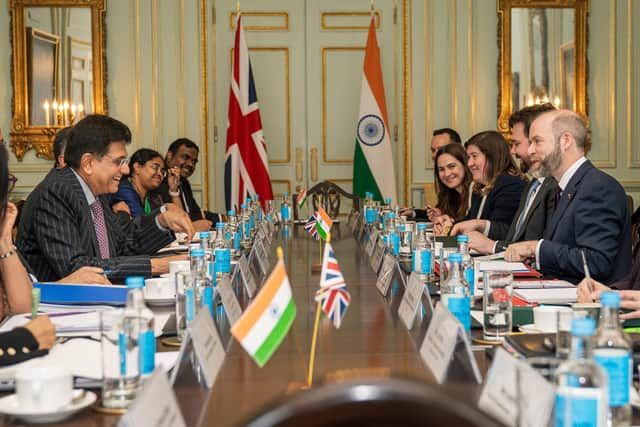

However, as the European Union remains in control of tariffs for goods entering Northern Ireland – it is likely that the full benefit of cheaper products from India will not be felt here.
Local companies will, however, benefit from improved access to the Indian market as the Windsor Framework does not inhibit Northern Irish exports.
However, the government says that Northern Ireland “could see cheaper prices and more choice on clothes, footwear, and food products”.
Trade minister Douglas Alexander confirmed this week that goods entering Northern Ireland would be subject to EU not UK tariff rates, when the deal comes into effect next year.
The TUV leader says he took the opportunity to press Mr Alexander on the status of Northern Ireland in relation to the UK’s trade deal with India.
“I put it to the Minister that the entirety of the United Kingdom will not benefit from this deal, as the UK does not control trade laws for Northern Ireland. Owing to the Protocol, Northern Ireland remains subject to EU trade law. Consequently, imports from India into Northern Ireland will be subject not to the UK’s agreed tariff, but to whatever EU tariff is in force — thereby denying Northern Ireland’s consumers the full benefits of the deal.
“While I received little in the way of solutions from the Minister, he did confirm that the situation is ‘exactly’ as I described it.
“Regrettably, no other Northern Ireland MP raised this critical issue, which starkly illustrates our semi-detached position within the United Kingdom and how we alone are being denied the opportunities that Brexit presents to the rest of the nation.”
Speaking in Westminster on Tuesday, the North Antrim MP said: “How can the Government make a trade deal for the whole of the United Kingdom if they do not control the trade laws for the whole of the United Kingdom? Northern Ireland is still under the control of EU trade laws.
“To give a practical illustration of the problem, under the UK-India trade deal any imports to Northern Ireland from India—I speak of imports, not exports—will be subject not to any agreed UK tariff but to whatever prevailing EU tariff there is on those goods, and the EU does not have a trade deal with India.
“Is this not another illustration of how Northern Ireland has been left behind by a protocol that has left us still in the EU?”
Douglas Alexander, Minister of State in the Department for Business and Trade, responded: “The Northern Ireland’s trading relationships and its status within the United Kingdom are not altered as a consequence of the Indian free trade agreement that was reached today.
“The established position is exactly as the right hon. Member describes and recognises the distinctive history and significance of the Good Friday agreement—not just in the protocol but the Windsor Framework.
“A huge amount of work has been put in by both sides of the House to try to maintain a hard-won peace in Northern Ireland, and that is not compromised by today’s agreement”, he said.
The Department for Business and Trade described the deal as a “multi-billion-pound boost to UK economy” and claimed it would “make working people better off”.
A spokesperson said the Northern Ireland economy “is to be given a boost” by the deal.
“Indian tariffs will be slashed, locking in reductions on 90% of tariff lines, with 85% of these becoming fully tariff-free within a decade.
“Whiskey and gin tariffs will be halved from 150% to 75% before reducing to 40% by year ten of the deal, while automotive tariffs will go from over 100% to 10% under a quota.
“Other goods with reduced tariffs, which can open markets and make trade cheaper for businesses and Indian consumers, include cosmetics, aerospace, lamb, medical devices, salmon, electrical machinery, soft drinks, chocolate and biscuits.
“Northern Ireland shoppers could see cheaper prices and more choice on clothes, footwear, and food products including frozen prawns as UK liberalises tariffs.
“The deal is expected to increase bilateral trade by £25.5 billion, UK GDP by £4.8 billion and wages by £2.2 billion each year in the long run.
“UK businesses gain a competitive edge over international competitors when entering India’s enormous market as it gets even bigger, forecasted to become the 3rd largest global economy within three years”, they said.