
'We are lagging behind the rest of the UK': Demands for transgender changing room guidelines to be published in Northern Ireland
A unionist politician has said that “women should not have fewer safeguards simply because they live in Northern Ireland”, as he warned the Province “lags behind” the rest of the UK on the issue.
DUP MLA Jonathan Buckley made the comments as new guidelines came into force, effectively stating that, in general, women’s changing rooms and toilets are reserved for people who were born female, not those who self-identify as such.
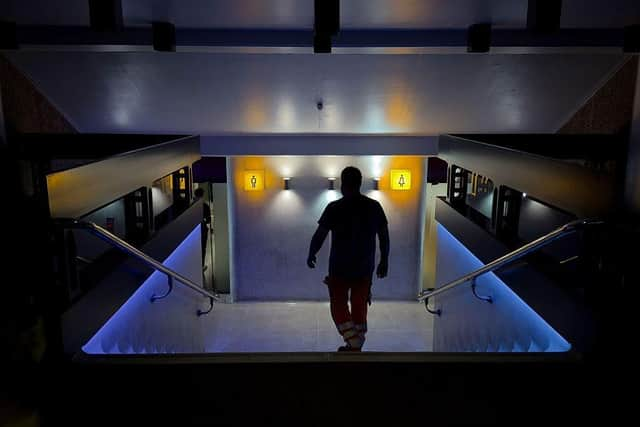

But these guidelines only apply in Great Britain.
Joining him Mr Buckley demanding that similar guidelines now be published for Northern Ireland are feminist organisations the Women’s Rights Network (WRN) and Sex Matters, while his party colleague Carla Lockhart said that the ongoing absence of these guidelines in NI damges the credibility of those responsible.
All of this stems from a landmark judgment handed down by the UK Supreme Court last April which stated that, for the purposes of the Equality Act 2010, “woman” refers to people who are actually biologically female, and does not include “trans women”, who are biologically male (and vice-versa for men).
Since then there have been demands for the authorities to spell out what exactly this means for organisations’ day-to-day activities.
That is what the guidance from the Equality and Human Rights Commission seeks to do.
Its guidance applies to England, Wales, and Scotland, but not Northern Ireland, where the Equality Commission NI is taking the lead in developing such guidance.
However the commission has yet to issue any, and the matter has become enmired in legal wranglings in Belfast’s High Court, where the WRN is taking a case to try and force the commission’s hand.
WRN and other campaigners who support the Supreme Court’s judgment say there is nothing to stop the Equality Commission publishing guidelines now, spelling out that, for example, female toilets are reserved for the use of natal females only.
The guidelines that have entered force today in GB are somewhat long and complex (even the explanatory memorandum, giving a simple outline of them, runs to 2,100 words), but the upshot is that they reinforce the 2025 Supreme Court ruling; for example, when it comes to competitive sports they state that “trans people should not be included in single-sex or separate-sex competitions for the sex with which they identify”.
Mr Buckley, who has been an outspoken critic of the transgender movement, told the News Letter he welcomes the GB guidelines – although “the fact that a Supreme Court judgment and subsequent guidance is even required on an issue so obvious as biological sex is, in itself, a ridiculous place for modern society to find itself”.
But he went on to add: “What is deeply frustrating, however, is that Northern Ireland continues to lag behind the rest of the United Kingdom.
"While England, Scotland and Wales now have clear official guidance following the Supreme Court judgment, Northern Ireland remains in a state of uncertainty.
“That is simply not good enough.
"The people of Northern Ireland deserve the same legal clarity and the same protections as everyone else in the United Kingdom.
"Organisations should not be left guessing what the law requires, and women should not have fewer safeguards simply because they live in Northern Ireland.”
He also said: “The UK Supreme Court was unequivocally clear on the meaning of sex in the Equality Act.
"Any attempt to frustrate or delay the implementation of that clarity in Northern Ireland is a rejection of common sense and an attempt to ignore the legal position established by the highest court in the land.”
Ms Lockhart meanwhile said: “Equivalent guidance to that published in Great Britain should already have been issued here.
"Public bodies, the Civil Service, councils, and other bodies deserve clarity and the public expects common sense.”
The failure to do so has “destroyed any credibility” of those responsible.
The WRN tells the News Letter it is “deeply disappointed that the Equality Commission for Northern Ireland has still failed to issue guidance”.
"More than a year after the judgment, women, employers and service providers are still being left without the clarity they need on the lawful operation of single-sex spaces and services, including toilets, changing rooms, hospital wards and intimate care,” it said.
"Instead of providing the guidance it has a statutory duty to issue, the Equality Commission has advised employers to seek their own legal advice to understand their obligations under the law.
"We urge employers and service providers to do exactly that, to ensure they are complying with the law and protecting the rights, safety and dignity of female staff and service users.
"WRN NI’s judicial review, alongside the Equality Commission’s own judicial review, are both scheduled for leave hearings in December.
"Women in Northern Ireland should not have had to wait more than a year for the clear guidance that employers, service providers and the public urgently need.
"The continued uncertainty is entirely avoidable and must now be brought to an end.”
Fiona McAnena, originally from Londonderry, is now director of campaigns for the charity Sex Matters, based in London.
“The people of Northern Ireland - and especially women and girls - are being let down by their own Equality Commission,” she said.
"Instead of issuing guidance that single-sex spaces, services and sport must be on the basis of biological sex, the Equality Commission has asked the high court to tell it how to proceed.
“Women and girls need female-only spaces, not just for privacy but for safety too.”
She said that “the relevant law in Northern Ireland is the Sex Discrimination Order (1976), which is clear that single-sex provision is lawful and appropriate”, adding that the commission “should step up and issue a strong reminder to all service-providers in Northern Ireland that any service for women must exclude all men, regardless of their claimed identity”.
The Equality Commission said: “The Supreme Court judgment in ‘For Women Scotland’ did not consider the context of the different legal obligations in Northern Ireland, in particular Article 2 of the Windsor Framework.
"While the Dillon judgment provided some clarity that Article 2(1) of the Windsor Framework may be enforced in domestic law in appropriate circumstances, it identified new uncertainties.
"The commission’s objective is to secure the greatest possible legal clarity regarding the interpretation of the judgment for everyone in NI and in particular employers and service providers who have responsibilities under the law.
"The High Court has now scheduled a date for the leave hearing, in December 2026, after which the court will decide whether the commission’s application can proceed.
"The timing of the publication of the commission’s guidance for employers, service providers and public authorities will depend on the outcome of this.
"In the meantime, interim information has been provided for employers and service providers.
"The commission is working firmly within its statutory remit and is not seeking to challenge the Supreme Court’s judgment.”