
'We're not Del boy and Rodney' - supermarket body slams Irish Sea border 'green lane' checks as lorries sent back to Scotland
Trade bodies have given a damning assessment of how the Windsor Framework’s so-called ‘green lane’ is operating – with lorries being sent back to Scotland and one supermarket having to complete “tens of thousands” of customs declarations.
MPs have also been told that supermarket chains like Tesco and M&S are being treated like wheeler-dealer sitcom characters Del Boy and Rodney – with the NI Retail Consortium (NIRC) saying its members are not trying to secretly get goods across the Irish border.

They also heard concerns about potential gaps on shelves in local supermarkets by the summer.
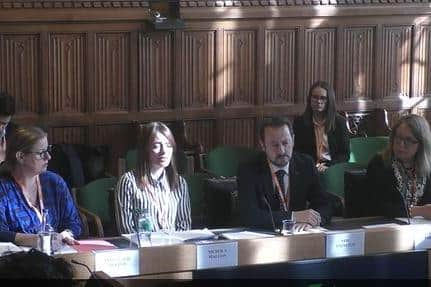
Westminster’s Northern Ireland Affairs Committee heard evidence from a range of industry bodies about how the trading arrangements are impacting their sectors.
It revealed huge levels of checks and bureaucracy in the ‘green lane’ – also known as the UK Internal Market System. The DUP claimed last year to have removed checks under this system as part of its Safeguarding the Union deal – and Gavin Robinson said “the green lane is gone”.
The arrangements were put in place after a deal between Rishi Sunak’s government and the EU in a bid to smooth the flow of trade within the UK – which is now split into two zones, with Northern Ireland remaining largely in the EU single market for goods.
The committee heard claims that the deal had been “to some extent oversold” – and that businesses still faced huge challenges, which are set to get worse at the end of the month. MPs were also told that some businesses were bypassing the supposedly simplified green lane and subjecting themselves to full EU customs checks in the red lane because it was more “predictable”.
Neil Johnston, director of the NI Retail Consortium (NIRC) said the Windsor Framework was an improvement on the NI Protocol, but trade was becoming “more and more difficult in recent times” for the supermarkets his organisation represents.
He said an “overly bureaucratic approach” was being taken by officials implementing checks at NI’s ports – describing it as “very very difficult” and a “never ending saga”.
Mr Johnston highlighted that companies including Asda, Co-op, Sainsbury’s and Iceland – who don't have stores in the Republic of Ireland – were forced to fill out a “vast amount of paperwork” despite there being no risk of goods moving into the Republic of Ireland.
The purpose of the green lane was supposed to be free movement of trade within the UK for companies selling goods in physical retail outlets.
“We are not Del Boy and Rodney. We are not trying to get our goods secretly over the border into the South”, Mr Johnston said. He said companies like Tesco have track and trace technology and should be trusted – not having to fill in vast amounts of paperwork to move goods – but that is not being seen in the trusted trader scheme operated under the Windsor Framework.
He also expressed “great concerns” about changes to the green lane coming into effect at the end of the month. “One of the supermarkets is filling in tens of thousands of customs declarations at a cost of £1.5m. If you replicate that across the sector, it's a significant burden”, he said – adding that it is “highly likely” that there will be problems for supermarkets.
He also revealed that checks under the UK internal market scheme had increased - despite political promises that they would decrease – and revealed that supermarket trucks had “been sent back to Scotland”.
Mr Johnston also said that come July “it's highly likely that there will be gaps on shelves. Household products that people are used to having on their shelves in Northern Ireland may well - I hope not, we've had this before with phase one and phase two - but there may be products that, come the end of July, that disappear”.
When the Safeguarding the Union deal between the DUP and the government was announced last year, the party’s then-deputy leader Gavin Robinson said the green lane was gone and defended the principle behind the red lane.
The East Belfast MP said the government “had provided constitutional harm, which we have repaired. They imposed friction on trade – which we have reduced”.
Asked by the BBC about whether the Irish Sea border had been removed, the East Belfast MP said: “We have always said that there should be no barrier to trade within the United Kingdom and its internal market.
“The green lane is gone. The checks that were outlined within the green lane, within the Windsor Framework, are gone. There will be no checks – physical or identity checks – on goods moving from one part of our country to another within the internal market.
“The border posts are there for the red lane. And the red lane is there for goods that are moving to, or at risk of moving to, the European Union. So we have never taken issue with that”.