
Paul Givan Resignation: Why has Paul Givan resigned as First Minister of Northern Ireland?
Paul Givan, Northern Ireland's First Minister has announced his resignation in protest at the Northern Ireland Protocol.
The First Minister of Northern Ireland, Paul Givan has resigned in protest of the Northern Ireland Protocol.
Last night, Northern Ireland's agricultural minister, Edwin Poots, announced he had withdrawn checks on goods coming into Northern Ireland from the UK.
The checks form part of the Northern Ireland Protocol, which keeps Northern Ireland in the single market for goods, preventing a hard border with Ireland.
The protocol checks on goods entering Northern Ireland from the UK has proved contentious, as there are suggestions it creates a trade border in the Irish Sea.
Here's everything you need to know about Paul Givan's resignation and what this means for Northern Ireland.
Who is Paul Givan?
Paul Givan is the First Minister of Northern Ireland, he was appointed to the role by Edwin Poots in June 2021.
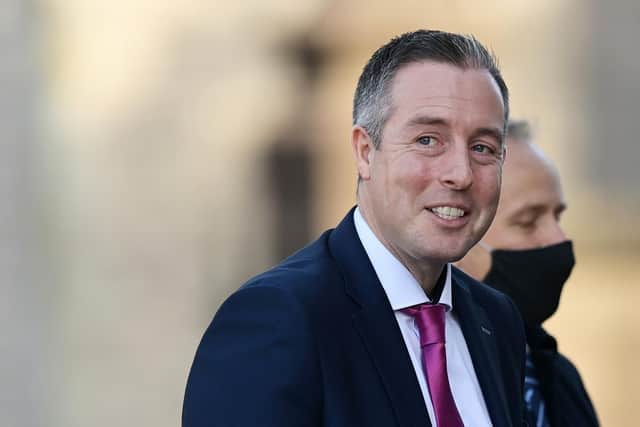

Why has Paul Givan resigned?
Paul Givan has resigned in protest over the Northern Ireland Protocol.
Speaking at a press conference announcing his resignation he said,
"Today marks the end of what has been the privilege of my lifetime, to serve as the first minister of Northern Ireland."
"Our institutions are being tested once again, and the delicate balance created by the Belfast and St Andrew's Agreements has been impacted by the agreement made by the United Kingdom and the European Union which created the Northern Ireland Protocol."
What happens after Paul Givan resigns as First Minister of Northern Ireland?
The office of First and Deputy First Minister in Northern is joint, so if he resigns that means that the Sinn Féin Deputy First Minister Michelle O'Neill will be removed from her post.
Parties will then have seven days to re-nominate and appoint a new First and Deputy First Minister.
However, if either party decides not to re-nominate a new minister, this means that the Stormont government cannot be formed and will not be able to function properly.
It is expected that even though the Stormont Executive would not be able to meet, those who remain in their posts but would be unable to make any new decisions.
To prevent the Stormont government from collapsing new rules were brought into Westminster to change this legislation, which will allow the government to continue, without having to have an election for between six to nine months.
More from the News Letter: