
Women's rights group behind landmark Supreme Court sex ruling slams NI Equality Commission legal action
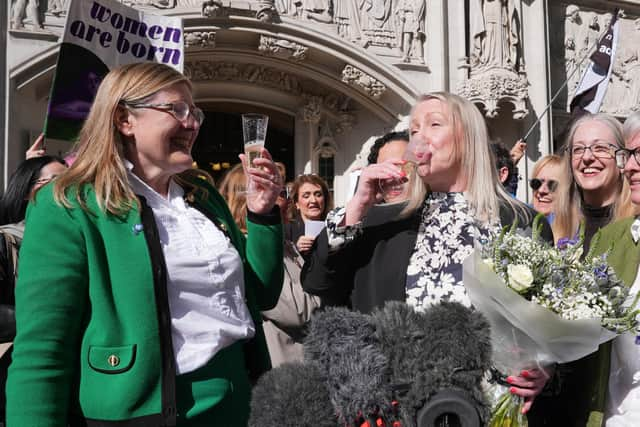
The campaign group which took the Scottish government to the Supreme Court and won over the definition of a woman has rubbished legal action by the Equality Commission on the ruling’s implications in Northern Ireland.
Legal opinion commissioned by For Women Scotland (FWS) says there is nothing in the EU law applicable in the province under the Windsor Framework which would “make any difference to the interpretation and application” of the UK court ruling.

However, the commission (ECNI) maintains that the “legal landscape is more complex” in NI – and has repeated its position that terms like ‘man’ and ‘woman’ are not defined in local legislation.
The equality watchdog has written to around 60 interested parties asking them for their views on its proposal to ask the High Court to “clarify” the law here. That has prompted rebuttals from various organisations, including the campaign group Sex Matters and Stormont’s Department of Education.
Last week, the DUP leader Gavin Robinson told the News Letter ECNI was “pushing their own agenda” by asking the High Court to rule on the definition of a woman in Northern Ireland. He said it is “totally absurd” that the term woman might be defined differently in Larne than in Stranraer.
The issue was prompted by a Supreme Court ruling earlier this year, in which the UK’s top judges ruled that sex in relation to the 2010 Equality Act in Great Britain is defined by biology, not the self-declared or certificated gender identity of an individual. That meant single-sex spaces are to be male only, or female only.
It was welcomed by women’s rights groups and gay and lesbian groups – who had warned that undermining sex as a protected characteristic would undermine legal protections for sexual orientation.
However, ECNI argues that EU rights provisions in the Windsor Framework mean terms like ‘woman’ might have a different meaning in NI than in the rest of the UK. Next month the Supreme Court is expected to rule on whether those provisions supersede domestic UK law, after government legislation on immigration and legacy was struck out in NI by the courts.
In its submission to ECNI, FWS has said that even if the Supreme Court rules that certain EU laws have primacy over UK law, it would not “make any difference to the interpretation and application” of the Supreme Court sex ruling in NI.
The legal opinion by Aidan O’Neill KC says that “In contrast to the situation under the law in the UK, at an EU law level there are no Treaty provisions relating specifically to discrimination on the basis of trans(gendered) status or claimed ‘gender identity’. And there are no provisions of the EU Charter of Fundamental Rights which refer specifically to trans(gendered) status or claimed ‘gender identity’.”It argues that even if European courts were to demand an increased protection in NI for people claiming transgender status, that can be done under UK law “without any need to modify or amend what is meant under our national law by the protected characteristic of ‘sex’”.
FWS argues that the ECNI’s concerns expressed in their June 2025 legal paper on the potential EU law incompatibility of the judgment of the UK Supreme Court “are wholly misplaced”.
“It is indeed the case that equality law means the same in Belfast as it does in Birmingham, Bristol or anywhere else in the UK. The impact of the Windsor Framework in the context of Northern Ireland makes no difference on this matter. There is simply no justification for the any suggestion – whether from the ECNI or any other party – that the meaning of ‘sex’, and related terms, should be interpreted differently in Northern Ireland from the rest of the United Kingdom, of which it still form part. Accordingly there is no need for the ECNI to seek the assistance of the courts in order to establish the correct legal position”, FWS says.
ECNI last week defended its position after similar criticism from the Sex Matters lobby group. A spokesperson said NI has different equality laws to GB “which were not considered by the Supreme Court and an added complication is that NI is subject to Article 2 of the Windsor Framework which the Supreme Court also did not consider.
“Article 2 of the Windsor Framework provides for the non-diminution of rights, safeguards and equality of opportunity as set out in the relevant chapter of the Belfast /Good Friday Agreement. Whether or not any specific right is within the scope of the Windsor Framework is a matter for determination by the Courts”.
They said laws on health and safety, education, prisons, social security, etc, use terms like ‘men,’ ‘women,’ and ‘sex’ “without defining them” – adding that ECNI is committed to finding “legal certainty” for the benefit of everyone.