
Young unionist delegation raises 'grave injustice' over democratic rights with government
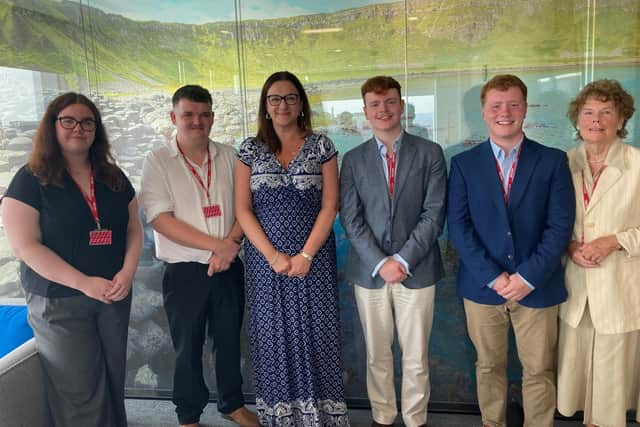
A delegation of young people from Northern Ireland have met the government to express their opposition to the “grave injustice” that they do not have the same democratic rights as their peers in the rest of the UK.
A letter – signed by representatives from the three main unionist parties – was handed over to Baroness Anderson at the NIO headquarters in Belfast on Wednesday. It questioned her response to concerns raised earlier this year about their inability to shape the laws that govern them, due to the Windsor Framework.

300 areas of law, principally but no exclusively governing trade regulation, are decided in Brussels rather than in London or Belfast under the post-Brexit agreement between the UK and EU.
When the issue was raised in the House of Lords, Baroness Anderson – the Cabinet Office spokesperson in the chamber – said that parliament is “as accessible to them as it is to any other British citizen”.
Her comments were in response to an amendment from Baroness Hoey on a proposed government law on House of Lords reform. Kate Hoey’s proposal sought to address the lack of democratic input uniquely affecting people in Northern Ireland.
However, the cross-party group has told the Labour politician that she had completely misunderstood the point they had made. They accept that they have the same right as anyone else to be considered for a seat in the Lords or to stand for election to the Commons – but are “now confronted with a truncated second class citizenship because having a seat in the Lords, Commons or Northern Ireland Assembly only gives us the right to make some of the laws to which we are subject”.
The group said that “having enjoyed full UK citizenship along with the rest of the UK, we now only enjoy a partial citizenship” – and said that young people faced the “injustice” of being “disinherited from aspects of our citizenship and subject to discrimination”.
Defenders of the current arrangements point to the fact that the Windsor Framework arrangements were overwhelmingly endorsed by parliament, which is sovereign.
The group told Baroness Anderson that while the constitutional arrangements “imposed on us” proclaim that the people of England, Wales and Scotland are worthy of the right to stand for election to make all the laws to which they are subject, “they proclaim that the people of Northern Ireland are only worthy of the right to make some of the laws to which we are subject.
“This is deeply distressing and a grave injustice”, the Baroness was told.
The government was encouraged to “fight for the rights of all its citizens to be fully re-enfranchised” – regardless of the demands of EU countries over the framework.
“If the EU27 persist in their current course they will make themselves the instigator of the biggest and most reactionary disenfranchisement operation of modern times”, the delegation said.
DUP members Jack Steele and Rachel McCaughey attended the meeting, along with representatives from the TUV and Ryan Rea, who is not involved in a political party.
Referencing the government’s plans on Lords reform, Jack said: “The presence of hereditary peers presents no barrier to anyone from fully engaging in the democratic life of the United Kingdom. The Windsor Framework on the other hand means that people in Northern Ireland have no say on the laws that are imposed by the European Union.
“As young people who all value Northern Ireland’s place within the United Kingdom we are more interested in the real barrier to democracy that is placed by the Framework, rather than a phony class-war being fought by Labour against hereditary peers.”
Jonathan Jackson of the TUV said the group was grateful to Baroness Anderson for listening to their concerns. “As more and more laws are imposed on us this issue is going to become a bigger and bigger problem. Indeed the Government's decision to propose votes for 16 to 17 year olds is going to put the issue in sharper focus.
“We will not rest until the people of Northern Ireland are fully re-enfranchised, able to stand for election to make all the laws to which they are subject. This is a basic right, a non negotiable”. he said.
The letter presented to Baroness Anderson was signed by Anny Henry and Jonathan Jackson (TUV), Rachel McCaughey and Jack Steele (DUP), Jay Basra (UUP) and Ryan Rea who is not a member of a political party. Baroness Kate Hoey and the TUV’s Dan Boucher also attended.