
Belfast traffic congestion: 'It takes me twice as long to commute by car as it does by bike'
Commuting in and out of Belfast now takes twice as long by car for some as by bike, thanks to the congestion.
That is the claim of one cyclist, who regularly travels to and from Comber and the Ormeau Road in south Belfast.
Keen rider James Alexander, 25, works at McConvey Cycles, and mainly commutes in largely using the Comber Greenway - an eight-to-10-mile stretch of pathway designed for cycles and pedestrians.
But one day a week he makes much the same trip between Comber and Belfast by car.
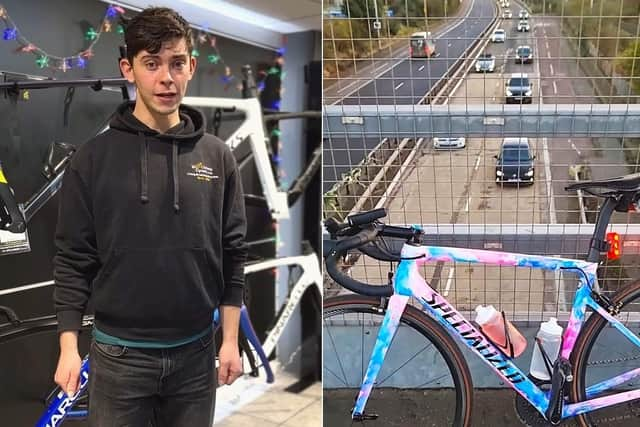

The upsurge in congestion in recent weeks has meant his car journey now takes an hour - a third longer than it used to - while the bike journey takes just half that.
His co-worker Lance McCarthy makes a similar claim - that his commute to work from Lisburn by car takes about an hour these days, compared with about 30 minutes by electric bike.
They have both posted videos of their commutes online to encourage people to travel by bike to avoid the current gridlock.
Mr Alexander said: "For me to get out of Belfast it could take 20 minutes to go a mile or two [due to the current congestion]. It takes so long to get out of the heart of Belfast. It started in the summer and then it's really picked up lately.
"There's some nights you could be stuck in the car on the Ormeau Road for 10 or 15 minutes just trying to get out, get turned and up the road, which is not even a mile.
"It's pretty mad to cover that distance on a bike so much faster.
"It's quicker for me to ride my bike into work, get a shower, make coffee, then be on the shop floor, than to drive in and find a parking space."
Meanwhile the Department for Infrastructure has said that road safety is a "priority" after facing criticism for its plan to let taxis use bus lanes.
As well as being for buses, the lanes in Belfast are also used by cyclists and motorcyclists.
The idea behind the plan is to free up lane space for general traffic by diverting taxis into the lesser-used bus lanes - though cyclists, and now motorcyclists, have complained that this will make matters more dangerous for them.
Martyn Boyd, the Northern Irish representative for Motorcycle Action Group UK, said this week that the current traffic "chaos" in Belfast is down to the "inept" handling of the situation by the department, stemming largely from the closure of the Boyne Bridge in October.
"The whole idea of restricting bus lanes to buses, cyclists, motorcyclists and a limited number of taxis was to improve the flow for those vehicle types and - crucially - improve safety for motorcyclists and cyclists," he said.
"I fully understand why the taxi operators want to have wider use of bus lanes right now.
"But letting many more types of vehicles into them will seriously compromise the safety of motorcyclists, who are, as declared by the department, the most vulnerable of all road user groups.
"So it seems Mr O’Dowd is quite happy to compromise the safety of motorcyclists who are legitimately using bus lanes (motorcycles have been allowed to use them since 2005) to try to take some pressure off himself, the person responsible for the chaos."
The department responded: "Road safety is a priority for the minister who is committed to the safety of all road users.
"The department engages with representatives from the Motorcycle Action Group on a range of issues, and will continue to do so.
"To launch the taxis-in-bus-lanes pilot scheme, a change in legislation is required.
"This means the normal legislative process must be followed, including a consultation period.
"Further details on the pilot scheme will be announced soon. We will carefully consider all views received during the consultation period."