
Northern Ireland breaks its mean temperature record for the summer season
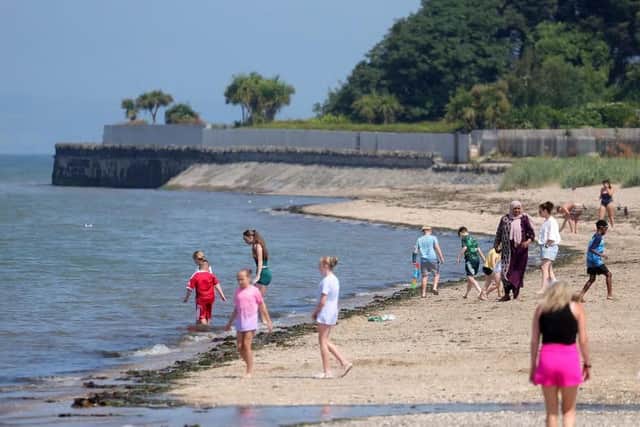
Summer 2026 was the warmest in Northern Ireland since records began in 1884, according to provisional figures from the Met Office.
The average temperature across June, July and August was 15.43C, beating the previous high of 15.4C set in 1995.

It was also the warmest summer in the UK as this year's average was 16.5C, beating the previous high of 16.1C set only last year.
It means the top six warmest summers on record in the UK have all occurred this century, including three this decade: 2026 in first place, followed by 2025, 2018, 2006, 2003 and 2022.

The summer in Northern Ireland had 424 hours of sunshine, which the Met Office described as "bang on average", as well as 246.88mm of rainfall which is 91% of the long-term average.
Those who struggled to sleep at night will be forgiven as Northern Ireland had the second highest overnight minimum temperatures on record during the summer months.
Co Down, Co Armagh and Co Antrim all broke their own mean temperature records this summer, with Co Tyrone and Co Londonderry having their third hottest summer. It was the fifth hottest summer on record for Co Fermanagh.
The highest temperature recorded during the summer was 30.8C in Castlederg, Co Tyrone on June 25.

A summer such as the one in 2026 is around 130 times more likely because of climate change and is now a “one in nine year event”, the Met Office said.
The figures reflect the impact of a “remarkable” summer of extreme heat and very little rainfall, that led to devastating wildfires, water restrictions for millions and many areas being declared in drought.
Parts of the country have seen as many as five heatwaves in recent months, with the first in late May, followed by one in late June, two in July and one in mid-August.
The June heatwave prompted a rare red alert from the Met Office for extreme heat and saw temperatures peak at 38.0C on June 26 in Lingwood in Norfolk – a new record for the month.
An estimated 2,877 deaths in England were associated with the heatwaves in May and June, according to the UK Health Security Agency.
As the scorching summer continued, England saw its driest July since data began, with only 7mm of rain measured, or 10% of the long-term average.
The most recent heatwave, in mid-August, saw temperatures climb as high as 38.1C in Kew Gardens on August 13, making it the hottest day of the year.
It meant 2026 became the first year to see three separate days where temperatures exceeded 37C.
Met Office head of climate attribution, Dr Mark McCarthy, said: “The summer of 2026 has been remarkable and is an example of the extremes we can expect to see more frequently as a consequence of human induced climate change.
“Our analysis shows a summer like the one we’ve just experienced is now around 130 times more likely because of climate change.
“In a climate unaffected by human emissions of greenhouse gases, a summer like this would be exceptionally unlikely – one in over 1,000 years.
“In our current climate, which is changing because of the effect of burning of fossil fuels, we should now expect this to be roughly a one in nine year event.”