
Northern Ireland enjoys a sunnier, warmer and drier March than average
Northern Ireland enjoyed a sunnier than average March last month, but did not break records – unlike England.
England did have its sunniest March on record, and Wales came close to breaking its record, as persistent high pressure brought long spells of clear weather..
By other weather measures Northern Ireland, like the rest of the UK, had a drier March than average, with NI recording a mere 31% of its normal monthly rainfall.
And, like England and Scotland and Wales, the province saw temperatures that were notably higher than normal for that month. The mean temperature across the month in NI of 7.5 Celsius was 1.3C above the long-term average.

Some 185.8 hours of sunshine were measured across England, a massive 59% more than the long-term average, according to provisional figures from the Met Office. This beats the previous record of 171.7 hours set in 1929. Wales saw its second sunniest March, with 53% more hours than average.
Scotland and Northern Ireland also saw an above average amount of sunshine, at 20% and 13% respectively, though neither nation came close to record levels. NI had 114.8 hours of sunshine.
Normally in March England gets about 15 hours sun more than Northern Ireland – typically 117 hours compared to 102 hours, about half an hour extra a day. But this year England had far more sun than here – an extra 71 hours over the month, which works out at about 2 hours and 17 minutes per day extra sunshine than NI enjoyed.
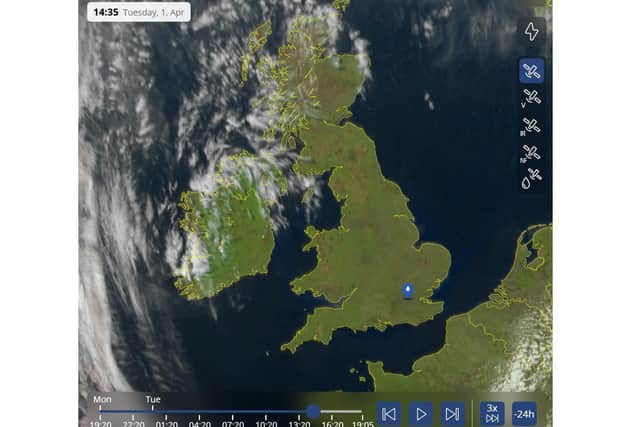
The good weather is continuing into April, with largely sunny weather across Britain and Ireland on the first day of the month today (Tuesday April 1) and more expected for the rest of the week. Northern Ireland, however, had a mix of light cloud and sun for much of the day, and did not have the total sunshine that almost the entirety of England enjoyed all afternoon and evening until sunset (see the satellite image on this page, taken at 2.30pm, which shows completely clear skies over England).
Across the UK as a whole last month there were 158.1 hours of sunshine, the third highest total recorded for March, behind 165.5 hours in 2022 and 166.9 hours in 1929. Met Office records for sunshine begin in 1910.
But, while NI was also sunnier than average last month, the month before – February – saw an almost record long grey spell. Armagh had a six-day sequence of sunless days from February 13 to 18, then the five days before that a mere 0.5 hours of sunshine. The last time Armagh had a sequence of six sunless days in a row in February was in 1966.
Last month, March, was also very dry, with the UK seeing just 43% of its average rainfall for March. Northern Ireland, with 27mm of rain, recorded only 31% of its normal March rainfall. It NI’s ninth driest March on record. Most of the southern half of England and parts of South Wales recorded only a fifth of their long-term average.
Wales experienced its fourth driest March on record, and England its sixth, based on Met Office data for rainfall beginning in 1836. By contrast, Scotland saw nearly two-thirds (64%) of its average rainfall for the month. Many counties had a very dry March, with Norfolk, Suffolk, Devon, Cambridgeshire and Gwynedd all within their top three lowest rainfalls for the month.
The long periods of high pressure meant temperatures were able to build during the day, before falling overnight as heat escaped under clear skies, the Met Office added.
This led to the UK experiencing its tenth warmest March on record, with a mean temperature across the month of 7.0C, 1.3C above the long-term average. The warmest ever March was in 1938, when the mean temperature reached 8.0C, according to records dating back to 1884.
Met Office scientist Emily Carlisle said: “Persistent high pressure, along with a lack of fronts arriving from the west, has meant that many have enjoyed a warm, dry and very sunny March.
“At the beginning of the month, some areas of Cumbria reached 19C for example and although temperatures have dipped at times, many have continued to enjoy some warm spring sunshine.”