
William Ferguson Massey, farmer from Ulster-Scots roots who became hugely significant New Zealand political figure
New Zealand’s two most significant late-19th- and early-20th-century prime ministers were born in Ulster. They were drawn from opposite ends of the political spectrum and both founded political parties.
John Ballance, who was born in Glenavy in 1839, founded the Liberal Party. William Ferguson Massey founded the Reform Party. Whereas Balance’s ancestry was predominantly English, Massey’s heritage was Scottish and Ulster-Scots.
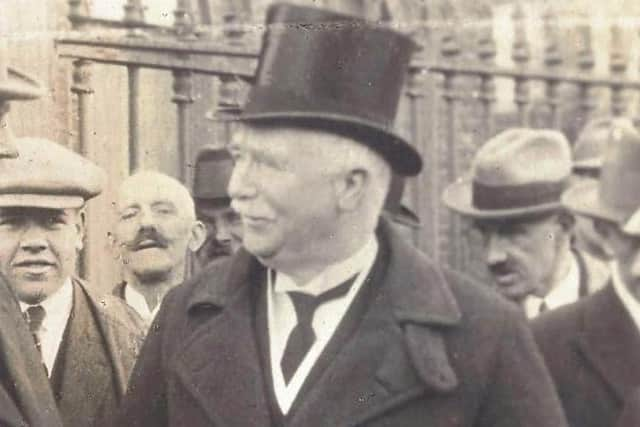

A generation younger, Massey was born on March 26 1856 at Keenaught near Limavady, Co Londonderry, elder son of John Massey and Mary Anne (née Ferguson). His father was an Ulster-Scots Presbyterian tenant farmer but both his mother and paternal grandmother were Scots.
In the 1860s John Massey sold the family farm and emigrated to New Zealand, leaving William behind with his grandmother to complete his education. He joined the family in New Zealand in 1870.
After his arrival, Massey worked as a farmhand for some years prior to acquiring his own farm in 1877.
In 1882 he married Christina Allen Paul, his neighbour’s daughter. Two of their seven children would later follow their father into parliament.
During these years he achieved local prominence through the local farmers’ club (of which he was president) and through his local Presbyterian Church.
In the early 1890s he was grand master of the Orange Order in the North Island but New Zealand historians are uncertain as to how strong his Orange sympathies actually were. Rory Sweetman, for example, contends that the strength of Massey’s Orangeism has been ‘assumed rather than demonstrated’.
His neighbours thought Massey should represent them on the national stage. Although he failed to win the Franklin constituency in the general election of 1893, he successfully contested a by-election in the neighbouring constituency of Waitemata in 1894.
As an independent, he was joining a disorganised and dispirited collection of individuals who possessed no realistic prospect of dislodging the Liberals from power.
In 1901 he became leader of the opposition and leader of the National Association. By force of his personality and his political acumen he transformed the opposition into a coherent and properly organised political party, the Reform Party.
The choice of name is surely revealing about the centre of political gravity in the early-20th century and renders Massey’s future longevity as prime minister even more impressive.
In the general election of 1911, the Reform Party won more seats than the Liberal Party but not an absolute majority. The Liberals, relying on the support of independents who had not joined Reform, were able to stay in power until the following year when they lost a vote of no confidence.
Massey became prime minister in July 1912. He had sufficient intellectual confidence to surround himself with able and talented colleagues.
Between 1912 and 1925 his government confronted serious challenges: difficult economic conditions, strikes, growing societal divisions, a world war and the worst pandemic in the country’s history.
He secured an absolute majority on only one occasion – in 1919 – but Massey’s skilful parliamentary management enabled him to govern and to achieve the rare distinction, shared with Robert Borden, the Canadian prime minister, of being one of the few prime ministers in the world to hold office before, during and after the Great War.
Like Ballance, Massey was a man of honesty and integrity but he was more direct and blunt than Ballance.
In domestic politics his mindset was essentially that of a late-19th-century Ulster tenant farmer wishing to become a landed proprietor. This is reflected in his election slogan in the 1890s: ‘Every man his own landlord.’
However, he also possessed a broader vision. At one stage he was prepared to contemplate New Zealand becoming part of Australia.
Always Empire-minded, he became an Imperial statesman during the Great War. No part of the Empire was more loyal to the Mother Country than New Zealand.
On July 31 1914, even before war was declared, the New Zealand parliament voted unanimously to send an expeditionary force to Europe. Despite having a population of slightly over a million, New Zealand sent 11% of its population to war, of whom 17,000 did not return.
Massey represented New Zealand at the Versailles settlement in 1919, ensuring appropriate recognition for New Zealand’s sacrifices at Gallipoli and on the Western Front.
Despite his deep-seated scepticism (which was fully vindicated by events), he took New Zealand into the League of Nations, the precursor of the United Nations.
Although his sympathies were unionist, Massey was always circumspect in his comments on Ireland. He appreciated that there was significant support for Irish Home Rule throughout the Empire and its advocates contended that Home Rule would only extend to Ireland the freedom that made New Zealand so loyal and contented.
In August 1914 he was delighted when unionists and nationalists in Ireland buried their differences and supported the war effort.
Despite the Easter rebellion of 1916 and growth of republican separatism, Massey remained restrained in his references to Ireland.
Following the Anglo-Irish Treaty of 1921, he hoped that ‘the people who have been opposing the government of the United Kingdom – of the Empire – will become loyal citizens of the new Dominion which is being set up’.
However, he privately warned Lloyd George that ‘any attempt to coerce Ulster ... will mean very serious trouble all over the Empire’.
After the first elections to the new Northern Ireland parliament, he congratulated James Craig and hoped for the restoration of ‘peace and harmony to the whole of Ireland’.
Although Massey chose not to attend the official opening of the Northern Ireland parliament, he sent a further message of goodwill.
Craig and Massey held each other in high esteem. In November 1923 Craig said, ‘If anything happened to him, he hoped that Ulster would tempt Mr Massey to become prime minister of Northern Ireland’.
In January 1924 Massey responded by telling an audience in Londonderry that ‘he had to divide his affection between the land of his birth and the land of his adoption, and he was not really sure which made the greater call’.
Massey never had to choose because he died on May 10 1925. He was buried at Point Halswell, at the entrance to Wellington harbour.