
Five talking points ahead of Northern Ireland’s clash with Georgia
Northern Ireland are back in the second tier of the Nations League and kick off their campaign away to Georgia in Tbilisi on Friday.
Here we look at the key talking points ahead of the match.
Four games in 11 days
This new-look international window with four matches in quick succession, a model which will be repeated in next year’s Euro 2028 qualifying, presents a huge challenge for smaller nations who have less depth in their squads.
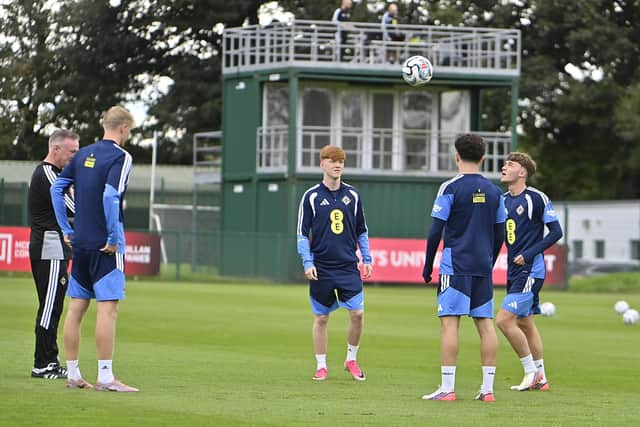

When Jamie McDonnell pulled out with a hamstring injury this week, that was the Oxford man gone for four matches rather than two as it might otherwise have been.
And with recovery time at a premium, Northern Ireland have also been given a tough hand in starting with their longest away trip of the campaign, a 5,000-mile round trip to Tbilisi.
Behind closed doors, but not entirely
Friday’s match is officially behind closed doors – the result of sanctions placed on the Georgian FA following crowd trouble against Armenia last year – but around 60 Northern Ireland fans have made the trip.
They were granted an exception as they had booked their travel and accommodation before it was communicated to them that they would be unable to attend.
However, they may still struggle to make themselves heard at the 54,000-capacity Boris Paichadze National Stadium as there will also be around 5,000 schoolchildren on hand.
UEFA’s regulations allow children under the age of 14 to attend games being played behind closed doors, and the Georgian FA has handed out tickets to several football schools from across the country.
Euro 2028 opportunity
Northern Ireland’s success in the Nations League C last time around brought them a World Cup qualifying play-off, which they lost to Italy in March.
This year’s competition will feed into the seeding for December’s Euro 2028 qualifying draw – if O’Neill’s men can finish in the top two of their group they will be placed in the second band of seeds.
Should Northern Ireland struggle, relegation is no longer a certainty, with the bottom-placed side facing a play-off against a League C runner-up.
Seeking further progress
The youthful nature of O’Neill’s Northern Ireland squad has been a point of discussion for some time, and the average age is barely creeping up given a fresh set of youngsters – teenagers Ceadach O’Neill, Kieran Morrison, and Braiden Graham – have all kept their places from the summer, as did Tom Atcheson who turned 20 on Tuesday.
The average age of the squad is just 24 with only Dion Charles, 30, Paddy McNair, 31, and the veteran Josh Magennis, 36, over the age of 30.
With a clear goal of reaching the next Euros, this final set of competitive fixtures before qualifying starts is a key step in developing the squad.
Away woes
While much progress has been made within the group, this generation is yet to enjoy much success away from Windsor Park in competitive fixtures.
Since O’Neill returned to the job at the end of 2022, Northern Ireland have won only two of their 12 competitive matches outside Belfast – and those two wins were against relative minnows Luxembourg and San Marino.
If Northern Ireland are to realise their ambitions of reaching major tournaments with more regularity, that must change.