
Michael O'Neill believes his 'brilliant' World Cup experience can benefit Northern Ireland

Northern Ireland manager Michael O’Neill believes his “brilliant experience” at the World Cup can bring benefits to the nation – both in terms of contacts and strategy as the country aim to continue making positive strides.
O’Neill was part of FIFA’s World Cup Technical Study Group (TSG) alongside the likes of Jürgen Klinsmann, Gilberto Silva and Pablo Zabaleta.
The team of experts analysed and provided insights from all 104 matches played at the major tournament hosted across America, Canada and Mexico – O’Neill’s assignments included assessing how Cape Verde exceeded expectations.
Northern Ireland missed out on reaching their first World Cup in 40 years after losing a play-off semi-final to Italy, but O’Neill’s presence ensured the country still gained valuable information which they’ll hope to implement in upcoming international windows.
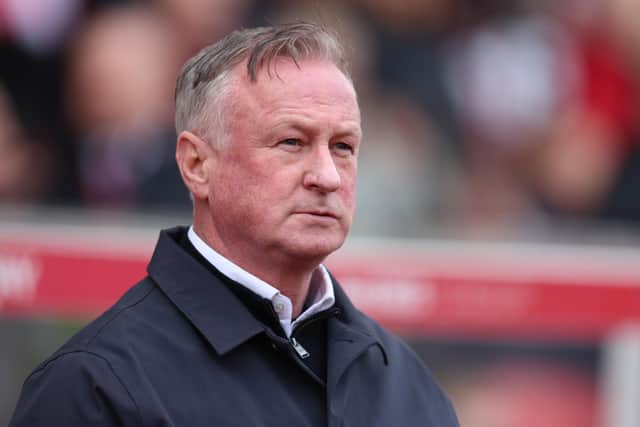

“It was a brilliant experience,” said O’Neill. “I worked with some excellent people, I was around some excellent people the whole time we were there.
"Great contacts, I think, going forward, both for myself and the association and developing football here.
"I think the biggest thing we saw from the World Cup, and maybe sometimes you see that more in a tournament situation, was how the smaller teams did cope, the likes of obviously Cape Verde in particular, their level of performance.
"The gap between the smaller nations and the bigger so-called traditional nations, the European and South American nations, I wouldn't say it's closing, but I think the smaller nations can show that they can compete in those types of games.
"Often in the World Cup, the games were decided by individual brilliance more than dominance of a team.
"The most dominant team performance I saw was probably Spain versus France in the semi-final and how Spain controlled the game and really limited France to very few attacking opportunities.
"But often in the games it was the individual players that made the difference. The games were very tight.
"There's always some games more possession-based, a lot of teams played in a lower defensive line and had counter-attacking threats, we saw that consistently with maybe the smaller nations.
"I think it's really important to have athleticism in your team if you're going to play like that.
"Also the importance of set-pieces, for and against, how you use that.
"If you're limited in possession, then obviously every opportunity you get from a set-piece and that type of thing is vitally important.
"For me it was a terrific football experience and also I thought the games were terrific as well.”
The 2026 World Cup, which was expanded to 48 teams, came in for criticism over a number of changes, including the introduction of hydration breaks.
Every match was paused for three minutes midway through each half with FIFA highlighting player welfare amidst extreme heat in certain locations.
Alongside rehydrating, players were also given tactical advice by coaches during the breaks while broadcasters were given an opportunity to run adverts.
While O’Neill knows there’ll be no need for such breaks in Northern Ireland’s matches, he was a fan of the general concept at the World Cup – and believes it helped cut down on stoppages elsewhere.
"Personally, I didn't mind the hydration breaks,” added O’Neill. “I didn't think that was a huge issue.
"I think that from a coach's point of view, it was beneficial.
"I think that what we did see in the hydration breaks, particularly the second half, we saw maybe teams being able to make three substitutions at once and be better prepared coming onto the pitch because it's quite difficult to do that in-game without a hydration break.
"You're changing three players, you may be changing something tactically, but you're changing set-pieces for and against as well at that point in time...having a hydration break at that point in time I think was beneficial to the coaches.
"I think also the first hydration break in the game allowed teams to change tactically.
"We did see that they had a little bit more time to evaluate whether they would change what they did tactically if they had not started the game particularly well – I can think of one or two occasions when we saw that as well – but I didn't think it took away from the tournament.
"I don't think we're going to need a hydration break here, but certainly with the weather situation and the climate, we have to be conscious of the players.
"What we didn't see in the World Cup is goalkeepers going down injured to allow a tactical situation to arise in the game.
"There's a lot of stuff that FIFA have done to try and continue with speeding up the game, not having these situations where the tempo and the flow of the game is broken by player decisions or teams asking their goalkeeper to go down so that they can gather the players and have a tactical break...what the hydration break did was create a tactical break.
"We didn't have to deal with that situation, which I thought was a real positive.”