
Successful first VAR venture in BetMcLean Cup final leaves door open for further Irish League use

VAR’s successful first venture into Irish League football for Sunday’s BetMcLean Cup final between Glentoran and Linfield has left the door open for further future implementation.
The Northern Ireland Football League (NIFL) confirmed the historic decision late last month that the technology would be utilised for the first time in a professional match in Northern Ireland.
While Irish FA referee Ben McMaster was the man in the middle, VAR operations were controlled by Scottish officials – Grant Irvine in charge and Garry Hilland serving as his assistant.
As former FIFA ref Alan Snoddy pointed out to the News Letter ahead of the showpiece decider, only nine of UEFA’s 55 association members currently don’t use some form of technology in their respective leagues with VAR rolled out across Europe.
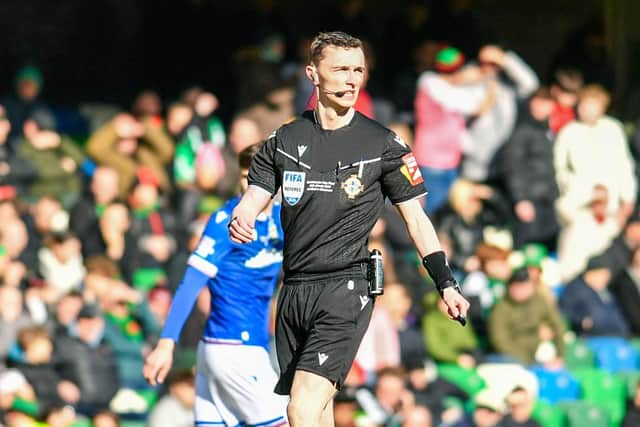

Throughout the first half at Windsor Park, Irvine and Hilland were observers just like the 12,297 fans from both clubs packed inside the Belfast stadium – the only real brief pause of action coming as VAR checked a potential Linfield penalty following a challenge on Matthew Fitzpatrick.
It was efficient use of the technology with action stopped for only a matter of seconds as McMaster communicated with colleagues before waving play on.
There were no heavy challenges, no genuine spot-kick calls – a dream scenario for all associated as the players went about deciding the fate of a first ‘Big Two’ cup final since 2010.
Another penalty call – this time for Glentoran handball appeals – was waved away by VAR with seven minutes to go, again another short pause in action.
McMaster’s decision to award a late spot-kick after MJ Kamson-Kamara brought down Chris McKee was also vindicated by VAR.
One major problem with the system in general is the in-stadium experience – fans in attendance aren’t shown replays and not aware of what has happened.
NIFL CEO Gerard Lawlor has left the door open for VAR to be potentially used in one-off matches with high stakes – the European play-off final at the end of this season would be the next such occasion.
It remains unlikely that VAR will be rolled out across the Irish League – the full package on show in England and Scotland comes with significant costs and technology requirements.
When VAR was introduced in the Scottish Premiership, it reportedly cost approximately £1.2million per season with the 12 top-flight clubs paying on a sliding scale depending on league position.
With that price deemed too expensive by many associations, FIFA have developed Football Video Support (FVS) – a system which allows each manager to make up to two review requests per match and can be used with only four cameras.
This season, the Malta FA have trialled FVS in their Jubilee Cup competition and it has also been tested in Italy and Spain.
FIFA referees' chief Pierluigi Collina has hinted that FVS will be rolled out across further countries, saying in February: "It is probable that in the next weeks we will open the possibility to join the trial for the next season to member association and competition organisers.”
If technology is to be introduced in Northern Ireland, it appears joining the current FVS trial would be the most feasible option.
"Realistically, Football Video Support is the most likely route for the Irish League, that's the least expensive and doesn't need a VAR and AVAR,” said Snoddy. "Malta implemented it a couple of months ago...I was there just after it was implemented for a seminar and the clubs seem to be quite happy with how it is working."
While it has been reported VAR won’t be used in the Irish Cup final, it’s likely only a matter of time before some form of technology arrives on these shores on a more consistent basis.