
How to experience Ireland’s ultimate coastal road trip
House martins and swallows are our constant companions, whether snapping up fluttering mayflies in the car park of Glencar Waterfall during a downpour, or swooping from the eaves of The Shandon Hotel overlooking Marble Hill Strand beach in Donegal, where linen-coloured sand slips into grey-green ocean.
It might have celebrated its 10th official birthday last year, but Ireland’s Wild Atlantic Highway has been used by generations of these nippy little migratory birds, who fly from the Sahara to spend their summers in the UK and Ireland.
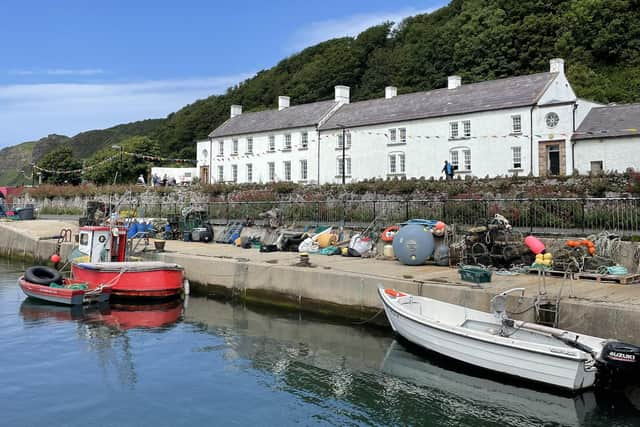

And, clever things, they know about Northern Ireland’s Causeway Coastal Route too.
Aside from the 60 million-year-old natural geometrical marvel that is Giant’s Causeway, this 120-mile stretch of raggedy, bewitching coastline, which starts in Belfast and ends in Londonderry, often gets lopped off road trips.
But no more.
As part of the Shared Island initiative, which “aims to harness the full potential of the Good Friday Agreement to enhance cooperation, connection and mutual understanding on the island”, Tourism Northern Ireland and Fáilte Ireland have teamed up to remind visitors that once you hit the end of the Wild Atlantic Way, the sea hasn’t run its course, the cliffs don’t peter out and the Guinness really doesn’t dry up.
It is possible to do both stretches, from Kinsale, Cork up over the crook of the island’s north, to Belfast, over three to four weeks, but it’s surprising how much you can see in just a few days.
Although, it would also be incredibly easy to stay put, wherever you end up. Like Paul Cole from the Whitehead Community Association, a “blow-in” who moved to the quaint Victorian seaside town in the 1960s. He takes us on a gentle e-bike tour of Blackhead Coastal Path.
“You can be born and never leave, but you can’t be buried here,” he explains ominously, (it’s a town joke, there’s no graveyard.
Paul is a fierce champion of Whitehead, where you can have a cup of tea amongst hulking great locomotives at the Whitehead Railway Museum and watch house martins dance in front of a row of houses along the front that are as bright and multicoloured as a pack of brand new felt-tip pens.
He is devastated when we run out of time to pull a pint of Guinness in his local Irish pub, but there’s whiskey to be drunk at Northern Ireland’s first whiskey hotel, The Harbourview Hotel in Ballymena.
It was previously called The Londonderry (the Marchioness of Londonderry built it in 1848), and was later owned by Winston Churchill – they have copies of his rent rolls and deeds.
Having paddled in swathes of seaweed while watching gannets dive bombing just off the shore at Carnlough Beach, I thought I was ready to warm up with some whiskey. I should be, considering the recent boom in Irish whiskey – in 2012 there were just four distilleries; now there are 54.
Adrian McLaughlin our host and co-owner of The Harbourview adds a pipette of water to my glass: “The water kicks the ass of the whiskey and says, ‘Get your flavours out there,’” he explains genially.
My tastebuds happily don’t get a break whichever chunk of coast we’re on, as a rule, portion sizes are colossal, the feeders generous.
At the Manor House on Rathlin Island, the decadent, moreish lobster Thermidor is the same fire hydrant red as the beaks of the puffins that bob about beneath the cliffs at Rathlin West Lighthouse.
“There’s a wee bit of chop,” says our captain as I try to train my binoculars on the funny creatures."
At The Rusty Mackerel, a pub at the foot of Slieve League, the highest accessible cliffs in Europe – which on a damp, humid day are imposingly sheer and a-buzz with midges – the cheesy fish pie with a hunk of brown bread transports you forward in time to autumn, when the landscape is purpled all over with heather.
And at Willow and Lore a ‘fire, feast and folklore experience’, we slick Irish butter on crackers and potato bread so thickly that each bite leaves teeth marks.
No stop is as tasty as Londonderry though. Much like its Peace Bridge, which elegantly bestrides the River Foyle, shaped like two hands reaching out to shake, the city acts as a connecting, crossover point for the Wild Atlantic Way and the Causeway Coastal Route.
A roadside inn of a city, here you can eat well and rest up before embarking seamlessly on the next leg.
Hannah Ramraj from Derry By Fork takes us on a tour that should come with a warning: do not eat breakfast first. The spicy, moreish Catanzaro sandwich – salame, ‘nduja with soft cow’s milk cheese and jalapenos in lightly crisped Tuscan schiacciata bread (from Italian deli Salumeria Mariuccia, run by Antonio Lovati), could power you through a week.
Don’t miss a pint of Dopey Dick at the Guildhall Taphouse (named after the orca that swam up the Foyle in 1977), or the loaded nachos from Guapo, where even the owner’s daughter queues.
You’ll need coffee too — try Terra Bakehouse. And at O’Loughlin’s Irish Bar, just up from Peadar O’Donnell’s, I finally pull the perfect pint of Guinness.
As the trip winds down, a final dip — or surf — at Strandhill recharges everything. Instructor Zuhe Coronil, a Venezuelan “blow-in,” has us laughing, popping up on boards, and catching waves until our arms ache.
Back on shore, dripping with salt water and adrenaline, house martins wheel overhead, their wings as black as our wetsuits.
Follow the birds. Follow the surfers. You won’t go far wrong.
*For more information, visit thewildatlanticway.com, ireland.com, and failteireland.ie.