
Forgotten Genius: Why the “Diesel” Engine should really be named the “Akroyd”
Every day, millions of cars, lorries, ships, trains and tractors rumble to life across the globe, powered by an engine bearing the name of German engineer Rudolf Diesel (1858–1913). Yet according to the historical record, credit for one of the modern world’s most vital machines belongs not in Germany, but in a British foundry and to a quiet man named Herbert Akroyd Stuart.
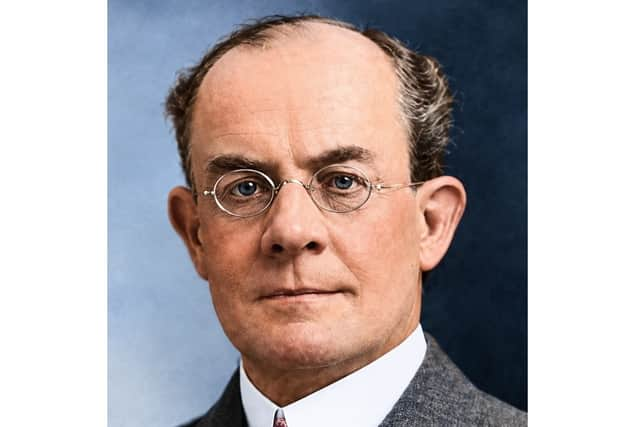

140 years after Akroyd Stuart built the world’s first working compression-ignition heavy-oil engine, the machine remains misnamed in honour of a rival who did not produce a functional equivalent until seven years later. Over the years I have written a number of articles about Herbert Akroyd Stuart and he like Frank Crossley (1839 – 1897) despite achieving so much to change the world have never received the recognition they both deserve.
Born in Halifax, Yorkshire, on the 28th January, 1864, to a Scottish pattern-maker father with Ulster-Scots roots in Paisley and around Strabane in County Tyrone and a Halifax mother, Akroyd Stuart was steeped in mechanical engineering from youth. After studying at Newbury Grammar School and the City and Guilds Technical College in Finsbury, where an early post in the testing department taught him the rigour of calculating engine efficiency he joined his father at the Bletchley Iron and Tin Plate Works.
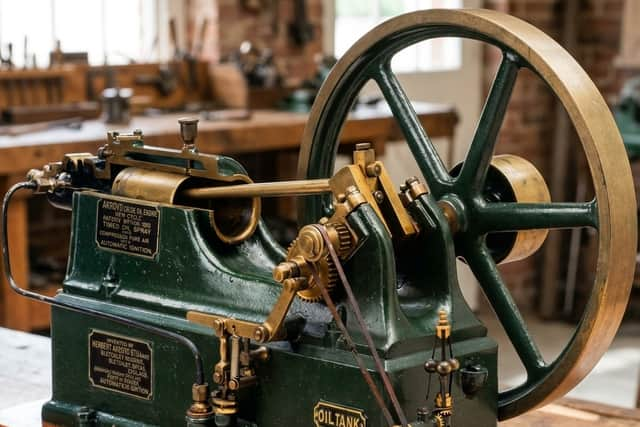
His breakthrough was born partly out of his father’s own mechanical setbacks. After repeated failures to build an engine from scratch, Charles Stuart bought a Spiel’s petroleum engine to run the factory and handed his son both the maintenance duties and his notebooks detailing everything that had gone wrong. Armed with a clear map of dead ends to avoid, the young engineer began filing his own oil-engine revolutionary patents in 1886, 140 years ago. This would just be just 10 years after an Ulsterman Frank Crossley (1839 – 1897) perfected the first modern internal combustion engine of 1876 that commenced the second industrial revolution.
Initially, like his contemporary William Dent Priestman (1847 - 1936), Akroyd Stuart relied on an external ignition source. Legend has it that a workshop accident changed engineering history: oil dripped from a lamp onto a piece of red-hot steel in the Bletchley foundry and instantly vaporised and ignited.
Akroyd Stuart realised he could eliminate external spark or flame altogether. On the intake stroke, his cylinder drew in pure air; on the compression stroke, the piston squeezed that air until friction and pressure raised its temperature high enough to ignite a fine spray of injected oil on contact. To encourage air turbulence, he added a narrow-necked vaporiser chamber, universally known as the "hot bulb" and cast a water jacket around the cylinder to prevent premature firing.
By 1890, he had a completed an improved working engine. A year later, he licensed the design to Richard Hornsby & Sons of Grantham. Following a debut at the Royal Agricultural Show in June 1891, the first commercial Hornsby-Akroyd engine was sold in May 1892 a full year before Rudolf Diesel even applied for a patent on a flawed coal-dust engine.
That July, the world’s first commercial compression-ignition engine went into service at the Fenny Stratford waterworks. A string of world firsts rapidly followed:
1896: Hornsby built the first compression-ignition locomotive for the Woolwich Arsenal.
1896–1897: Akroyd Stuart and Hornsby developed an oil-driven tractor, exporting units to Australia.
1903: Hornsby produced the world’s first "V" configuration oil engine.
Ultimately, more than 45,000 Hornsby-Akroyd engines were built. Akroyd Stuart’s machines lit the Statue of Liberty, powered Guglielmo Marconi’s landmark transatlantic radio transmission, and drove the earliest oil-powered cars. Alongside Hornsby, he even co-invented the continuous-track "caterpillar" tractor more than 500 of which hauled Allied artillery during the First World War before famously underestimating its peacetime value and selling the patent rights to the American firm that became Caterpillar.
Meanwhile, Rudolf Diesel struggled to catch up. Diesel’s first prototype did not appear until 1897 and exploded. His earliest functional oil engine, unveiled at the 1898 Paris Exhibition, was a towering, ten-foot vertical machine that looked cumbersome beside the compact British design. Yet Diesel possessed what Akroyd Stuart lacked: a relentless flair for self-promotion.
Shy, unmarried, and intensely private, Akroyd Stuart emigrated to Australia in 1900 to form an engineering firm with his brother. Diesel, by contrast, became a household name, even as debt and paranoia shadowed his life until his mysterious disappearance overboard from the steamer SS Dresden in September, 1913.
In his final years, Akroyd Stuart grew deeply embittered watching a rival’s name become synonymous with his own invention. He lobbied unsuccessfully until his death from throat cancer in Perth on the 19th February, 1927 to have the technology renamed the Akroyd engine.
Having amassed a fortune from royalties, he used his estate to defend his place in history, endowing engineering lectures at the Universities of Western Australia and Nottingham, the Institution of Mechanical Engineers, the Royal Aeronautical Society, and the Institute of Marine Engineers—lectures that continue today.
Modern engineering has ultimately vindicated Herbert Akroyd Stuart. Today’s high-efficiency compression-ignition engines rely on Akroyd Stuart’s principle of solid oil-spray injection and constant-volume combustion, while Diesel’s complex air-blast injection system has long been obsolete.
Akroyd Stuart belongs squarely in the pantheon of British engineering giants alongside Isambard Kingdom Brunel, George Stephenson, Frank Crossley and Sir Frank Whittle.
In 2026 140 years after he built his first prototype compression ignition engine setting the historical record straight is long overdue: the engine powering the modern world is not a Diesel it’s an Akroyd.
Stevan Patterson, Castlederg Co. Tyrone