
Turning Down School Heating Will Cost More Than It Saves
Expert comment by Naomi Whiteley, Behaviour Transformation and Pressure Specialist and creator of the Firm Ground® methodology
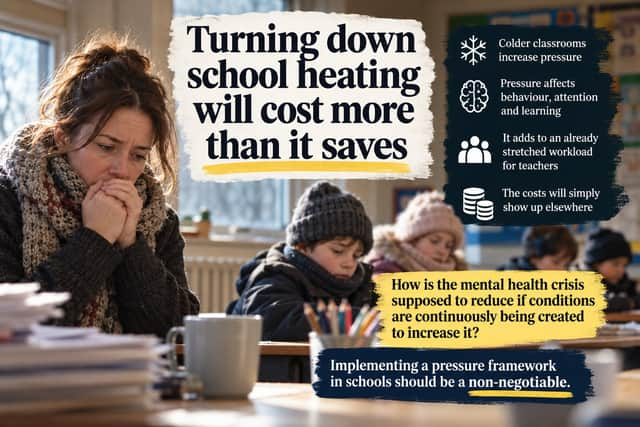

The principal of Tullygally Primary School in Craigavon has raised an extremely important point about attempts to reduce energy consumption in Northern Ireland's schools.
Kirsty Logan-Hall said:
“It is important to recognise that there is limited scope for reducing energy consumption without adversely impacting the quality of provision, staff working conditions or the wellbeing of pupils, including those with additional needs.”
She is right.
But there is another layer to this that should not go unnoticed.
What will happen to behaviour and teaching quality when a colder and more stressful environment is deliberately created for people who are already operating under sustained pressure.
Many teachers are constantly running on what feels like 60% and trying to keep going.
Late-night marking. Assessments. Expectations. Paperwork. Behaviour. Home pressures. Their own financial pressures and family responsibilities.
Then add another responsibility: police the electricity.
Don't turn that on.
Turn that light off.
Don't increase the heating.
Wear another layer.
That is another demand competing for mental capacity which is already stretched.
When people are under sustained pressure, attention drops. Patience becomes shorter. Decision-making becomes harder and the ability to tolerate yet another interruption or behavioural incident reduces.
Now make them cold as well.
You can tell somebody to wear as many layers as you like. That does not automatically make their fingers warm. It does not make their face warm. It does not remove the physical discomfort of sitting or working for hours in an environment that feels cold.
Being uncomfortably cold is another thing the brain and body have to respond to.
And the same applies to children.
Children are already showing us the effects of pressure through challenging behaviour, low-level disruption, disengagement, emotional outbursts and difficulty concentrating.
Then they are expected to sit in a classroom feeling cold and maintain the same level of attention and engagement.
Expecting children to engage properly when they are uncomfortable and cold is like asking a dog to lay an egg.
It is ridiculous.
And children with additional needs may find changes in temperature, discomfort or an altered environment even more difficult to tolerate.
So what happens next?
A child who was already struggling has less capacity.
Behaviour increases.
The teacher, who was already stretched, has less patience and capacity to manage it.
Teaching gets interrupted.
Other pupils lose learning time.
Staff pressure increases again.
Eventually some staff become unwell or absent.
And suddenly the money supposedly saved by reducing heating is being spent somewhere else: supply cover, additional staffing, behaviour interventions, lost teaching capacity and dealing with the consequences of increased pressure.
Save a bit with one hand and spend twice as much with the other.
That is not efficiency.
It is shifting a cost from one budget line to another and pretending the cost has disappeared.
There is constant discussion about a mental-health crisis among children and adults.
How is the mental-health crisis supposed to reduce if conditions are continuously being created to increase it?
Schools should not be put in a position where keeping children and staff comfortably warm is treated as an optional expense they must somehow squeeze out of already pressured budgets.
It is only common sense that schools should receive a realistic allowance for heating and energy costs based on the needs of their buildings and pupils.
Older buildings cannot suddenly become energy efficient because somebody sends a memo.
Schools with specialist provision cannot simply stop using parts of their estate because the electricity bill is inconvenient.
And teachers cannot be expected to absorb an endless succession of additional pressures without those pressures eventually showing up somewhere.
If behaviour problems rise, teaching quality is affected and staff sickness absence increases, it will not be difficult to connect the dots.
The heating bill will not have disappeared.
The cost will simply show up somewhere else.