
Years of Service Don’t Equal Expertise: Why I Support TransformED
Over recent weeks, my public support for TransformED has prompted considerable discussion about the future of education in Northern Ireland. Whilst many have engaged constructively with my arguments, others have questioned whether my age and relatively limited length of service as a teacher qualify me to contribute to the debate.
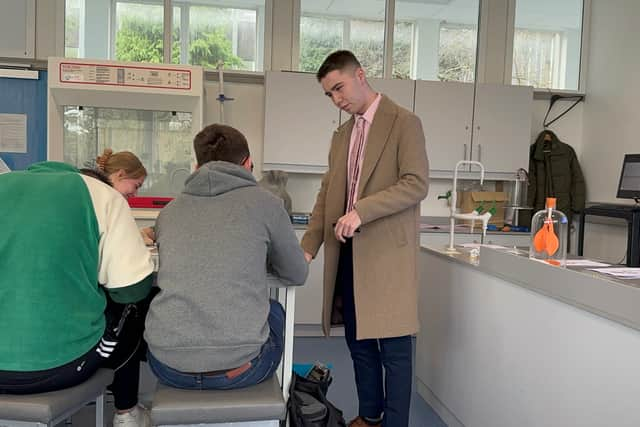

I find this rather interesting in a profession that encourages young people to question assumptions, examine evidence and think critically. Surely these same principles should apply to teachers?
Of course, experience matters. Some of the most valuable professional advice I have received has come from colleagues with years of classroom experience. However, length of service and expertise are not necessarily synonymous.
Professional expertise also develops through engagement with research, critical reflection, professional curiosity and a willingness to challenge established practice.
My undergraduate research examined Rosenshine’s Principles of Instruction and pupil learning at Key Stage 5. Since then, I have continued exploring cognitive science, metacognition and evidence-informed teaching through postgraduate study and classroom practice.
I certainly do not claim to know everything. Far from it. However, educational arguments should be judged on their evidence and substance, rather than the age or professional seniority of the person presenting them.
Why I Support TransformED
I am a strong advocate for TransformED because I believe Northern Ireland urgently needs a clearer, more coherent and more equitable curriculum.
For too long, we have operated within a framework that emphasises broad educational aspirations without sufficient clarity about the essential knowledge pupils should acquire, how that knowledge should be sequenced or how progression should develop across the key stages.
Whilst critical thinking, creativity and independent learning are important educational ambitions, they cannot develop independently of knowledge.
A curriculum should establish a clear educational entitlement, ensuring that every child has access to essential knowledge regardless of the school they attend.
Scrutinising the 2007 Curriculum
Much of the current debate has focused on scrutinising TransformED. However, I believe we should be equally willing to examine the limitations of the curriculum introduced in 2007.
The 2007 Northern Ireland Curriculum emerged from substantial research, review and consultation. Nevertheless, consultation alone does not guarantee that a curriculum will remain effective indefinitely.
Almost twenty years later, I would argue that one of its fundamental weaknesses is its excessive breadth and insufficient specificity, particularly regarding essential subject knowledge, sequencing and progression.
When curriculum requirements are expressed through broad statements that leave considerable room for interpretation, schools can make substantially different decisions about what pupils learn.
Consequently, educational entitlement risks becoming dependent upon the school a child happens to attend. Surely that should concern us?
The Department of Education’s Strategic Review identified concerns surrounding curriculum clarity, coherence and progression. These are fundamental issues that deserve serious attention.
We need a curriculum that builds knowledge incrementally, beginning with foundational concepts and progressing towards increasingly sophisticated understanding.
Consider History. How can pupils critically evaluate historical interpretations without understanding the events underpinning them? Similarly, how can pupils make informed financial decisions in Business Studies without understanding costs, revenue and profit?
Knowledge is not the enemy of critical thinking. It is what makes critical thinking possible.
Teacher Autonomy and Inclusion
Greater curriculum specificity should not be confused with restricting teacher autonomy.
There is a fundamental distinction between establishing what pupils should learn and prescribing how teachers must teach it.
Teachers must retain the professional judgement to explain, model, question, scaffold and adapt their teaching according to pupils’ needs. A clearer curriculum should provide the foundation for that professional judgement, not replace it.
My interest in inclusion and special educational needs makes implementation particularly important. An ambitious curriculum must remain accessible to all learners, including pupils with additional needs.
Evidence-informed approaches such as explicit instruction, modelling, scaffolding, guided practice and retrieval can support pupils in accessing challenging content. However, no single approach should be prescribed as a universal solution.
The Department must therefore ensure that TransformED is accompanied by meaningful pedagogical guidance, professional learning, sufficient time and appropriate resources.
Supporting reform does not mean overlooking these challenges. I want them addressed precisely because I want TransformED to succeed.
Consultation and Constructive Engagement
Concerns have also been raised about the extent of teacher consultation.
The Department’s 2026 public consultation attracted more than 4,300 submissions, with reported support of 53.9% for the proposed curriculum aim, 53.4% for its objectives and 60.8% for its capabilities.
These findings deserve careful interpretation, particularly regarding the views of primary and post-primary teachers. However, suggesting that consultation simply did not occur overlooks the process undertaken.
The priority now must be ensuring that feedback meaningfully informs the final curriculum frameworks, pedagogical guidance and implementation arrangements.
Curriculum reform must be developed with teachers, not simply presented to them.
Evidence Over Ideology
Education in Northern Ireland is inevitably influenced by politics. However, curriculum reform should be judged primarily on its educational merits rather than the political identity of the Education Minister.
Supporting TransformED does not mean agreeing with every decision made by the Minister or Department. Nor does it mean dismissing legitimate concerns about implementation.
If another political party introduced the same evidence-informed proposals, I would judge them on precisely the same basis.
Surely the central question should be whether reform improves what children learn, rather than who receives the political credit?
Ultimately, I believe the teaching profession should encourage engagement with research, critical reflection and informed debate, regardless of an individual’s age or length of service.
Experience deserves respect, but it should never place an argument beyond scrutiny. Equally, being relatively new to teaching should not invalidate a contribution grounded in evidence.
I remain firmly behind TransformED because I believe Northern Ireland has an overdue opportunity to establish a clearer, more coherent and more equitable curriculum.
Almost twenty years after the introduction of the 2007 curriculum, we should be willing to examine its limitations and consider how we can better serve future generations.
Length of service is not synonymous with expertise. What matters is the strength of the evidence, the quality of the argument and, ultimately, the interests of the children and young people we serve.
Evidence over ideology. Always.
Darrágh Conway is a full-time Business Studies teacher, postgraduate student specialising in Inclusion and Special Educational Needs, and founder of Beyond the Classroom. He writes in a personal capacity.