
Jackson Pollock, hugely influential 20th century American artist, came from Ulster-Scots stock
This year marks the 70th anniversary of the death of Jackson Pollock, the fifth and youngest son of a family of Ulster-Scots heritage, who, as the leading light of the abstract expressionist movement, was one of the most significant figures in American art in the 20th century.
During his lifetime, Pollock enjoyed considerable fame and notoriety. A recluse, he had a volatile personality (possibly as a result of bipolar disorder) and had serious problems with alcohol abuse since adolescence.
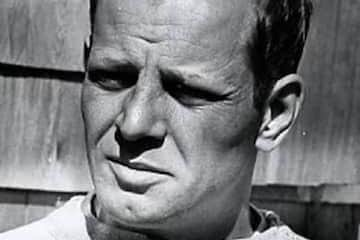

He was born on January 28 1912 in Cody, Wyoming (the town is named after ‘Buffalo Bill’), and grew up in Arizona and California.
He moved to New York around 1930 and studied at the Arts Students’ League there with Thomas Hart Benton, an American painter and muralist who was a leading light in the Regionalist art movement.
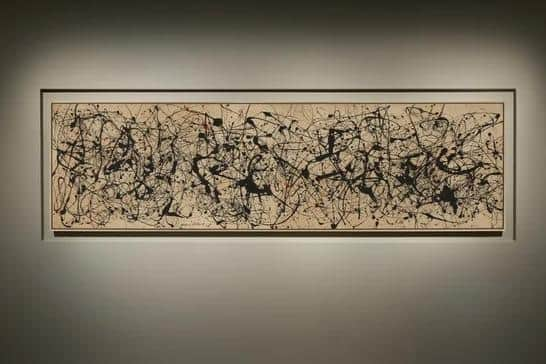
Eventually Pollock rejected Benton’s emphasis on representational subject matter and embraced the Mexican muralists and the European surrealists.
From the Mexican muralists, he took their use of large scale, synthetic paints and their experimental techniques. The ideas of the European surrealists about myth and relevance of the unconscious to artistic creativity dovetailed with his own appreciation of non-Western Art and informed his own work.
He became the first exponent of ‘tachism’ or ‘action painting’ in the United States. By ‘action painting’ (the term was coined by the critic Harold Rosenberg), we mean the style of painting in which paint is spontaneously dribbled, splashed or smeared onto the canvas, rather than being carefully applied with a brush.
Who better to explain this than Pollock himself?
‘My painting does not come from the easel. I prefer to tack the unstretched canvas to the hard wall or the floor. I need the resistance of a hard surface. On the floor I am more at ease. I feel nearer, more part of the painting, since this way I can walk around it, work from the four sides and literally be in the painting.
‘I continue to get further away from the usual painter's tools such as easel, palette, brushes, etc. I prefer sticks, trowels, knives and dripping fluid paint or a heavy impasto with sand, broken glass or other foreign matter added.
‘When I am in my painting, I'm not aware of what I'm doing. It is only after a sort of “get acquainted” period that I see what I have been about. I have no fear of making changes, destroying the image, etc., because the painting has a life of its own. I try to let it come through. It is only when I lose contact with the painting that the result is a mess. Otherwise there is pure harmony, an easy give and take, and the painting comes out well.’
Pollock's most famous paintings were made during the ‘drip period’ between 1947 and 1950. He achieved national and international celebrity in August 1949 with a four-page spread in Life magazine which posed the question: ‘Is he the greatest living painter in the United States?’
Pollock abandoned titles for his paintings and started numbering his works instead. He offered the following explanation: ‘... look passively and try to receive what the painting has to offer and not bring a subject matter or preconceived idea of what they are to be looking for’.
Lee Krasner, his wife, also an artist, whom he had married in October 1945, expanded on this when she observed that Pollock ‘used to give his pictures conventional titles... but now he simply numbers them. Numbers are neutral. They make people look at a picture for what it is – pure painting’.
At the peak of his fame, Pollock abruptly abandoned the drip style. In 1951 and 1952 he painted several works in black and white, many with anatomical motifs.
These paintings have been referred to as his 'Black pourings' and when he exhibited them at the Betty Parsons Gallery in New York none of them sold. Parsons later sold one to a friend at half price. The departure from his earlier style was not what his collectors wanted and so they did not sell.
Pollock was a man largely indifferent to criticism, a point underscored by his memorable observation: ‘There was a reviewer a while back who wrote that my pictures didn’t have any beginning or any end. He didn’t mean it as a compliment, but it was a very fine compliment.’
In 1955, Pollock painted his last two paintings: ‘Scent’ and ‘Search’. He did not paint in 1956 at all, concentrating instead on making sculptures made from wire, gauze and plaster. These have heavily textured surfaces similar to what Pollock often created in his painting.
He died on August 11 1956 in a single-car crash at East Hampton, less than a mile from Pollock’s home, while driving under the influence of alcohol. One of his two passengers, Edith Metzger, was also killed but the other passenger Ruth Kligman, his mistress and another artist, survived.
During the early stages of the Cold War, Life magazine lauded Pollock’s work as evidence of both artistic freedom in the West and of America’s coming-of-age. Ironically, Pollock had communist leanings, as did his father who had been a great admirer of the Bolsheviks.
A significant part of Pollock’s legacy is the great influence which he exerted on a subsequent generation of artists, notably Morris Louis, Robert Morris, Allan Kaprow and Robert Smithson.
Jackson Pollock’s 'drip paintings' constitute one of the most original bodies of work of the 20th century. In May this year ‘Number 7A, 1948’ sold for a record €155.65 million (£133m) at Christie's in New York. The sale makes it the fourth most expensive work ever sold at auction. The previous auction record for the abstract expressionist painter was €52.5 million, set in 2021. Other works by him have been sold privately for up to €171.8 million (£147m).