
Givan: ‘Utterly betrayed’ by Donaldson after sharing office visited by his children
Paul Givan shared a constituency office with the jailed sex abuser Jeffrey Donaldson. The education minister’s children would sometimes visit their father there after finishing school. It is a detail that gives Givan’s reaction to the former DUP leader's crimes a particularly personal dimension.
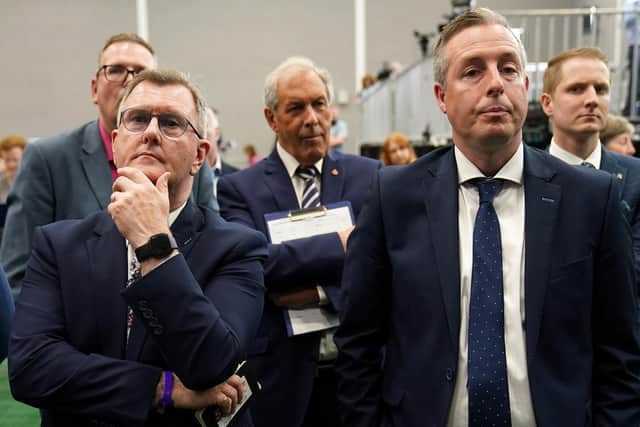
"The feelings first of all have to be for the victims of his abuse and at a personal level, I feel utterly betrayed," he said. “I had my children with me in that office when they finished school. As a father, it horrifies me that this individual was there when they were.

“I cannot fathom how on earth he was able to live the life that he lived knowing what he had done."
Mr Givan, a father of three daughters, said he was “disgusted” by Donaldson's behaviour.
"As a dad of three daughters just find it incomprehensible how he could ever engage in behaviour towards any child in the way in did. I find it horrific.”
Asked whether he had maintained contact with Donaldson after his arrest, he was unequivocal.
"I had no contact with him in any shape or form from the day and hour that he was arrested."
The interview then turned to another difficult subject for the DUP: the divisions within unionism and last week’s departure of Carla Lockhart from the party.
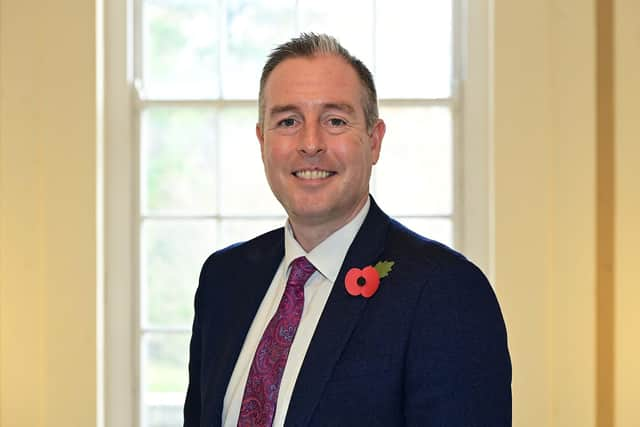
Mr Givan was clear about where he stands on the party leadership, giving his backing to Gavin Robinson.
"I support him and have supported him because he is our leader and he is leading the DUP and he's leading it effectively. I've been able to witness that at a time when he took over the party and the way in which he went about making sure he was building relationships and unifying the party.”
He also pointed to Lockhart's own comments about Robinson, saying: "I think that has actually came through in what Carla Lockhart has even said in her departure that Gavin is an honourable man. He has acted with honour and is a friend, and I think that speaks volume to who Gavin is as an individual."
However, he acknowledged that her departure had disappointed him.
“Yes, I am disappointed with it because in the face of the nationalist republican community clearly coalescing, coming together, and rallying behind Sinn Féin, the unionist community wants to see us coming together and not having further fracturing within the wider unionism community.”
Mr Givan added: "Division is division within unionism is Sinn Féin's greatest ally."
For him, the problem goes beyond the internal politics of the DUP. He believes unionism has reached a crossroads and needs to consider how it can work more effectively as a political movement.
"My disappointment is one that, you know, Carla, as a friend and someone who is valued and continues to be valued, had a voice within the DUP, and now that is something which is no longer within the party and is coming from outside. But I trust and hope the door is always open in that respect, and I want us to work together, and hopefully we'll be able to do that."
He said he had communicated directly with Lockhart to make clear that she remained valued.
Asked whether unionism was imploding, Mr Givan rejected that description.
"No, I actually think unionism is now at a point of reflection in terms of how we move forward from this moment, and it has been a wake-up call."
He referred to efforts by his colleague Jonathan Buckley to engage with other unionists, arguing that the process needed to move beyond discussion and into practical work.
His vision, he said, was for a conversation involving both political leadership and grassroots unionism, rather than an exercise controlled exclusively by elected representatives.
"My view on this has always been that there is only one precondition to people being involved in this process. It's Northern Ireland's place within the United Kingdom as a unionist, and there shouldn't be a predetermined outcome from any of the participants in this process."
He believes the movement must understand why internal divisions have become so damaging, particularly when there are voters who support the Union but do not necessarily support unionist political parties.
"The ordinary unionists that I meet in the street are saying, 'How did that happen? That unionism turns in on itself', and that speaks to the need for us to actually find ways to work more closely together."
Mr Givan believes the answer to some of unionism's political difficulties lies in demonstrating that it can govern effectively.
He points to his work as Education Minister, particularly childcare subsidies and changes to nursery provision, as examples of policies designed to benefit families regardless of their political background.
"When you cut through the noise and look at actual substance of what departments have delivered tangibly for the public, like the DUP ministers, and obviously I can speak to my department in education can show here's what a minister can do whenever they have a clear policy agenda and they make sure that the civil service operates to a minister who directs and controls their department."
He said childcare had been part of the DUP manifesto from the beginning of his time in office.
"Day one was part of our DUP manifesto agenda, the childcare. So to work towards meeting the costs of hardworking families, and that's something that benefits everybody in Northern Ireland."
He argued that supporting working families was also important to the wider constitutional argument.
"As a unionist, we have to be alert to making sure that people feel secure and want to be part of the United Kingdom, and therefore we need to be able to meet their needs and expectations, and at least acknowledge that when there's hardship, we can be responsive."
He also highlighted changes to nursery admissions and the provision of additional full-time places for children.
The minister was critical of what he described as a tendency for departments to be led by civil servants rather than ministers with a clear programme of reform.
He also defended his wider education transformation agenda, questioning calls to slow down changes without an alternative being offered.
On religious education and collective worship, Mr Givan said he believed Northern Ireland's schools should retain their distinctive Christian traditions while respecting the religious freedom of families from different backgrounds.
He said he had supported the Catholic vision for education launched at St Mary's College on the Falls Road, arguing that the principle of religious liberty should apply equally across the education system.
"When you believe in religious liberty for all, then that includes me supporting the right of Catholic families to have their children brought up in the Catholic ethos within their education system, in the same way for controlled schools to be more reflective of the proper Christian values."
He added: "That's what a real, true liberal society is. It's recognising that there is differences, there is diversity, and we should provide that plurality of choice."
Mr Givan defended his approach to transgender issues in schools, saying teachers in Northern Ireland are not compelled to use the pronouns of a pupil identifying differently from their biological sex.
He said his guidance made clear that teachers could use pronouns reflecting biological sex, while arguing that schools must also handle questions of identity with empathy and sensitivity.
“The guidance that I provided in response to biological sex also made clear that teachers in Northern Ireland can use the pronouns that are reflective of biological sex and are not compelled to use the pronouns of somebody identifying different to their actual biological sex,” he said.
Mr Givan invoked the case of Enoch Burke, the teacher previously jailed after repeatedly breaching court orders arising from a dispute over the use of a transgender pupil’s name and pronouns. He argued that, under the policy he introduced, Mr Burke would have been protected in a Northern Ireland school.
“In Northern Ireland, Mr. Burke would have been protected in a school under the DUP Education Minister's policy that I was able to introduce,” he said.
Mr Givan also described removing a 67-page Education Authority document dealing with sensitive issues, including transgender matters, and replacing it with a one-page policy.
He said the replacement set out a straightforward approach to access to toilet facilities and changing rooms, as well as participation in competitive sport. He added that neither the Equality Commission nor the Human Rights Commission had taken him to court over the policy.
But the minister was keen to present his position as one that, while rooted in his understanding of biological sex, did not rule out compassion for young people experiencing difficulties with their identity.
“I come to that, actually, from a very empathetic position,” he said.
He said he would consider the perspective of a parent whose child was struggling with their identity.
“If that was my son or daughter that was struggling in terms of their own identity, how would I deal with that?” he said.
“And I would want to deal with it in a very loving way while still clearly articulating my view,” he added, before explaining that his position was based on biology.
He said such situations had to be handled sensitively and that those involved should be recognised as human beings.
“You know, we do need to recognise that you people are human beings, and we need to be able to deal with these sensitively,” he said.
However, he argued that affirming an identity contrary to biological sex could compromise the rights of girls, particularly in relation to single-sex facilities and sport.
“When it comes then to positively affirming somebody's identity that is contrary to their biological sex, and in doing so, that compromises the rights of girls, for example, to have their single identity provision in whether it's through toilets, whether it's in sports, in changing rooms. Well, then that is to deny their rights,” he said.
Away from Stormont, Mr Givan plays five-a-side football every week with school friends he has known for almost 30 years.
He has also become involved in hockey through his daughters, helping coach senior and junior teams and qualifying as an Ulster hockey umpire.
One match in his own constituency produced an amusing encounter when a player reminded him that she had voted for him at the last election as he prepared to issue her with a card.
He gave her a verbal warning instead.
His musical tastes include country, jazz and contemporary Christian music. Asked to choose between American country singer Luke Combs and Tyrone's Philomena Begley, he made clear his preference for American country, while insisting there was “no slight intended” towards the Irish country star.
Mr Givan’s central message remained political: unionism needs to stop turning in on itself, government needs to demonstrate its value, and the public needs to see practical results.
As he put it, the movement must find ways "to work more closely together".